

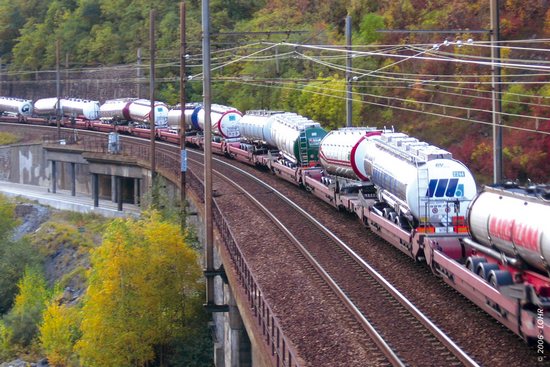





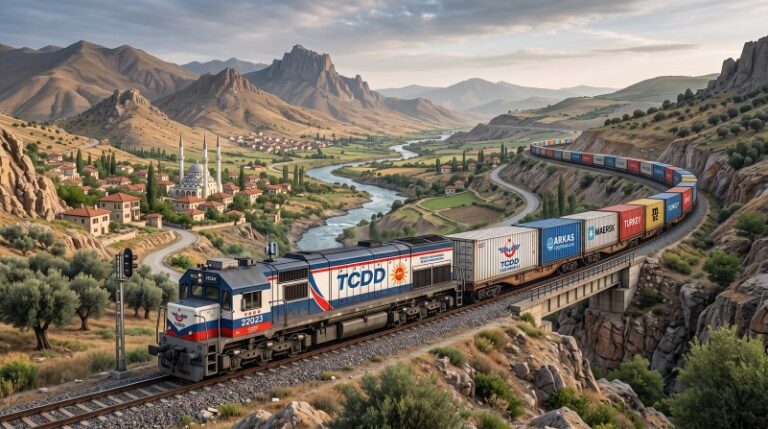
Projects to expand Turkey’s rail network along several international corridors are continuing to gather momentum. The authorities in Ankara are planning the construction of a new high-speed, high-capacity line, carrying both passengers and freight, along the Black Sea coast, where there is currently no rail corridor. Extending for more than 500 kilometres, the new line will start in Samsun and run through Ordu and Trabzon before reaching Sarp, a village known mainly as a border crossing with the almost identically named Sarpi in Georgia. Designed for a maximum speed of 250 km/h, the line is expected to carry 12 million passengers a year, with journey times significantly shorter than on the parallel road network. It will also provide rail freight capacity estimated at 14 million tonnes annually. These forecasts are less surprising when the new route is viewed not as an isolated connection, but as part of a much broader rail infrastructure network, much of which is already under construction or at an advanced planning stage.
Samsun, the western terminus of the new railway, will be reached by the high-speed line from Ankara. The section between the Turkish capital and Delice, just over 120 kilometres long, is already in operation, while construction began in 2025 on the next 120-kilometre section to Çorum, an Anatolian city around 140 kilometres from the Black Sea as the crow flies. Construction there is expected to be completed by 2029. The tender procedure has reportedly already been completed for the following sections to Merzifon and Havra. Overall, more than 290 kilometres are currently under construction. Major engineering works are required to cross a geologically complex region, including eight tunnels, 26 bridges and viaducts, as well as road overpasses and more than 80 underpasses.
Turkey’s new high-capacity rail network, comprising sections already in operation, under construction or at the planning stage, will radically reshape the country’s transport infrastructure and become fully integrated into long-distance connections between Europe and southern Asia. Links with ports will also be a key feature, including Bandırma on the Sea of Marmara, Izmir on the Aegean Sea, and Antalya, a gateway to Turkey’s Mediterranean region together with Mersin.
The increasingly close integration with continental Europe is based not only on infrastructure, but also on aspects that may appear secondary but are far from insignificant. One example is the new E5000 family of electric locomotives produced by Turkish industry, deliveries of which to the Turkish railways began in June 2025. It is the first locomotive to be certified in accordance with the European TSIs (Technical Specifications for Interoperability), making it suitable for operation on the European Union rail network and therefore potentially capable of crossing borders on long-distance freight services without a change of traction.
Piermario Curti Sacchi