


Maersk resumes imports at the port of Haifa
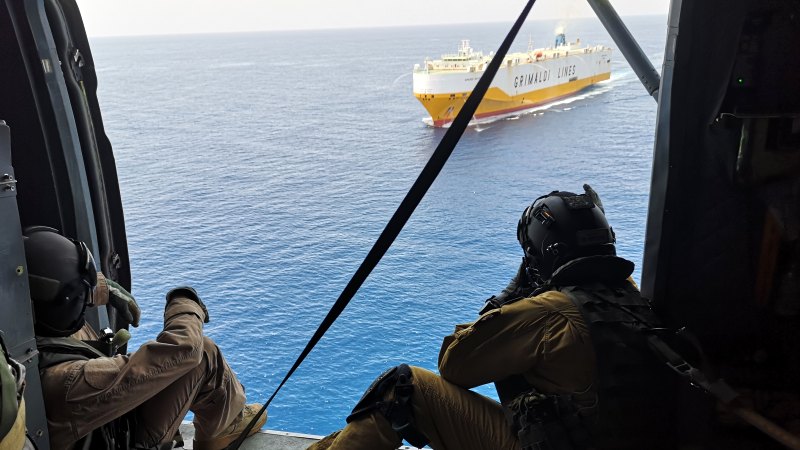
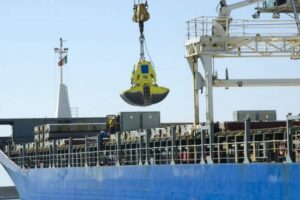
After a five-day suspension, Maersk has resumed cargo shipments to the Israeli port of Haifa. The announcement was made by the company itself, which, in a 26 June update, confirmed the restart of imports from 25 June 2025. The decision follows encouraging signals pointing towards a ceasefire in the region. Exports remain temporarily suspended pending further safety assessments. Operations continue at the port of Ashdod with ongoing monitoring. Maersk also confirms that the Strait of Hormuz remains open to navigation and that emergency plans are being activated on a case-by-case basis.
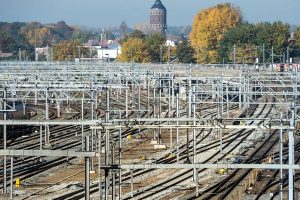
Bulgaria announces three tunnels for freight rail traffic
To improve north-south railway connectivity, currently hindered by the Balkan mountain range (Stara Planina), Bulgaria has announced the construction of three new railway tunnels. The initiative, promoted by the government, aims to overcome the infrastructural barriers dividing the country and to enhance freight transport by rail.
Airbus and Mtu partner on hydrogen-powered aircraft
Airbus and Mtu Aero Engines have signed an agreement to develop hydrogen-powered fuel cell propulsion technology as part of efforts to decarbonise commercial aviation. The deal, signed at the Paris Air Show by Bruno Fichefeux (Airbus) and Stefan Weber (Mtu), outlines a three-phase roadmap: development of key components through projects such as Clean Aviation, coordination of hydrogen technology R\&D programmes, and the eventual creation of a complete propulsion system. The ultimate goal is a zero-emission electric aircraft.
Delays hit rail traffic bound for Europe
Since mid-June, rail routes to Western Europe via the Alashankou-Dostyk hub have been facing major operational delays. The primary cause is reconstruction work on the second rail line between Dostyk and Moynt in Kazakhstan, which is now nearing completion. However, the works have temporarily reduced the line's capacity to less than a third of normal, creating a significant bottleneck. According to several logistics operators, the blockage has triggered a threefold chain reaction: the availability of heavy and empty wagons has dropped sharply, nearly one hundred trains have accumulated at the border port, and thousands of containers are currently stuck at Dostyk station. Transshipment times, usually short, have risen to 10–15 days, an increase of over 50 per cent. These delays are also affecting overall transit times to Europe: by the end of June, connections to Germany were already taking three to five days longer than at the beginning of the month. Short-term improvement prospects are rated as poor, and pressure on delivery times is expected to persist. In this complex scenario, the rail route via Khorgos-Atengori stands out positively, showing improved punctuality. Notably, the Guangzhou (Zengcheng) to Malaszewic connection has reached a record time of 16 days, outperforming the 18 days required by competing routes from Chongqing, Chengdu and Zhengzhou. Other express routes also remain steady: Chengdu to Lodz holds firm at 20 days, while Xi’an to Milan is averaging between 26 and 28 days, with limited fluctuations.
China-Europe trade slows
By the end of 2025, trade between China and Europe continues to be affected by geopolitical tensions and weak European demand. Exports of electric vehicles are slowing and photovoltaic modules are seeing a year-on-year decline. Rail transport is suffering from evident overcapacity, with loaded volumes falling short of expectations and holding back rate increases. In July, rail platforms are announcing new tariffs: Chengdu is increasing rates by 3 per cent, Chongqing is aiming for stability, Xi’an is introducing a three-tier system based on speed (up to 6,500 dollars), while Zhengzhou is implementing a general increase of 100 dollars and 500 dollars on the Milan route. Wuhan remains stable. Only a few slots are available until mid-July. As for container rates, there are noticeable differences between eastern and western European routes. Inland stations are seeing minor price changes, while costs from coastal ports to Malaszewic have dropped by 100 dollars and to Lodz/Warsaw by 50 to 150 dollars. Rates to western hubs (Hamburg/Duisburg) remain unchanged.
Explosives dog unit trials completed at the port of Genoa
The explosives dog unit trials at the port of Genoa were successfully completed on 27 and 28 May at the Passi Nuovo and Ponte dei Mille gates. The initiative, part of a preliminary evaluation phase for inbound checks, featured James and Bond, two two-and-a-half-year-old labradors from Sicily handled by Giuseppe. During the tests, the dogs detected inert substances simulating explosives by sitting to signal suspicious areas. The trial anticipates the potential systematic use of dog units in port security. A new phase involving underwater drones is planned for autumn.