





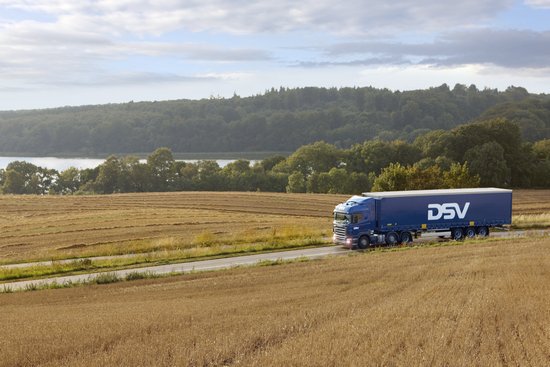
- The revision announced by DSV in February 2026 brings the completion of the integration of DB Schenker forward to the end of 2026, 20 months after the closing of the acquisition. Annual synergies remain set at DKK 9 billion, with full impact now expected in 2027.
- In November 2025, the Danish group announced that integration had been fully completed in Italy, while in other countries, Germany first and foremost, it plans to finalise the process by the end of 2026.
- DSV has published its 2025 results and its outlook for 2026. The target is to achieve an EBIT of between DKK 23 billion and DKK 25.5 billion and to reduce net debt.
At the start of 2026, the integration of DB Schenker into DSV has shifted up a gear. In early February, the Danish group announced that the process will be completed by the end of 2026, just 20 months after the acquisition closed, bringing the timeline forward by around two years compared with the original roadmap, which had pointed to 2028 as the completion horizon. The revision does not only concern deadlines: it also brings forward the full economic impact of the synergies, which DSV continues to estimate at DKK 9 billion per year, around €1.2 billion, but now with full effect expected in 2027 rather than 2028. In concrete terms, this acceleration translates into a faster impact on networks, capacity and customer management models.
Within the scope of the transaction, DSV is building an entity generating more than €40 billion in revenue, operating in over 90 countries with a network of around 1,850 locations. As of February 2026, the global workforce is reported at 151,751 people, down from the more than 160,000 employees indicated by the group immediately after the closing of the deal. The integration is being led directly by CEO Jens H. Lund and by a reorganised top management team drawing on executives from both DSV and Schenker, following a logic of continuity and skills selection. Key appointments include Vishal Sharma as Group Chief Commercial Officer, Helmut Schweighofer as head of the Road division and Saskia Blochberger as sustainability lead. The decision to retain DSV’s three historic operating divisions, Air & Sea, Road and Contract Logistics, allows for convergence by functional “blocks”, absorbing into existing activities Schenker’s specialist capabilities such as project logistics, express services and trade fair and event logistics, which are particularly significant in Germany.
Germany is the true focal point of the operation, both because of Schenker’s historical scale and because of the industrial and trade union implications. DSV has announced investments of €1 billion over three to five years to develop sites, infrastructure and transport solutions, and has set out an integration path that, in the second half of 2025, had to pass through an agreement with works councils, described as a decisive step in aligning processes and structures.
In Germany, the legal mergers of the first companies began in January 2026, with further operating units brought into the integration process in February. On employment, estimates communicated over time range from targeted reductions in Germany of 1,600 to 1,900 positions out of Schenker’s 15,000 employees in the country, to an overall reduction of 6–8% of the global workforce, equivalent to around 13,000 positions, with a focus on cutting administrative roles and improving productivity. DSV has also declared social commitments for two years after the closing of the deal and the general maintenance of existing agreements and individual conditions during that period.
The country-by-country approach is one of the elements explaining the acceleration announced in February 2026. In Italy, DSV completed the unification of structures and systems by November 2025, also defining the new national organisational chart, while by the end of 2025 overall structural integration had reached 30%, roughly double the original target of 15%. The same area-based execution logic is evident outside Europe as well: in the Philippines, integration was completed in December 2025, with a formal merger announced at local level. At group level, data from mid-2025 indicated that more than 40 countries were already integrated or in the process of integration, with the aim of reducing operational discontinuities and protecting service continuity. For customers, this translates into a transition designed to stabilise operating platforms and relationship models early on, avoiding typical post-merger issues, from customer master data alignment to billing cycles.
Synergies remain the economic cornerstone of the operation. In 2025, DSV reports realised synergies of DKK 800 million, around €107 million, above the initial range of DKK 500–600 million, or €67–81 million, and for 2026 it estimates at least DKK 4 billion, or €538 million, on a path leading to the annual level of DKK 9 billion, €1.21 billion, in 2027. This combines rationalisation of transport networks, optimisation of logistics facilities in Road and Contract Logistics, centralisation of support functions and the unification of customer service through single teams.
The gains do not depend solely on overlapping sites or functions, but on the ability to align standards, systems and capacity planning across different modes, especially where Schenker had a strong footprint and more “local” processes. Analysts believe the most delicate challenge lies in technological integration. Schenker is seen as having suffered from investment constraints under Deutsche Bahn, with less flexible internal systems, while DSV brings experience in large-scale integration and a more standardised approach, including the use of artificial intelligence in processes such as customs and bookings. Digital convergence is the prerequisite for enabling flow visibility, unified documentation and faster decision-making along the supply chain, as well as for integrating tools developed at Schenker, from volume forecasting to automated allocation management and computer vision in warehouses.
The flip side lies in one-off costs and execution risks. The integration programme is estimated at DKK 11 billion, around €1.5 billion, with a significant share in 2026, booked as extraordinary items alongside transaction and restructuring costs. For 2025, integration expenses are estimated by analysts at between DKK 2 billion and DKK 2.5 billion, €268–336 million.
All this is taking place in a challenging market environment, with pressure on air and ocean freight rates, an industrial slowdown in segments such as automotive and geopolitical uncertainty, factors that heighten management’s focus on operational discipline and margin protection. Competitors have sought to use the acquisition of Schenker as a commercial opportunity, with some openly stating that they expect revenue from customers seeking to diversify their logistics providers. However, early evidence suggests that customer attrition at Schenker has been limited and that most customers have remained through the transition.
Against this backdrop sit DSV’s 2025 results and its guidance for 2026, which form the second key to interpreting the February update. In its annual results published on 4 February 2026, DSV reported a gross profit for the fourth quarter of 2025 of DKK 19.119 billion, €2.57 billion, and EBIT before special items of DKK 5.592 billion, €751 million, also confirming a global workforce of 151,751 employees.
Management links the strength of the accounts to the ability to generate cash and simultaneously finance integration and debt reduction. In the third quarter of 2025, DSV generated free cash flow of DKK 4.276 billion, €574 million, with a cash conversion rate of 96%, reducing net debt by more than DKK 4 billion, €537 million, to DKK 89 billion, €11.95 billion.
The forecasts for 2026 announced in February incorporate the accelerated integration. DSV indicates EBIT before special items of between DKK 23 billion and DKK 25.5 billion, €3–3.4 billion, with special items of around DKK 6.5 billion, €873 million, and an indicated tax rate of 28%, partly reflecting the earlier timing of activities and costs linked to the merger. Expected synergies for 2026 underpin the outlook for maintaining operating performance in a year when the market may remain challenging.
For logistics and warehouse management operators, the concrete short-term implications revolve around service continuity during systems unification, the repositioning of capacity in markets where DSV and Schenker overlap, and the speed at which processes and service levels will be harmonised across different modes. The Danish group says it has maintained high customer satisfaction scores even while carrying out a targeted reduction of more than 5,000 full-time equivalent positions in administrative roles, signalling that efficiency efforts are focused primarily on support and coordination functions rather than on operational capacity in the field. In parallel, the push on technology and automation, from routing and planning through to warehouse management, is presented as a lever to increase productivity and visibility along supply chains, a particularly relevant factor for industrial customers and for high-complexity flows such as special projects and automotive logistics.
Michele Latorre