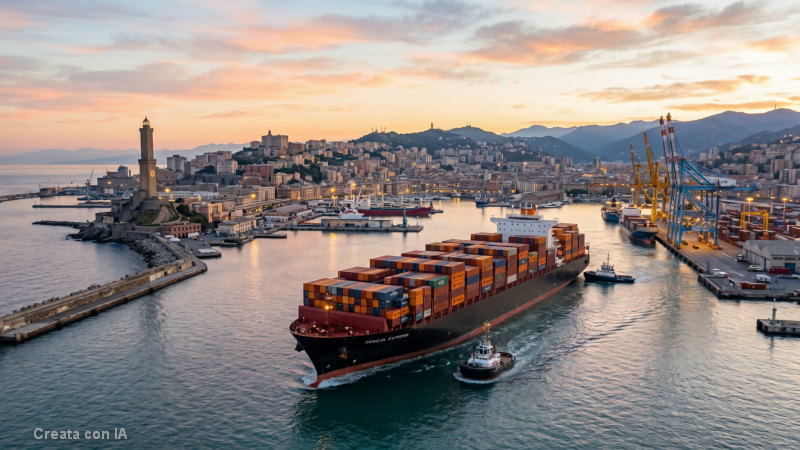









The Indian government has formally launched the process to establish Bharat Container Shipping Line, a new public liner shipping company for containers conceived as a national carrier. On 3 February 2026, a memorandum of understanding was signed setting out the institutional framework of the initiative, which forms part of a broader strategy to strengthen India’s control over container flows and reduce dependence on major foreign shipping lines. According to Indian media reports, the new company will operate under the aegis of the Ministry of Ports, Shipping and Waterways and represents one of the pillars of the government’s self-reliance policy.
The agreement does not yet mark the operational launch of a commercial carrier. BCSL is still at an early stage, with only a framework agreement in place and no information available on an operating fleet, service network or definitive corporate structure. The company is expected to be established as a public-sector entity, with a central role for the Shipping Corporation of India alongside other state bodies, but details on governance, shareholdings or incorporation timelines have yet to be disclosed.
The project is linked to the Container Manufacturing Assistance Scheme announced in the 2026–27 Union Budget and sits within the broader framework of the Sagarmala and PM Gati Shakti initiatives, which aim to promote the integrated development of ports, infrastructure and logistics links. The Minister of Ports, Sarbananda Sonowal, and the Minister of Railways and Information Technology, Ashwini Vaishnaw, have described the new company as a tool to support the competitiveness of Indian exports and strengthen the country’s position in global value chains.
The structure outlined in the memorandum envisages the involvement of multiple public-sector entities. In addition to the Shipping Corporation of India, identified as the operational backbone, participants include the Container Corporation of India, a major rail-based intermodal operator, and several port authorities, including Jawaharlal Nehru Port Authority, V.O. Chidambaranar Port Authority and Chennai Port Authority. Sagarmala Finance Corporation Limited, a financial vehicle controlled by the Ministry of Ports, is also cited as supporting infrastructure funding. This multi-entity approach is intended to integrate maritime transport, port terminals and hinterland connections into a single national container transport ecosystem.
From a financial perspective, the initiative is part of a wider public investment framework. The government foresees joint funding commitments of up to 15,000 crore rupees, equivalent to around €1.65 billion, for eligible projects aimed at expanding port capacity under the Sagarmala and PM Gati Shakti programmes. The funding model will favour debt-based financing for infrastructure works such as breakwaters and onshore and offshore developments, including through partnership schemes such as the Hybrid Annuity Model. In parallel, the government has approved an overall programme worth 65,000 crore rupees, around €7.15 billion, to develop shipbuilding, ship recycling and national maritime capacity.
One of the most significant elements of this ambitious programme is the fleet itself. Indian sources report plans to build fifteen container ships in India in the 2026–27 financial year as the first phase of a five-year plan envisaging a total of 51 vessels. The objective is to equip the country with a container fleet large enough to serve routes considered strategic. However, no details have yet been released regarding vessel classes, capacity in TEU, environmental standards, the shipyards involved or possible technical partnerships with foreign builders.
Through this initiative, the government aims to reduce India’s exposure to freight rate volatility driven by foreign operators and to “anchor” a larger share of container traffic in Indian hands, both in terms of ship ownership and commercial control of routes. Integration with rail-based intermodality managed by CONCOR and with port development projects is expected to improve operational continuity along the logistics chain. These objectives are also linked to the country’s macroeconomic outlook, with government estimates suggesting that India could reach a gross domestic product of around $7.3 trillion, approximately €6.7 trillion, by 2030, accompanied by a significant increase in import and export flows.
The absence of a national player in container shipping has repeatedly been cited as a major vulnerability in India’s production system, particularly at a time when the country is positioning itself as a regional competitor to China, which has developed a powerful integrated system over time. This vulnerability has been compounded by the sharp fluctuations in container freight rates over the past two years. A public shipping company could provide greater service stability on priority routes even during periods of global turbulence. Nonetheless, many questions remain open regarding BCSL’s positioning vis-à-vis major international operators, in terms of scale, alliances, geographic coverage and business model, areas for which no independent, data-backed analyses are yet available.
Mara Gambetta