









Lower average spot container freight rates on routes between Asia and Europe pushed down Drewry’s World Container Index, which on Thursday 24 September 2026 fell 1% from the previous week to $4,468 per 40-foot container. Year on year, the composite index remains sharply higher, up 154%. The steepest decline was recorded in the Mediterranean. On Shanghai-Genoa, freight rates fell 5% in seven days, dropping below the $4,000 threshold to $3,835 per 40-foot container, while Shanghai-Rotterdam declined 4% to $3,485. Both routes remain at almost double their levels of a year ago, up 93% for Genoa and 101% for Rotterdam. The adjustment was more limited on the return leg, with Rotterdam-Shanghai down 1% to $599, 30% higher year on year.
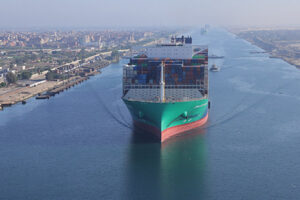
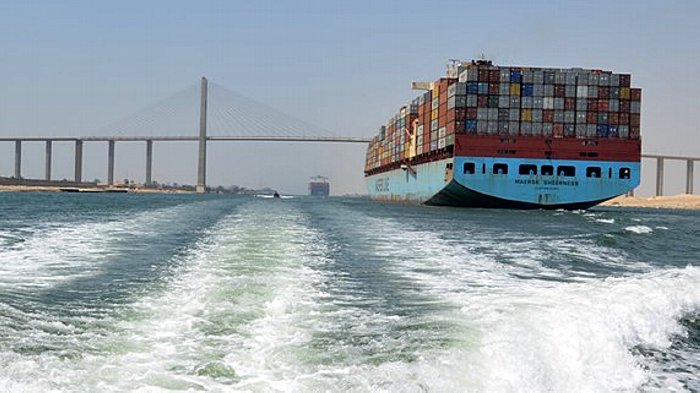
Driving rates lower is the recovery in capacity. Transits through the Suez Canal rose from 41 in week 37 to 48 the following week, an increase that Drewry says is having a greater impact than carriers’ scheduled blank sailings. On the Asia-Europe route, seven cancellations have been announced for next week, compared with three this week. Although the maritime research firm sees the cancellations as a sign of tightening capacity, it expects freight rates to fall further in the coming days.
On the transpacific, the picture is less uniform. Shanghai-Los Angeles was the only one of the index’s eight routes to rise, gaining 2% to $7,838 per FEU, with a year-on-year increase of 239%, the highest recorded. Shanghai-New York was unchanged at $10,373, remaining the most expensive route in the basket and 216% higher year on year, while the Los Angeles-Shanghai return leg also held steady at $791, up 10%. Carriers are also adjusting supply on this trade. Fifteen cancellations have been announced for next week, compared with nine this week, but according to Drewry they will not be enough to support rates, which are expected to fall ahead of China’s Golden Week in early October.
Movements on the Atlantic were limited. New York-Rotterdam fell 2% to $1,102, up 31% year on year, while Rotterdam-New York remained unchanged at $3,121, 72% higher than a year earlier. The East-West market remains uncertain overall, Drewry notes, with carriers seeking to balance capacity against uneven demand and continuing operational disruption. Tensions in the Middle East remain a risk factor: Suez transits are increasing, but security in the Red Sea remains the main uncertainty. Capacity through the Panama Canal continues to be constrained, while European supply chains are being affected by industrial action in Germany and low water levels on the Rhine.
M.G.