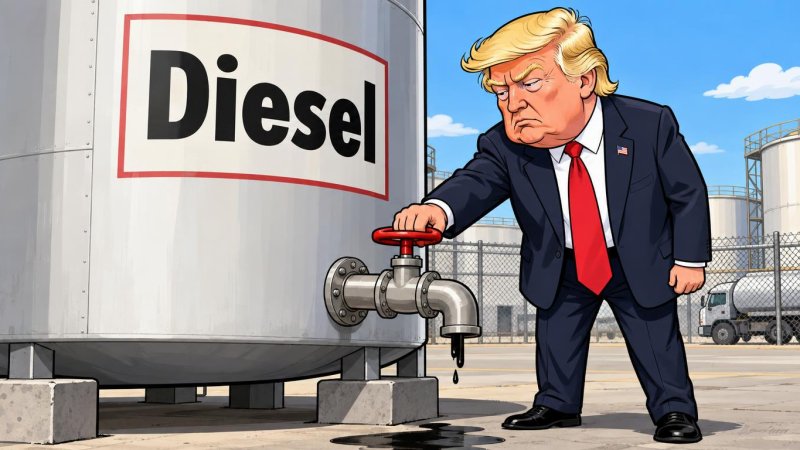












Diesel will remain expensive for longer than estimated only a few weeks ago, and its price may continue to rise until at least mid-2027. This is the conclusion of two separate studies by the US Energy Information Administration (EIA) and investment bank Goldman Sachs. In its Short-Term Energy Outlook (STEO), published on 9 September, the EIA, part of the US Department of Energy, raised its estimate for the average US distillate refining margin, or crack spread, to $1.57 a gallon for 2026 and $1.25 for 2027, respectively 20.8% and 28.5% above its August forecast. Twelve days earlier, Goldman Sachs had revised its estimates even more sharply: the investment bank now forecasts diesel margins over Brent in 2027 of $63 a barrel in the United States and $49 in Europe, compared with the $27 and $19 indicated in February. Expected petrol margins are lower, at $29 a barrel in the US and $22 in Europe, while the US 3-2-1 crack spread, based on a refining configuration that produces two barrels of petrol and one barrel of distillates from three barrels of crude, is forecast at $40.
In the EIA's outlook, the pressure peaks during the autumn months. From August to November, the US diesel margin will exceed $2 a gallon, before declining steadily until mid-2027. However, the agency's forecast for an easing of the pressure rests on three assumptions: a near-term return to normal oil tanker traffic through the Strait of Hormuz, an increase in distillate exports from refineries in Saudi Arabia and Kuwait, and greater crude availability for East Asian refineries, allowing them to increase production. The same STEO identifies two upside risks. If flows from the Middle East remain constrained beyond the end of 2026, global distillate margins would be higher than in the baseline scenario. Another factor is the loss of refining capacity in Russia as a result of Ukrainian strikes and the subsequent export ban, with effects on the global market expected to last into the first half of 2027. For the Middle East, the agency assumes that some restrictions on oil exports will remain in place until the end of the year and that crude production will stay below pre-conflict averages until the second quarter of 2027. It should be noted that these forecasts were finalised on 3 September and do not take subsequent developments into account.
In the US market, inventories are a problem: distillate stocks will fall below 100 million barrels in September and remain below the 2021-2025 five-year minimum for much of 2027, according to the STEO. Meanwhile, since February, monthly US net distillate exports have remained close to or above five-year highs, driven by international prices. The EIA expects the impact of low inventories on domestic prices to be particularly pronounced in autumn and winter, when refinery maintenance will reduce distillate output while the agricultural harvest increases consumption. Globally, the agency estimates that oil inventories have fallen by 400 million barrels since the start of the year.
Goldman Sachs attributes its revision to the sharp contraction in the supply of refined products. Global refinery runs have fallen by around 7 million barrels a day year on year, while plant outages are more than 60% above the seasonal norm. Global refined-product exports have fallen by around 6 million barrels a day, or 25%, with three quarters of the decline concentrated in the Persian Gulf and Russia. New refining capacity, estimated by the bank at 0.4-0.5 million barrels a day annually in 2026-2027, is insufficient to offset Russian outages and structural demand growth, while refinery runs are not expected to return to normal seasonal levels until the second half of 2027. Analysts link the pressure to increasing attacks on refineries in the Middle East and Russia, which have further constrained global refining capacity that was already under pressure, with diesel at the centre of the rise in refined-product prices. Fuel exports from the Persian Gulf are running at around 40% of pre-war levels, compared with an estimated 70-80% for crude. At the end of August, Moscow extended its diesel export ban until the end of September after Ukrainian drone attacks reduced output at Russian refineries.
The two forecasts differ on how long the crisis will last. The EIA expects flows through the Strait of Hormuz to return to normal in the near term, while Goldman Sachs, in its 7 September update, assumes that disruptions to maritime transport from the Middle East will extend into 2027 and has raised its Brent forecasts by $5, to $85 a barrel in December 2026 and an average of $80 in 2027. After averaging $91 in August, the US agency expects Brent to remain at around $90 a barrel in the second half of 2026 before falling to $74 in 2027 as production increases and inventories are rebuilt.
It should be made clear that the refining margin is not the same as the price at the pump, which is also affected by taxes, logistics costs, distribution and exchange rates, but it provides an early indication of upstream price pressure. For US retail diesel, the EIA now forecasts an average of $5.07 a gallon (€4.41) in 2026 and $4.40 (€3.83) in 2027, representing upward revisions of 4.4% and 8.2% respectively from its August forecast. Even the 2027 figure remains above the 2025 average of $3.66 (€3.19).
Antonio Illariuzzi