







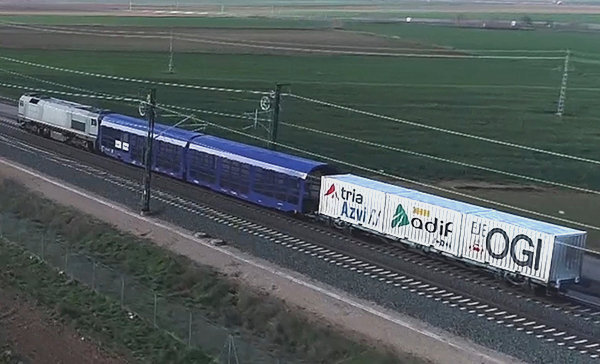
Spain is still dealing with a century-old separation from Europe’s rail network because of the national gauge, typical of the Iberian Peninsula, which was originally chosen largely for military reasons but is not compatible with the standard, or international, gauge used across the central and western European network. Ingenious solutions have been adopted to overcome this obstacle and enable cross-border rail links, such as variable-gauge bogie axles, long in use but only on international passenger trains, including the famous Talgo services.
To Spain’s credit, from the outset it adopted the European standard gauge for the construction of the first new high-speed line, Madrid-Seville, in 1992, and gradually extended it across the new high-speed network. More recently, the infrastructure manager Adif has launched a programme to move towards European gauge, mainly on TEN-T corridors, often by laying a third rail to make the affected railway lines interoperable.
But this effort is moving ahead without a coherent conversion plan, also because one has never been officially announced, with decisions taken case by case on individual sections and no clear indication of the final objective. Freight traffic is bearing the brunt, because it cannot rely on a homogeneous network rather than a patchwork one. As a result, only a handful of freight trains can still make effective use of Spain’s main corridors.
The largest ongoing programme to adapt the network to the European standard concerns, for example, the Mediterranean railway, running from the French border south of Perpignan to Malaga. Here, work is focused as far as Almeria, partly through the construction of new lines and partly through the conversion of existing sections. But until these projects are completed, it is unrealistic to expect tangible results for freight traffic, which cannot be subjected to breaks of load for technical reasons that may appear minor, but are in fact fundamental.
At the same time, Spain’s infrastructure manager is not only working on gauge conversion, but is also carrying out another demanding programme to upgrade electric traction systems. The country’s predominant power supply, 3 kV direct current, the same as in Italy, will give way to the higher-performing 25 kV alternating current system. For example, the entire network in Galicia, the large autonomous community in north-western Spain, will make this qualitative leap, probably with the sole exception of the historic Santiago-Ourense-Medina del Campo line. To Spain’s credit, it should be noted that this decision, undoubtedly demanding in practical terms, has few parallels among rail infrastructure managers in other countries, except in the construction of new lines, the electrification of routes previously available only for diesel traction, or the radical upgrading of completely obsolete parts of the network.
Piermario Curti Sacchi