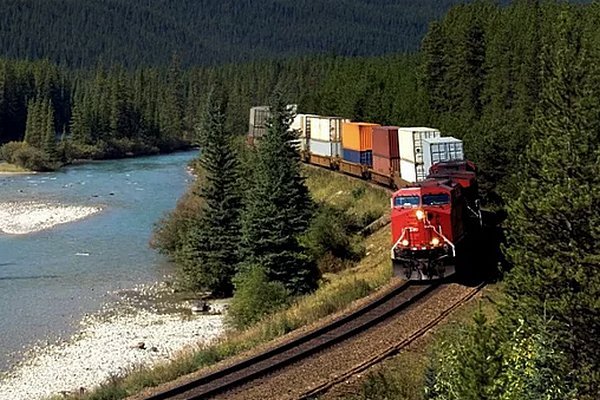







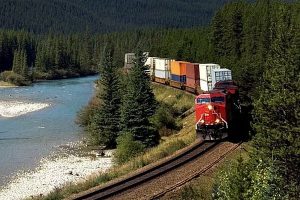
How can the number of containers on a freight train be doubled without increasing the number of wagons? The traditional answer is to stack two containers on each wagon, a solution used for years in the United States but one that requires infrastructure able to accommodate significant heights. In China, another route has been devised: reducing container height from 2.6 to 1.7 metres, while keeping the other dimensions standard, so as to comply with any loading-gauge limits along the line and remain compatible with handling equipment already in use at Chinese ports. The solution saw its first application on 12 August 2026 for a combined rail-sea movement of mineral products from Wanshuiquan'nan station, in Baotou, to the port of Huanghua, in Hebei.
It should be noted that the concept of a lower-height container dates back to 2022, when several ports in southern China, including Nansha, Zhanjiang and Haikou, introduced 1.7-metre containers to handle steel sections, seamless pipes and rails. By April 2023, the use of this format had been extended to 23 coastal ports. The new development in August 2026 is the extension of this height reduction to double-stack rail transport for a direct mine-to-port connection, a step that standard-height containers did not allow because of loading-gauge restrictions. In this trial, the lower-height container travels the entire route from the production site or mine to the port without ever being opened or transferred to another loading unit, eliminating more than five transhipment stages along the supply chain. According to Cctv News, the original source of the report, the unit transport cost is reduced by more than a quarter compared with the traditional solution, which requires a change of container between train and ship.
The railway route is operated by Baoshen Railway Group, a company specialising in bulk transport, primarily coal, and controlled by China Energy Investment Corporation, the successor to the Shenhua group. On the port side, Huanghua is part of the Cangzhou port group, which has already been involved in previous rail-sea intermodal initiatives for bulk cargoes, such as kaolin, bound for the south of the country. Baotou is an industrial and mining hub in northern China, while Huanghua is an important seaport for exports of coal and minerals from the northern hinterland. Thanks to the lower-height container, mineral and steel-related bulk cargoes, such as coal, ores, aluminium oxide, kaolin and steel reinforcing bars, will be able to travel more often in containers, both by rail and by sea, rather than through the traditional use of open wagons or bulk carriers, delivering efficiency gains and a lower environmental impact during loading and unloading.
Antonio Illariuzzi