








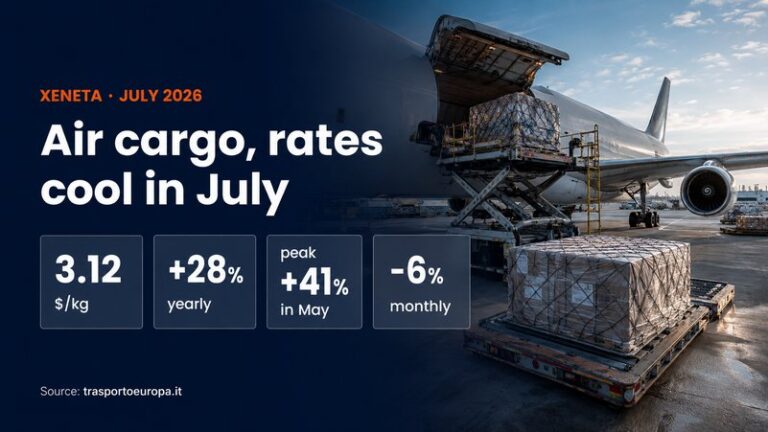
Spot rates for air cargo, valid for up to one month, averaged $3.12 per kg in July, 28% higher than in the same month of 2025, according to Xeneta. The figure, however, confirms a slowdown in growth for the second consecutive month: after peaking at 41% in May, the year-on-year increase had fallen to 38% in June. Month on month, rates declined by 6%.
The rate premiums paid by shippers since the intensification of the conflict in the Middle East at the end of February are therefore continuing to unwind, with few signs of an upturn linked to the peak season for airlines and freight forwarders in the second half of the year. "It is July, so the market is traditionally weaker than in June, and year on year rates have fallen as expected," said Niall van de Wouw, Chief Airfreight Officer at Xeneta, adding that the company’s more favourable forecasts for 2026 compared with those issued in November 2025 are based on the strong growth recorded at the start of the year, while a weaker market is expected in the second half. In discussions with shippers, van de Wouw said, charter flights for the peak season were mentioned in only one case.
As the market enters the summer holiday period in the northern hemisphere, rates are expected to continue falling, but the continuing conflict in Iran and recent fluctuations in jet fuel prices suggest a gradual decline rather than the sharp jumps seen during the upward phase. Airlines, according to Xeneta, "will fight by every means to avoid cutting rates as quickly as they rose", although the year-on-year trajectory remains downward despite continuing uncertainty in the Middle East.
The sharpest movements in July were on routes from Asia to Europe. Spot rates from Northeast Asia to Europe fell by 13% month on month, while those from Southeast Asia declined by 9%. The steepest drop was on China to Western Europe, where rates fell by 22% month on month to $4.15 per kg, a much sharper fall than the single-digit declines recorded during the same period in the past two years. The timing coincides with the abolition, from 1 July 2026, of the €150 customs exemption threshold for low-value imports into the European Union, replaced by a fixed duty of €3 per item. Some market reports are already pointing to the withdrawal of cargo capacity from China-Europe e-commerce services.
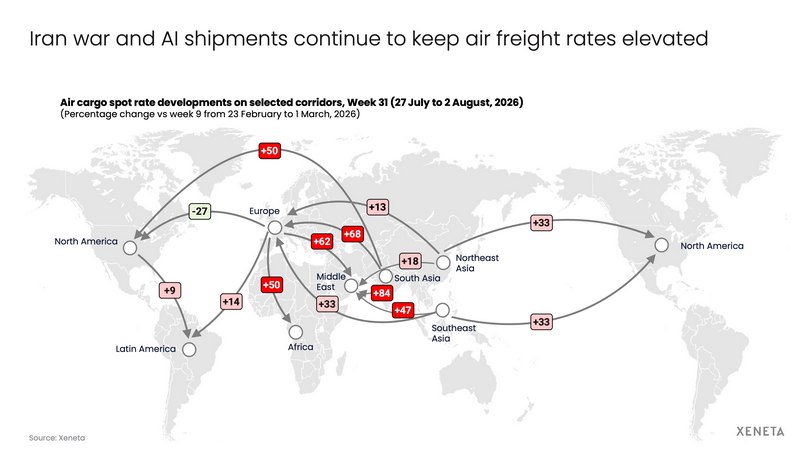
On routes reshaped by the conflict in the Middle East, rates remain well above pre-conflict levels. In the final week of July, spot rates to the Middle East were 84% higher from South Asia and 47% higher from Southeast Asia than at the end of February, before the intensification of the conflict, while from Europe to the region the increase reached 62%.
On the transpacific route, supported by shipments linked to artificial intelligence, rates from Northeast and Southeast Asia to North America remain 33% above end-February levels, although this is down from the 41% and 42% recorded at the end of June. On the transatlantic route, summer passenger flight schedules kept bellyhold capacity abundant, pushing Europe-North America rates to a level 27% below the end-February figure.
Growth in global air cargo demand halved, from 8% year on year in June to 4% in July. Capacity supply rose by 1% year on year, continuing its recovery from the contraction linked to the Middle East. Xeneta’s dynamic load factor, which measures capacity utilisation based on the volume and weight of cargo carried against available capacity, rose by two percentage points year on year to 61%.
According to Xeneta, several issues remain unresolved: the impact of the conflict in Iran on the pace at which rates fall, the effect of fluctuations in fuel prices and the consequences of new European customs duties on volumes arriving from Asia. Van de Wouw pointed to the fall in rates on the China-Europe route in June and July, which was steeper than in previous years, as a possible sign that the new e-commerce rules are already affecting the wider freight market. In this context, Xeneta also noted that the European Union has sanctioned AliExpress with a record €550m fine for failing to prevent the sale of illegal, dangerous and counterfeit products on its platform.
A.M.B.