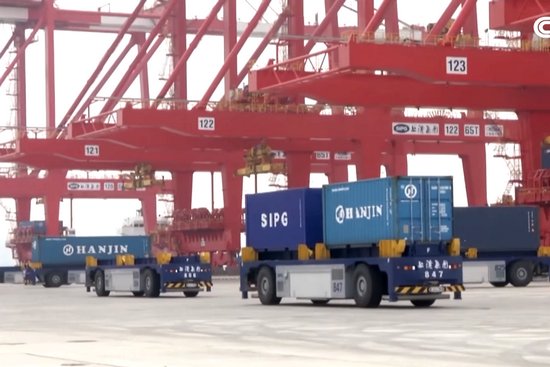







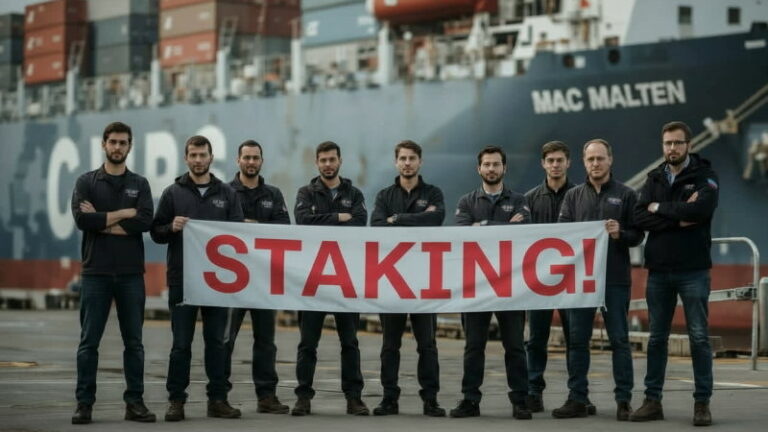
The Dutch trade union Fnv Havens has called an eight-hour national strike in the ports of Rotterdam, Amsterdam, Vlissingen and Terneuzen on Friday 4 September 2026, from 11:15 to 19:00. The protest, announced to members on 3 August, is set to mobilise about 6,000 port workers against the Government’s plan to cut €6.5bn from social security. No ships will be handled during the strike: loading, unloading, mooring, towage and cargo checks will face significant delays, according to the union. The strike coincides with the first day of the Wereldhavendagen (World Port Days), the major public event dedicated to the port of Rotterdam, which this year runs from 4 to 6 September. The union has made no secret of the fact that the timing is calculated to maximise the protest’s visibility.
Two measures are at the centre of the dispute: reducing the maximum duration of WW, the unemployment benefit, from 24 to 12 months, and cutting the reference daily wage used to calculate WIA, the work disability benefit. “Social security is not the Government’s piggy bank,” said Asmae Hajjari, a union official at Fnv Havens, noting that workers and employers have been paying the contributions that fund it for years. According to Fnv, anyone who remains out of work for more than a year would fall under a social assistance regime with a strict means test, forcing them to draw on savings and, in some cases, on their own home. The mobilisation has not come out of nowhere: as early as 31 March, more than 700 port workers voted at a meeting in favour of strike action if the Government failed to withdraw the cuts. Under pressure, the executive has already abandoned plans to raise the AOW state pension age and is looking for alternatives on the WW and WIA measures, but there is still no consensus in Parliament.
Deltalinqs, the association representing operators in the port of Rotterdam, has expressed understanding for union discontent over some of the plans announced by the Government. The strike on 4 September is not an isolated episode: other Fnv branches, including regional transport, urban transport and Fnv Rail, which also involves DB Cargo employees, have called further actions for 9 September, again against the same cuts. On 15 September, Prinsjesdag (Budget Day), the Government will present the 2027 budget to Parliament, the moment when the fate of the contested measures will be decided in practice.
A recent precedent helps frame the potential scale of a port protest in Rotterdam: in October 2025, a strike by lashing workers over pay rather than welfare lasted five days and left more than 20 container ships offshore, with about 17,000 full containers a day not handled and congestion codes stretching along almost 1,000 kilometres, forcing Maersk and MSC to reorganise routes. The dispute was resolved through court intervention and a wage agreement of 17-20% over three years. The strike on 4 September is different in nature, however: it lasts only one day, concerns a political rather than contractual demand and, by Hajjari’s own admission, is intended as a demonstration, with the aim that no further protests will be necessary.