







Drewry’s World Container Index (WCI), which tracks average spot freight rates in container shipping, recorded its second consecutive weekly decline, falling by 4% to $4,374 per FEU in the 23 July reading. The previous week, the index stood at $4,547; year on year, however, it remains 74% higher. The decline is being driven by transpacific routes, where outbound freight rates from China recorded the steepest weekly falls in the entire survey. From Shanghai to Los Angeles, the rate fell by 6% to $5,878 per FEU, the sharpest contraction among all monitored routes; from Shanghai to New York, the decline was more limited, at 4%, to $7,598. On a year-on-year basis, however, these routes still show the largest percentage increases in the basket, at +120% and +80% respectively.
According to Drewry’s Container Capacity Insight analysis, six blank sailings are scheduled on the transpacific route for next week, compared with nine in the current week: this points to higher capacity deployment by carriers, widening the gap between supply and demand. Drewry nevertheless expects freight rates to stabilise in the following week. On the customs front, the US global 10% tariffs are due to expire on 24 July, while new tariffs are expected in the first days of August, a development that adds an element of uncertainty for shippers.
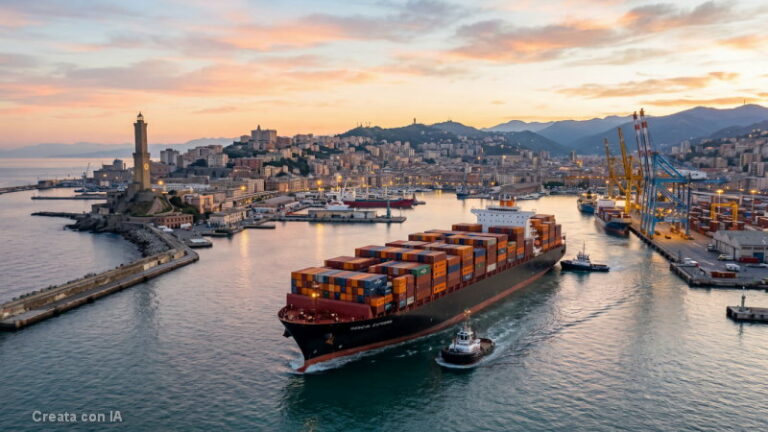
On the Asia-Europe corridor, the decline is more moderate but still widespread. From Shanghai to Genova, the rate fell by 5% to $5,988 per FEU, a sharper drop than in Northern Europe, bringing it below the $6,000 threshold exceeded the previous week. From Shanghai to Rotterdam, the weekly fall was 1%, to $4,824. Year on year, the two routes are up by 77% and 47% respectively. Available capacity is also increasing here: blank sailings scheduled on the Asia-Europe route are rising to four next week, two more than in the current week. Drewry forecasts a further slight decline in freight rates over the next seven days.
The picture remains complicated by tensions between the United States and Iran: concerns linked to the Strait of Hormuz have prompted several carriers to announce emergency fuel surcharges, effective from August 2026. Return routes and the transatlantic corridor, by contrast, show only marginal changes. From Rotterdam to Shanghai, the rate remains unchanged at $607 per FEU, up 23% year on year, while in the opposite direction, from Los Angeles to Shanghai, it rises by 2% to $839. On the transatlantic route, the rate from Rotterdam to New York falls by 1% to $2,635 per FEU, while from New York to Rotterdam it rises by 1% to $1,050.
M.G.