








The largest order for electric heavy-duty vehicles for chemicals transport in the European Union was announced in June 2026 by Finnish haulier Wibax. Scania will supply the company with 105 electric trucks for an undisclosed amount, under an exclusive agreement covering the next five years and marking a significant step in Wibax’s plan to fully electrify its fleet. The deal also opens a new chapter in the partnership between the two companies, which began in 2021, and is intended to reduce overall operating costs while lowering the climate impact of transport operations. In addition to vehicle supply, the agreement includes maintenance, charging solutions and digital services, making it a broader cooperation between Wibax and Scania.
A central part of Wibax’s electrification programme, made possible by the agreement with Scania, is data-driven planning and control. The company will be able to analyse driving styles, route planning and energy consumption, enabling it to size its fleet more accurately and operate it more efficiently. “This agreement is essential to achieving our environmental goal of electrifying our entire vehicle fleet. Scania is a solid and stable partner with whom we have a shared history, which matters given the scale of the operation,” says Jonas Wiklund, chief executive of Wibax.
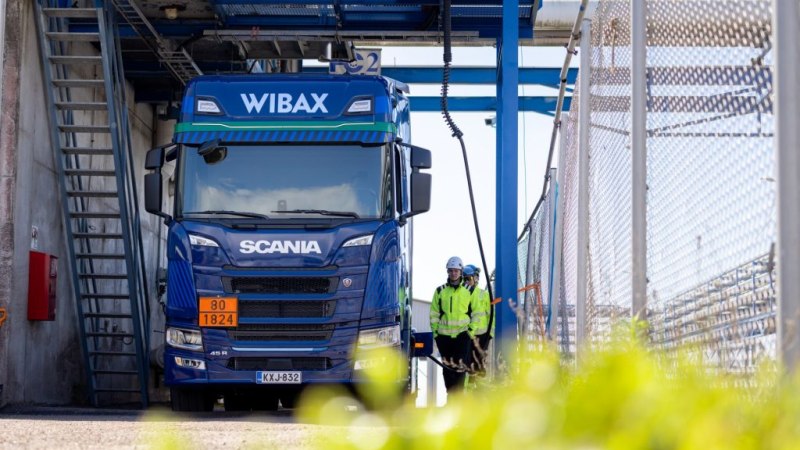
But what has now become a supply agreement on a European scale already has a concrete track record behind it. Since summer 2025, Wibax has been operating Finland’s first fully electric ADR-approved tanker truck, developed in cooperation with Scania as part of the “Wibax goes electric” project, which has set ambitious goals for the whole organisation. The vehicle is based at the Hamina terminal and is used daily to deliver liquid chemicals to customers. At the wheel is Toni Jaakkola, a driver since 2012 and with Wibax since 2025, who drove an electric vehicle for the first time last year. “The ride is pleasantly smooth and quiet, and in this respect the electric truck is perhaps even slightly better than a diesel vehicle. I was really satisfied,” he says, noting that driving it is not very different from driving a diesel vehicle, except for the immediate availability of full torque at the touch of the accelerator, which makes it easier to merge into traffic.
Aki Eerola, transport planner and driver supervisor in Hamina, says electric vehicle training does not start from scratch. Driving remains similar to that of a diesel truck, but the driving style changes, with smoothness and efficiency becoming essential, as driver habits have a direct impact on battery life and make anticipatory driving more important than in the past. Training takes the form of an intensive course focused on charging procedures and managing exceptional situations, including the emergency release of a charging point. More serious technical faults still require external intervention, but drivers are trained to deal independently with minor problems that arise on the road.
Drivers’ shifts generally last between eight and ten hours, during which the electric truck covers about 300 kilometres. In these cases, an intermediate charge is required at the Lappeenranta charging point, as the vehicle’s range at full load is around 200 kilometres. According to Eerola and Jaakkola, the most surprising aspect of daily vehicle management is the impact of weather conditions on range. Contrary to what might be expected, severe frost is not the most critical factor for heavy-duty vehicles, thanks to an advanced battery thermal management system that ensures performance even in extremely cold conditions. Instead, road surface conditions have a greater impact: roads not cleared of snow, slush and higher rolling resistance reduce range more significantly than sub-zero temperatures. “The batteries are liquid-cooled and liquid-heated: every time the truck is connected to the charging point, a liquid circulates to preheat the battery pack. That is why the vehicle does not cool down easily at departure. Road surface conditions have a much greater impact than the cold alone,” Eerola explains.
Wibax is currently the only Finnish tank transport operator to have a fully electric truck in daily use, while electric vehicles are already more common in short-haul distribution. Eerola identifies charging infrastructure and vehicle range as the main challenges, as a fully loaded electric vehicle covers around 200 kilometres compared with more than 500 kilometres typical of a diesel fleet. A wider charging network would require more electric vehicles on the road, while the purchase of new electric vehicles in turn depends on suitable charging infrastructure already being in place. Jaakkola is looking ahead with one clear expectation: “If I could wish for one thing in the future, it would be greater battery capacity and range. Being able to travel longer distances with electric trucks is really my only wish.”
P.R.