






The sharp increase in military spending announced by the European Union could provide a boost to the continent’s automotive sector, which may receive billions in public funding for the production of vehicles or components, possibly even as part of an industrial shift from civilian to military or dual-use production. The industrial vehicle sector is certainly among the key players, having long operated in this field. A clear sign of what manufacturers expect from military investment has emerged at Eurosatory 2026, Europe’s most important defence exhibition, taking place in Paris from 15 to 19 June. Almost all European truck brands are taking part, also presenting new solutions for logistics and combat. Daimler Truck, Iveco Defence, Scania and Volvo Defence are presenting new vehicles, systems and industrial agreements, while DAF Trucks, Tatra Trucks and VDL Groep had already previewed some of their latest developments in March at the Brussels European Defence Exhibition & Conference (Bedex 2026), another sector event.
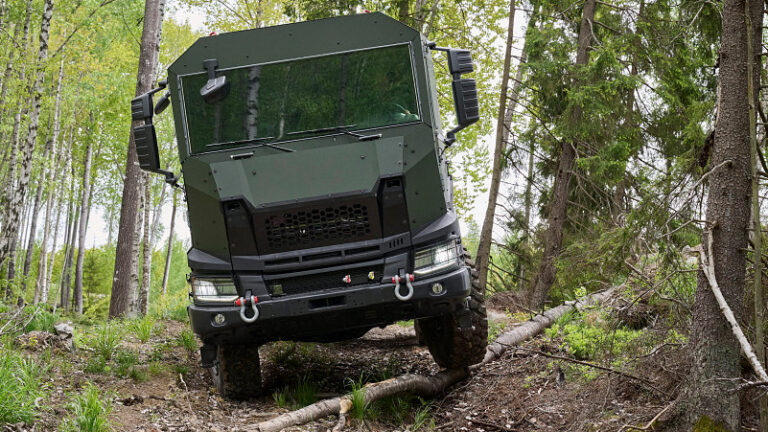
At Bedex 2026 in Brussels, held from 12 to 14 March, DAF Trucks presented a new 6x6 military truck together with Tatra Trucks and VDL Groep, the result of cooperation between the three companies in the design, production and servicing of military vehicles. The vehicle has all-wheel drive across its six wheels and is available either with an armoured cab supplied by Tatra Defence, offering ballistic and mine protection, or with a civilian DAF cab, featuring a low floor to improve accessibility. The dedicated superstructure, a military CargoBody, is supplied by VDL Groep, which provides the full range of bodywork compatible with the new 6x6.
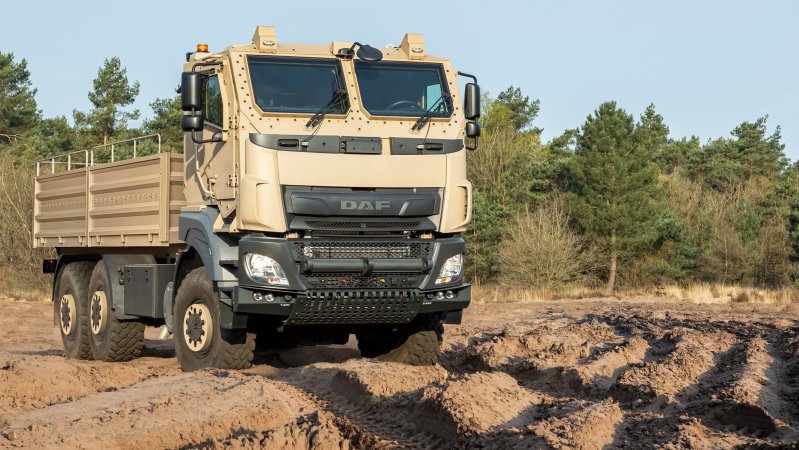
The vehicle inherits Tatra’s all-wheel-drive system, based on a central load-bearing tube and independent wheel suspension, combined with a central tyre inflation system to improve off-road mobility. The civilian cabs and Paccar MX-13 engines are supplied by DAF, which, together with the Belgian armed forces, also provides support for vehicles already in service through an international network of more than 1,150 dealers. Under a tender issued by the Belgian Ministry of Defence, DAF Trucks and Tatra Trucks have already completed delivery of more than 900 4x4 and 8x8 trucks: the former for general transport, the latter for special tasks such as container transport in off-road conditions and the rapid recovery of vehicles during military operations. The three companies are also assessing local production opportunities, given the importance that defence ministries attach to this aspect.
Daimler Truck also aims to grow in this military market and has launched a new global brand, Daimler Truck Defence, to bring its defence activities under a single identity. The group plans to invest several hundred million euros over the coming years to expand engineering, production, sales and service capacity, with the aim of reaching €1bn in defence-related revenue by 2028. The portfolio, currently based mainly on Mercedes-Benz Trucks vehicles, will gradually be extended to other group ranges and brands. Around 1,000 employees are already involved in the defence business, with growth driven above all by the production site in Wörth am Rhein, Germany.
The Wörth am Rhein plant and the Molsheim site in France form the core of Daimler Truck’s defence production in Europe and allow military variants to be integrated into existing production lines. The group also offers local assembly of militarised Mercedes-Benz trucks in customer countries. Its service network includes around 5,000 service points in more than 160 countries. Recent contracts include an order from the Bundeswehr (German Army) for hundreds of military logistics vehicles, an agreement with the Canadian Armed Forces, in cooperation with General Dynamics Land Systems, for at least 1,500 logistics trucks, and a framework agreement with the French armed forces, signed with Arquus, for 7,000 trucks based on the Zetros platform.
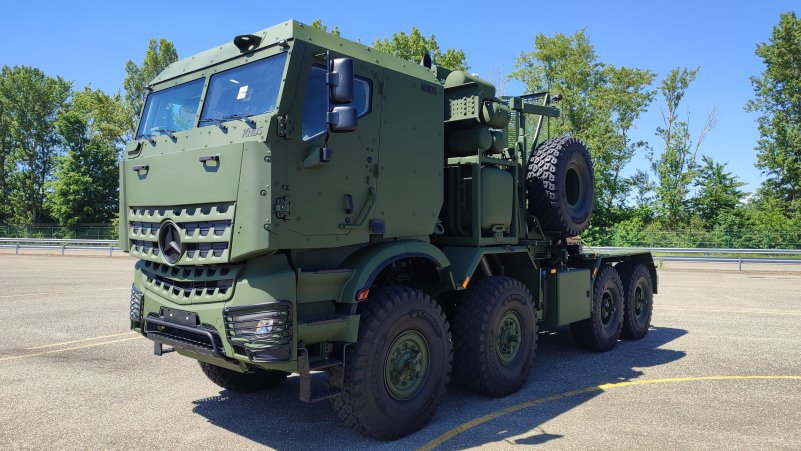
At Eurosatory 2026, Daimler Truck Defence is displaying a range of Unimog, Zetros and Arocs vehicles equipped with different mission systems developed in cooperation with industrial suppliers. In the same setting, the group signed a memorandum of understanding with Roshel for the joint development, production, marketing and support of protected and armoured vehicle solutions. The agreement combines Daimler Truck platforms, including Zetros, Unimog, Arocs and the FGA family, with Roshel’s expertise in the design and integration of armoured vehicles. It is aimed at defence and security customers in NATO, Europe, North America and other allied markets.
Iveco Defence Vehicles (IDV), a company that has just joined the Leonardo group, is presenting its latest developments in unmanned ground vehicles (UGVs) and autonomous systems at Eurosatory 2026, with an offer that includes wheeled and tracked platforms and integrated command-and-control systems. The new products include the latest generation of the Viking, a 6x6 multirole UGV making its international debut with an updated powertrain and several performance improvements. Its range in electric-only mode rises to 30 km, while the Janus-D electro-optical sensor, mounted on a mast to improve line of sight while keeping the vehicle concealed, integrates high-resolution cameras and new processors for teleoperation and computer vision. The Viking is being shown in two configurations: the first fitted with Leonardo’s Hitrole C-UAS anti-drone weapon station, integrating the 30x113 calibre Blaze cannon with ITAR-free technology and capable of operating on the move even in extreme environmental conditions; the second equipped with an MBDA precision surface-to-surface missile system, in an anti-tank configuration organic to the battle group, with three missiles on board to engage high-value targets.
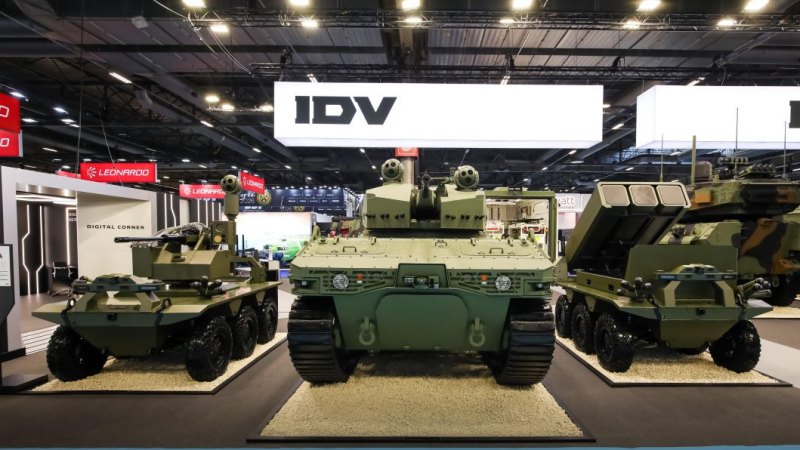
The CL2X is also making its debut at Eurosatory 2026. It is an unmanned light tank with hybrid propulsion, combining electrification and fully autonomous driving capability. Based on a series-hybrid architecture with an auxiliary unit for battery charging, or range extender, and rubber tracks, the vehicle has a total mass of 16 tonnes and a payload capacity of up to 5 tonnes. The series-hybrid powertrain delivers traction power of up to 500 kW, while the energy storage system, with capacity of up to 130 kWh, allows a maximum range of 500 km, including about 30 km in silent mode, with a top speed of 70 km/h. The control system supports both teleoperation and remote command and is prepared for autonomous functions. In the configuration shown in Paris, the CL2X integrates Leonardo’s Hitfist 30 UL light unmanned turret, with a 30 mm calibre, based on the ITAR-free X-Gun cannon and paired with air-burst munitions. Targeting operations are supported by the Janus-D system, which includes anti-drone capabilities. The MACE autonomy technology and ATLAS navigation technology for GNSS-denied environments, developed by IDV, are also designed to be retrofitted to other platforms, including those made by other manufacturers. This solution is already used on light multirole vehicles (LMVs) and IDV trucks, allowing these platforms to become optionally unmanned.
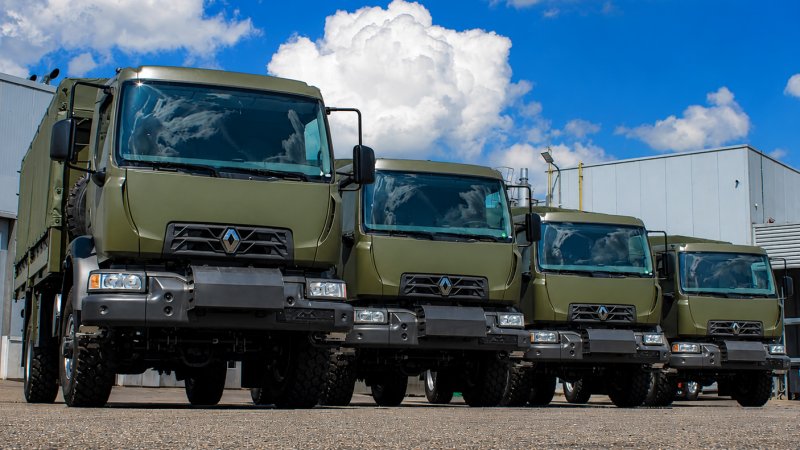
Renault Trucks is also presenting its range of vehicles for defence applications in Paris. In the outdoor exhibition area, the company is displaying two vehicles that illustrate its expertise in military logistics and off-road transport. The diamond brand’s vehicles intended for military use are produced at the Bourg-en-Bresse plant in Ain and the Blainville-sur-Orne plant in Calvados, on the same assembly lines as the brand’s trucks designed for the most demanding civilian operations.
Scania is taking part in Eurosatory 2026 with a modular protected cab designed for defence logistics and the most demanding missions. The new cab allows customers to configure protected vehicles without having to rely on a separate platform and represents a further step in the Swedish company’s modular system. Ballistic and blast protection can be configured according to operational and mission requirements and complies with STANAG 4569 levels 1-3. The protected cab is available for 4x4, 6x6 and 8x8 configurations and is designed to meet strategic mobility requirements, including the UIC GA profile for transit through railway tunnels. It is produced in Sweden and integrated into Scania’s standard production flow, sharing components, spare parts and service facilities with the rest of the civilian and military range.
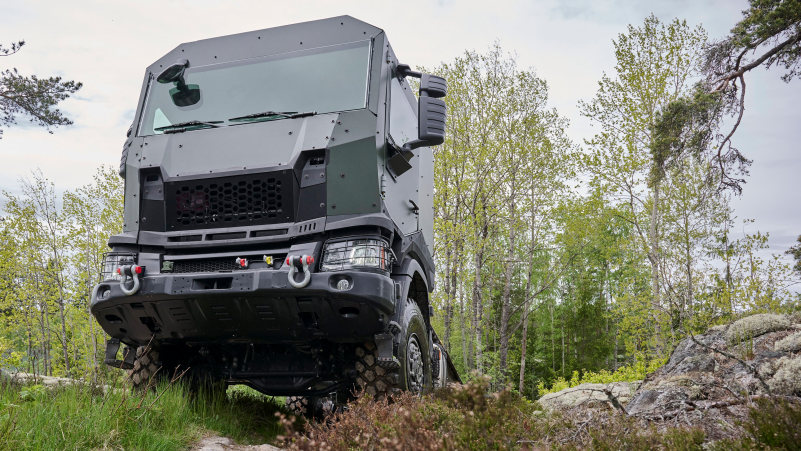
During the French event, Scania delivered to FMV, the Swedish Defence Materiel Administration, the first of three hybrid trucks planned under a joint development project. The vehicles will be assessed by the Swedish armed forces across the three service branches to examine the potential offered by electrified propulsion in the military field, including more fuel-efficient operation, the possibility of silent movement in electric mode and the use of the battery and onboard generator to power external equipment, such as command posts, sensors or temporary camps. The adopted solution is a parallel plug-in hybrid, in which the combustion engine and electric motor can move the vehicle separately or together. Range in electric mode is about 70-80 km, depending on use, load and operating conditions. The battery, with a capacity of 208 kWh, provides about 156 kWh of available energy at a 75% state of charge, enough for around four hours of alternating-current power supply, while full recharging through the combustion engine takes between 45 and 60 minutes at idle.
Volvo Defence is presenting the combined capabilities of the Volvo group at Eurosatory 2026, bringing together Volvo Trucks, Volvo Penta and Volvo Construction Equipment to support the defence logistics chain, from civilian transport and infrastructure through to frontline operations. The proposals on display include the Volvo Logistic Chain Solution, a logistics chain illustrating the contribution of Volvo’s portfolio across the entire logistics process, from port entry to the last mile, together with autonomous transport solutions designed to reduce personnel exposure in higher-risk areas while maintaining the efficient movement of supplies and equipment.
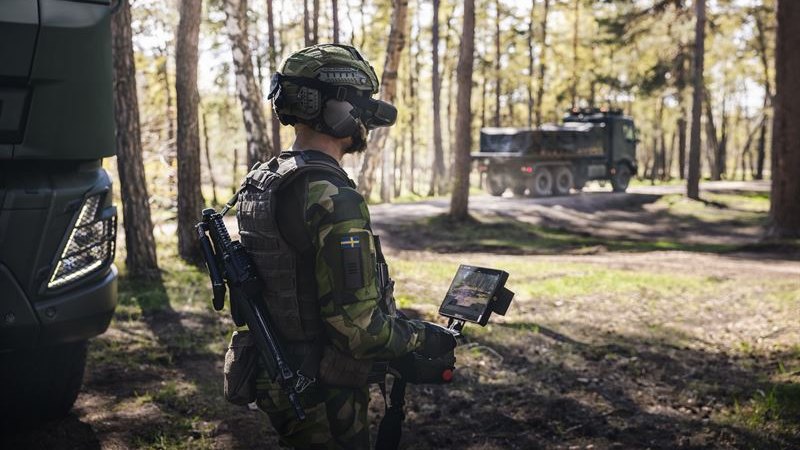
Among its logistics support vehicles, Volvo Defence is displaying the Volvo FMX 6x6 military truck, designed for on-road and off-road performance in the most demanding environments. The vehicle is equipped with the I-Shift automated transmission with ultra-low crawler gears and an automated lifting hook to optimise traction and mobility across different types of terrain. A high degree of commonality with civilian variants ensures vehicle availability, simplifies spare parts logistics and delivers economies of scale linked to the group’s commercial production.
P.R.