




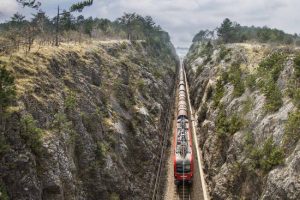
The new Slovenian railway line between Koper and Divača has only recently opened for operation, but doubling is already being considered. The new route was built as a variation from the historic line, whose infrastructure is now inadequate for both freight transport and passenger services. The distinctive feature of this long-gestating project is that a single-track line has been built as an ideal distant doubling of the historic line, which has remained in service. From the design stage, however, the possibility of doubling the line by laying a second track alongside the first existing one was not ruled out, should the need arise. For this reason, some engineering structures, and particularly the longer tunnels, were excavated with a profile already suitable to accommodate two running tracks.
Everything had suggested that doubling the line was a distant prospect. Instead, 2TDK (Družba za razvoj projekta, Project Development Company), the company responsible for the design, construction and management of the new line between Koper and Divača, wants to accelerate the timetable and in June 2026 had already submitted its application for the full building permit for the second track. The latter, referred to in the plans as the left-hand track, will run alongside the right-hand track that has already been built and was recently authorised for operation.
The procedure for this project will not be particularly quick because, apart from some tunnels that have already been prepared, the rest of the route will have to be built from scratch. In addition to the railway formation, two viaducts, Gabrovica and Vinjan, and the Glinščica bridge will have to be built alongside the existing structures, together with three tunnels, one just 80 metres long and the longest exceeding three kilometres. Publication of the two-stage tender for the construction contract is scheduled by the end of 2026. 2TDK expects construction work to begin during 2027, with completion by 2030. Once the doubling has been completed, the historic line will be decommissioned and repurposed as a tourist route.
The new Koper-Divača railway, an integral part of the TEN-T Baltic-Adriatic corridor, has a 27.1-kilometre route, around 75% of which is in tunnel, with seven tunnels totalling more than 20 kilometres and three main viaducts. These include the Glinščica viaduct, which will now have to be doubled in an area with particularly complex geology, as well as difficult logistics for access. The new rail route required five years of work and spending of just over €1 billion, funded only partly by Slovenian finances and with EU funds contributing at least 35%.
The potential of the new Koper-Divača line is significant, as transport capacity is expected to double, with forecasts of up to 200 freight trains a day, equivalent to 30 million tonnes of goods a year. As well as reducing the distance between the port of Koper and the Divača junction from 44.6 to 27.1 kilometres, the new route has high-capacity characteristics in terms of loading gauge, gradients and curve radii, with freight trains able to run at speeds of up to 120 km/h.
Piermario Curti Sacchi