

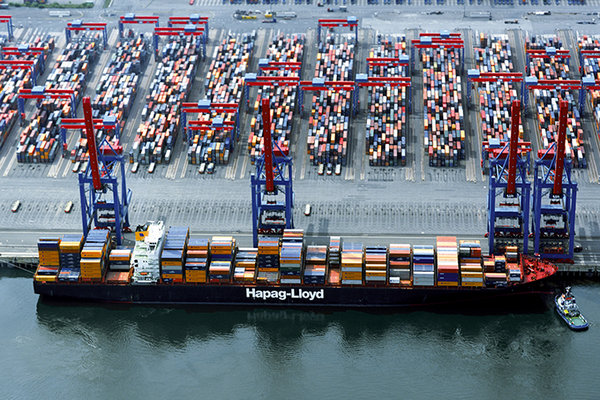








Average spot container shipping freight rates, tracked weekly by Drewry’s World Container Index, reached their highest level in eighteen months on 18 June 2026. The composite index rose to $3,969 per 40-foot container, up 12% from the previous week and 21% year on year. According to Drewry analysts, the increase is being driven by aggressive capacity management by carriers, which have announced new blank sailings, and by shippers front-loading cargo to avoid the impact of new US tariffs expected in July and the bunker adjustment surcharge due to take effect from the first of the month.
On the Asia-Europe corridor, pressure on spot rates is more pronounced against a backdrop of sharply reduced vessel capacity: only three blank sailings have been announced for next week. The Shanghai-Rotterdam route rose to $4,342, up 15% over the week and 37% year on year. The Shanghai-Genoa route is even more expensive, confirming its position as the costliest service to Europe at $5,756, up 12% week on week and 41% annually. In the opposite direction, Rotterdam-Shanghai stood at $643, with a more limited weekly increase of 3%, but a 24% rise over twelve months.
Transpacific routes to the United States showed the largest nominal increases in the overall picture, coinciding with the announcement of six blank sailings and the introduction of new tariff surcharges by carriers. The Shanghai-New York route rose to $6,769, up 15% week on week, with a more modest annual increase of 3%. On the Shanghai-Los Angeles route, the rate reached $5,142, up 10% over the week and 9% over twelve months. The return leg from Los Angeles to Shanghai remained at a lower level, at $822, with a minimal weekly change of 1% and an annual increase of 14%.
The transatlantic market is moving counter to the rest of the global trades, with total short-term stability. The Rotterdam-New York route remained unchanged at $2,507, down by just one dollar on the week but up 26% year on year. The reverse flow, New York-Rotterdam, stood at $957, also with a positive weekly change of one dollar, but in this case down 15% compared with a year earlier: an asymmetry that highlights opposing dynamics in the two directions of transatlantic traffic, despite short-term stability.
In the background, the situation in the Strait of Hormuz remains a factor, where the provisional agreement between the United States and Iran is reducing geopolitical tensions and helping to partially stabilise fuel prices. According to the latest reading, however, strong peak-season demand and route diversion strategies continue to put upward pressure on spot freight rates globally, with further rate increases expected from July through FAK and PSS mechanisms.
M.G.