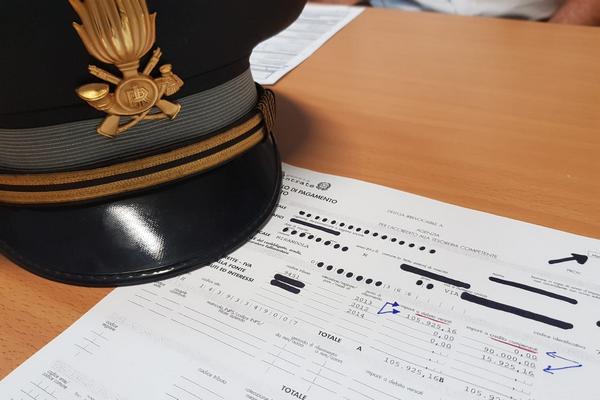





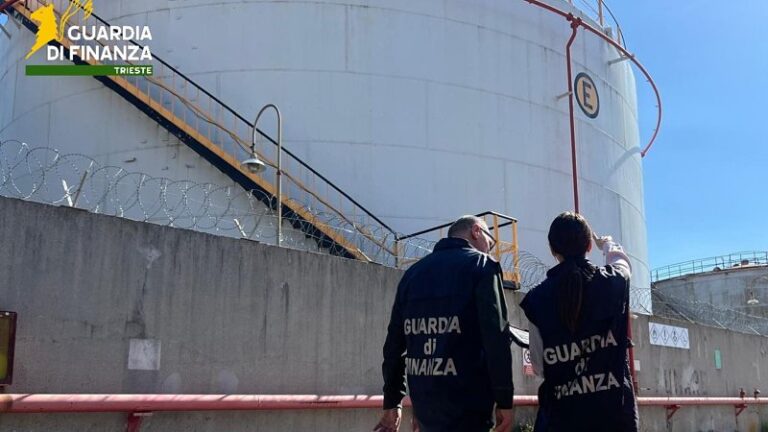
Officers from the Trieste Economic and Financial Police Unit have enforced the confiscation of movable and immovable assets worth a total of EUR2.5 million from two companies and four individuals. The latter had been finally convicted of tax offences, evasion of excise duty on hydrocarbons and self-laundering in connection with the acquisition of Depositi Costieri Trieste, which took place in 2017. The case stems from investigations delegated by the Trieste Public Prosecutor’s Office into the purchase of the company by four individuals from Campania. At the time, Depositi Costieri Trieste was a major local business active in the storage and handling of petroleum products within the port area. Three of the four buyers had criminal records for mafia-type criminal association and proven links with Camorra clans in the Naples area.
The investigative work established that the four individuals, formally hired as employees of the company, were in fact the real drivers of its management. Their administration was marked by the systematic commission of tax offences and the simultaneous self-laundering of illicit proceeds. The company was also used to carry out sales of petroleum products while evading tax, through anomalous operations that ultimately led to its bankruptcy for failure to meet fiscal obligations. A separate criminal proceeding for bankruptcy has been opened on this point.
Investigators reconstructed how the acquisition of the company had been carried out by reinvesting proceeds from illicit activities, using entities created solely to issue false invoices. These so-called "paper companies" were fictitiously inserted into the commercial chain with the dual aim of generating substantial tax debts to the Treasury, which were never paid, and concealing the origin of the money. Analysis of financial flows enabled investigators to establish that the money withheld from the tax authorities, held across multiple financial relationships and also through cryptocurrencies, was used for travel, purchases in luxury boutiques, leasing contracts and stays in five-star hotels.
During the proceedings, which led to the four individuals being reported to the authorities, cash, company shares, properties, cars and a yacht had already been seized, with a total value of EUR1 million. The same suspects were also served with an anti-mafia interdiction order issued by the Trieste Prefecture, due to the existence of attempted infiltration by organised crime. The measure barred them from any form of access to state-owned port areas, resulting in the company being placed under special administration.
The confiscation carried out in recent days marks the conclusion of the judicial case, following the rejection by the Court of Cassation of the appeal lodged by the defendants against the second-instance conviction. The assets already seized in 2017 have therefore been definitively removed from the convicted individuals’ control. Added to the value of those assets is around EUR1.5 million identified in recent months through further investigations conducted under the coordination of the Public Prosecutor General’s Office at the Court of Appeal of Trieste.
The assets come from positive current account balances, vehicles and company shares in two other businesses based in Campania and operating in the transport sector. These companies were formally registered in the names of frontmen but were in fact managed by one of the convicted individuals. This shows that, even after the seizure, those responsible for the offences continued to run illegal trafficking operations and accumulate significant economic resources. The case confirms how the port of Trieste can be exposed to attempted infiltration by organised crime operating in the transport and energy logistics sectors.