



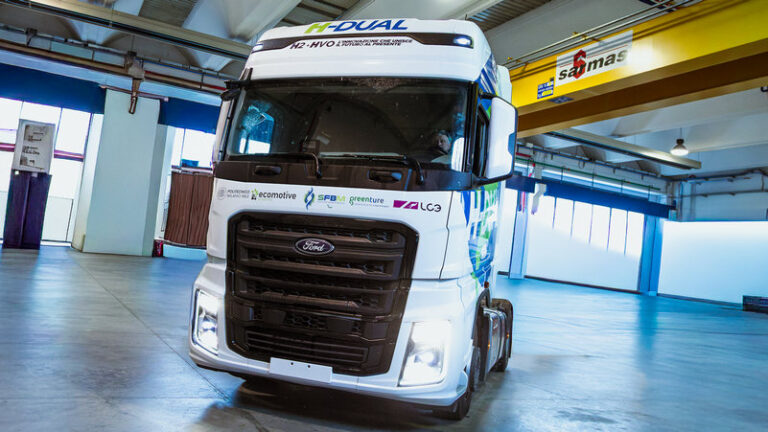
On 15 May 2026, at the Ford Trucks Italia stand at Transpotec Logitec, the H-Dual project was officially presented. It is an applied research and testing programme designed to decarbonise road haulage through dual-fuel technology fitted to an industrial vehicle operating in real road conditions. The project is the result of collaboration between Ford Trucks International, Ford Trucks Italia, Ecomotive Solutions, Politecnico di Milano (Polytechnic University of Milan), LC3 Trasporti, Sfbm and Greenture, a company in the Gruppo Snam. Its aim is to develop and test the first solution for adapting a road-going industrial vehicle to hydrogen fuelling, before commercialising it on a large scale and contributing to the development of an environmentally and economically sustainable logistics system.
The project addresses one of the most complex challenges in the energy transition: reducing emissions without disrupting fleet operations and without waiting for refuelling infrastructure that is still largely absent across the country. H-Dual does not propose the immediate replacement of conventional engines, but rather a gradual integration of hydrogen into existing combustion systems through the principle of energy blending.
The vehicle chosen for the trial is a Ford F-Max L in tractor unit configuration, already equipped with the H-Dual system and on display in the Transpotec test area throughout the event. Under the system, hydrogen is introduced into the air flow drawn into the engine, while a reduced amount of HVO is injected as a pilot fuel to trigger combustion. This arrangement ensures operational continuity: if the hydrogen runs out, the engine continues to operate on diesel or HVO alone, with no interruption for the driver or the load.
The project promoters say that, once H-Dual is fully operational, hydrogen will account for at least 30% of the overall energy mix. The next phase will involve testing advanced H2Ng blends - hydrogen plus biomethane - which offer greater flexibility. According to advanced simulation models developed by the Politecnico di Milano research group, H-Dual technology can cut CO2 emissions by up to 30%, while leaving the original combustion system almost unchanged.
Safety management and refuelling infrastructure are entrusted to Sfbm, which supplies the high-pressure tanks, and to Greenture, which is responsible for the dispensing infrastructure. Both companies are involved in component testing. The programme includes the collection of operational data from the hydrogen refuelling plant in Arquata Scrivia, in the province of Alessandria, with the aim of planning the gradual development of a refuelling network across Italy. This step is a fundamental part of the project: the availability of dedicated stations is a necessary condition for making the solution scalable beyond a single prototype.
Ecomotive Solutions, the producer of the dual-fuel technology and the company responsible for development and testing on the H-Dual prototype, brings to the project experience dating back to 2009, when it developed its first dual-fuel systems using LPG and methane for heavy transport. Over the years, Ecomotive Solutions’ work has evolved through gaseous biomethane, liquefied biomethane and, most recently, hydrogen. LC3 Trasporti is the operator that will use the test vehicle in real operating conditions, providing the operating data needed to validate the technology.
In addition to reducing CO2 emissions, the research will focus on improving engine performance and analysing total cost of ownership, with scientific support from the Dipartimento di Energia del Politecnico di Milano (Department of Energy of the Polytechnic University of Milan). The next phases of testing will identify innovative combustion strategies capable of increasing efficiency while reducing pollutant emissions. The promoters have also stated their commitment to adapting the regulatory framework and obtaining type approval for H-Dual technology, a process considered essential for subsequent large-scale commercialisation.
“The introduction of the test vehicle in real conditions shows that collaboration along the entire supply chain is the only real driver of change. The time for waiting is over: we need flexible, viable options that can cut emissions, and the Dual-Fuel project responds exactly to this concrete need,” said Michele Ambrogi, commercial director of LC3 Trasporti. Nicola Russo, chief executive of Ford Trucks Italia, stressed that the solution is “pragmatic and immediately applicable”, able to enhance existing vehicles and accelerate emissions reductions without waiting for fleets to be replaced in full. Marco Mele, sole director of Sfbm, instead highlighted the need to offer concrete alternatives to electric power, which in the case of heavy-duty vehicles presents significant technical and economic challenges.
P.R.