








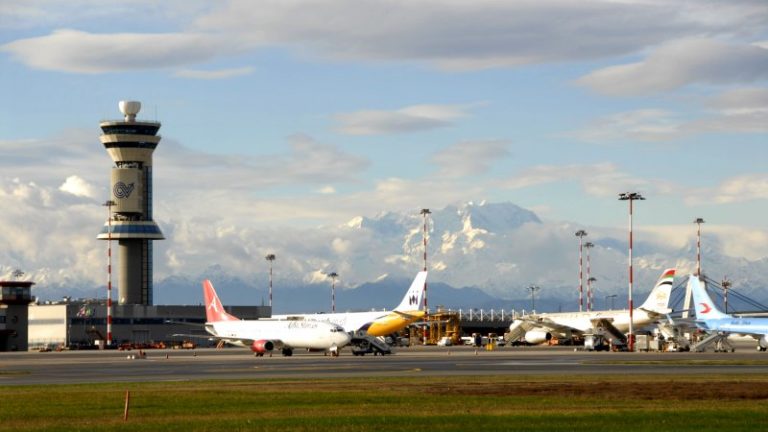
On 12 May 2026, at the headquarters of Italy’s Ministry of Transport in Rome, the minister presented the National Airport Plan 2026-2035 to institutional representatives, airport operators, carriers and social partners. The document, drawn up by the Ente Nazionale per l’Aviazione Civile (National Civil Aviation Authority), is intended as a political and technical guidance tool for the development of Italy’s airport network over the next decade. The presentation came shortly after Enac published its 2025 traffic data: last year, Italian airports handled 229.7 million passengers, up 5% on 2024. The non-EU segment recorded the strongest growth, at 7%, confirming the role of air transport as a driver of competitiveness for exports, tourism and international connectivity.
The central objective of the PNA 2026-2035 is to increase the capacity of the national airport system to handle around 305 million passengers a year by 2035. This is an expansionary scenario, the highest of those considered in the relevant technical documents, including the guidelines submitted to Parliament in October 2021. However, projecting demand over a ten-year horizon inevitably involves significant uncertainty: the current PNA and the guidelines themselves note that traffic scenarios must be updated periodically in the light of macroeconomic shocks and demand cycles, as shown by the effects of the pandemic. Choosing the most expansionary scenario implies ambitious infrastructure sizing - runways, terminals and accessibility - with the risk, should growth prove more limited, of creating overcapacity in some catchment areas.
The PNA 2026-2035 is fully aligned with the National Airport Plan approved in 2022 and with the guidelines already submitted to Parliament. The document maintains the logic of organising the network into homogeneous traffic catchment areas, ten in total, and identifies airports of national interest according to criteria including strategic role, territorial position, volumes and integration into TEN-T corridors. The current PNA includes 38 airports of national interest, while the 2026-2035 version, according to Enac, extends this classification to all airports in the network. Regional airport systems are confirmed: the Milan network (Malpensa, Linate, Bergamo), the north-east network (Venice, Treviso, Trieste, Verona, Brescia), the Emilia-Romagna network (Bologna, Parma, Rimini, Forlì) and the networks of southern Italy and the islands.
A significant part of the Plan concerns intermodal integration. The ministry announced investments of €1.2 billion for rail links to four airports: Bergamo Orio al Serio, Olbia Costa Smeralda, Verona Catullo and Venezia Marco Polo. Intermodality is a structural theme already present in the 2022 PNA, which explicitly defines itself as a chapter of the Piano Generale dei Trasporti e della Logistica (General Transport and Logistics Plan) and stresses integration with high-speed rail, electric and hydrogen vehicles and dedicated shuttle services. However, the €1.2 billion figure requires careful reading. Documents from Rete Ferroviaria Italiana and sources linked to the PNRR indicate that the works for Venice and Verona alone, when considered within the wider “railway revolution” in Veneto - with total investment estimated at more than €3 billion - already exceed the amount cited in the ministerial statement. It is therefore likely that the €1.2 billion figure refers to a specific funding component - PNRR quotas or functional lots already identified - rather than the total cost of all intermodal infrastructure works serving the four airports.
The PNA 2026-2035 also includes a section on environmental sustainability, in line with the objectives of the European Green Deal. The document sets increasing targets, for 2030 and 2035, for the share of passengers reaching airports by collective transport, and steers planning towards rationalising the existing network: optimal use of available capacity, reduction of overlaps between neighbouring airports and the functional specialisation of airports as intercontinental hubs, tourist airports and cargo infrastructure.
The presentation on 12 May 2026 ended a period of waiting that had generated tensions in the sector. During 2025, Fit-Cisl union had already publicly warned that the PNA “cannot remain stalled, locked away in the Government’s drawers”, cautioning that delays in planning risked undermining the competitiveness of Italy’s airport system, with consequences for intercontinental connections, employment and cargo development. In autumn 2025, Enac president Pierluigi Di Palma confirmed that the Plan was ready and would be presented “shortly” by the minister, while acknowledging that the procedural process was complex.
A question of transparency remains open. Unlike in 2022, when the PNA was made available in full on the ministry’s website, the 2026-2035 document had not been published in full at the time of its presentation. Traffic forecasts for individual catchment areas, updated airport classification criteria, the map of infrastructure priorities and alternative demand scenarios remain, for now, filtered through the political statement and a number of previews. For airport, air cargo and integrated logistics operators - which must shape investments and strategies over a ten-year horizon - the availability of the full text is essential to assess the real scope of the planning decisions set out in the Plan.
M.L.