




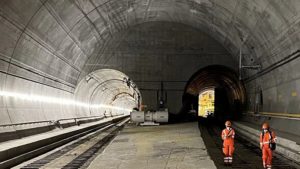
Almost two years after the incident that paralysed one of Europe’s busiest rail freight corridors for more than a year, the legal case linked to the derailment of a freight train in the Gotthard Base Tunnel has returned to the spotlight. The public prosecutor of the Canton of Ticino has closed its criminal investigation on the basis of an independent technical expert report, whose findings, according to the SRF programme "Rundschau", raise the possibility of liability on the part of Swiss Federal Railways. The starting point is the incident of 10 August 2023, when freight train number 45016 derailed inside the Gotthard Base Tunnel after the right wheel of the first axle of a freight wagon fractured. The consequences were severe: infrastructure damage estimated at around 150 million Swiss francs and the closure of one of the tunnel’s two tubes for more than a year, with full operations restored only at the beginning of September 2024.
What the Ticino public prosecutor is now questioning is not so much the mechanical cause of the incident, which has already been established by the Swiss Transportation Safety Investigation Board, Sisi, but the operational management in the phases leading up to and during the event. According to the expert report commissioned by the public prosecutor, SSB had received clear warning signals and had the opportunity to stop the train in time, or at least to activate measures that could have contained the scale of the infrastructure damage. The failure to adopt these measures could, again according to the report, constitute a possible offence.
SSB responded in an official statement, in which the company described as "false" the interpretation that it had ignored warning signals, characterising the prosecutor’s expert report as an "isolated" assessment not shared by the competent federal technical bodies. The railway company referred to the conclusions of Sisi and the Federal Office of Transport, Uft, which attribute the cause of the derailment solely to the fracture of a wheel disc on the freight wagon, without identifying any faults in the railway systems or operational errors by staff or management structures.
The final Sisi report, for its part, makes no findings against SSB, but issues specific recommendations to the European Union Agency for Railways and to the Uft, particularly regarding the maintenance of certain freight wagons operating in international traffic, the category to which the wagon involved in the incident belonged. SSB has repeatedly stressed this distinction: the freight wagon was neither owned by the company nor maintained directly by it.
In the meantime, the railway company says it has drawn operational lessons from the incident. Following the derailment, checks on freight wagons were stepped up and derailment detectors were installed at around ten strategic points along the approaches to the base tunnel, particularly before track switches near the portals. Thanks to these devices, FFS was able to lift the temporary speed reduction at the tunnel entrance, saying that it now operates above the statutory minimum safety requirements.