





- The first rolling motorway connection between Valencia and Entroncamento entered service on the night between 25 and 26 January 2026, extending across the border the Valencia–Madrid service launched in 2024 and marking the operational start of an Iberian rail backbone for semi-trailer transport.
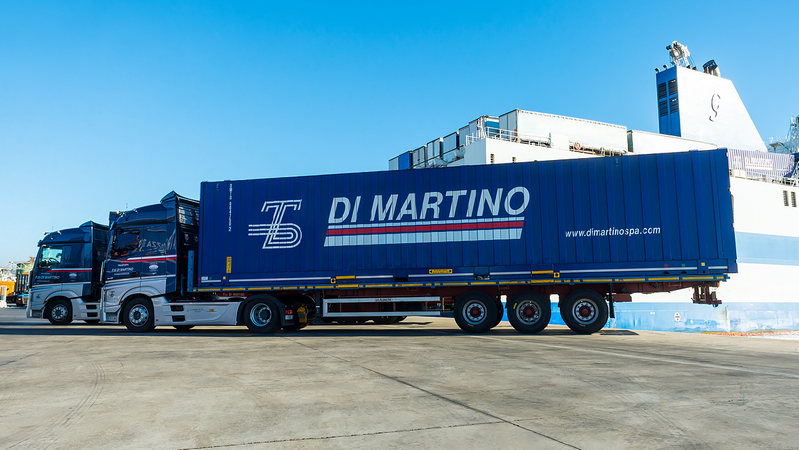
- The service uses T4000 wagons compatible with Iberian gauge and P400 semi-trailers, enabling the direct rail transport of high-volume road units without transhipment, with an initial frequency of two trains per week and a gradual approach to capacity management.
- The project forms part of the Atlantic–Mediterranean Corridor of the TEN-T network and is supported by public and private investment in infrastructure and rolling stock, with the aim of reducing reliance on road haulage and encouraging modal shift between the Mediterranean and the Atlantic.
On the night between 25 and 26 January 2026, the first direct combined road–rail freight connection between Spain and Portugal on Iberian gauge set off, with a freight train linking the port area of Valencia to the Entroncamento intermodal terminal. The service is operated by Tramesa, with traction provided by Medway, the railway company of the MSC Group. The inaugural run employed 13 T4000 wagons and carried 26 semi-trailers over a route of around 810 kilometres without intermediate stops, with an initial planned frequency of two trains per week.
This launch completes the first cross-border extension of the Valencian rolling motorway, following the Valencia–Madrid connection, which entered service in July 2024 and was progressively consolidated over the same year through increased frequencies. The objective is to create a rail backbone for semi-trailer transport linking the Iberian Mediterranean with the Portuguese Atlantic, fitting into the Atlantic–Mediterranean Corridor of the TEN-T network, a strategic infrastructure scheduled for completion by 2031.
The Valencia–Entroncamento link is part of a corridor designed to connect import and export flows from the port of Valencia and the Spanish hinterland with the Portuguese logistics hub of Entroncamento, an intermodal hub covering 22 hectares with a capacity of 7,000 TEU. The operational logic is to reduce the use of long-distance road transport, leaving trucks to handle the first and last mile, in line with a model already tested on the Valencia–Madrid route. That service has been sized to handle up to around 10,000 trucks per year, with an estimated reduction in emissions of 16,000 tonnes of carbon dioxide annually and avoided external costs valued at €7 million per year.
The most significant point of discontinuity in the service towards Portugal is technical in nature. For decades, the Iberian gauge of 1,668 millimetres represented a structural constraint on the development of rail intermodality on the peninsula, requiring transhipment operations or axle changes at borders. In this case, the solution adopted does not involve breaks in load, but rather the use of specialised wagons compatible with Iberian gauge and with semi-trailers designed for combined transport. The Sdggmrss T4000 wagons are articulated low-pocket wagons measuring 34.2 metres in length, with a tare weight of 36 tonnes and a load capacity of up to 99 tonnes depending on configuration. They are designed to accommodate P400 profile semi-trailers, allowing the transport of units up to four metres high from the wagon deck and making the service suitable for the main flows of high-volume curtain-sided semi-trailers.
The composition of the inaugural train reflects a cautious start-up strategy. The 13 wagons and 26 semi-trailers represent a reduced configuration compared with the standard indicated for the Valencia–Madrid route, where trains of 20 wagons and 40 semi-trailers operate. This choice reflects operational testing considerations and cargo availability, with the use of wagons previously laid up at Jundiz. The overall train length, at around 444 metres, falls within the operational limits of the conventional Iberian network and directly affects routing options and crossing with passenger traffic.
The origins of the service lie in planning launched in 2023. In June of that year, Tramesa declared its aim to extend the rail motorway towards Portugal, while in the same period a cooperation protocol with Infraestruturas de Portugal was referenced. In July 2023, Medway signed a three-year traction contract for the Valencia–Madrid route, with an option for geographical extension. In March 2024, the first wagons arrived and the facilities at the port terminal of Valencia were completed, including the installation of the crane at Dique del Este.
On 29 June 2024, the first test train ran between Abroñigal and Valencia, while on 22 July 2024 the commercial service began with a weekly frequency in each direction. In the fourth quarter of the same year, after the running-in phase, the Valencia–Madrid route was strengthened to four bidirectional weekly frequencies, with an estimated throughput of around 304 trucks per week. In 2025, the operators announced the imminent launch of the connection with Portugal and carried out operational simulations along the Madrid–Badajoz corridor, also in relation to the new Medway terminals in Extremadura.
A.I.