







The week ending 4 June 2026 marked another sharp acceleration in average spot freight rates for container shipping. According to the weekly Drewry World Container Index, the global composite index, the average of all monitored routes, stood at $3,433 per 40-foot container, a 23% jump from the $2,800 recorded on 28 May 2026. Year on year, the composite index remains slightly negative, down 3% compared with the same period in 2025.
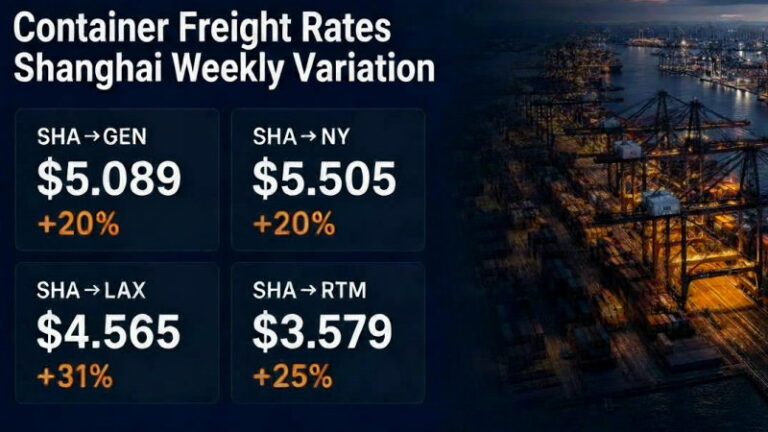
On routes between China and Europe, two psychological thresholds were crossed. The first concerns the Shanghai-Genoa trade, which remains the most expensive in absolute terms among all the routes surveyed and has passed the $5,000 per FEU mark, reaching $5,089. The weekly increase was 20%, equal to an additional $836 compared with the previous week’s $4,253, with annual growth of 25%. The Shanghai-Rotterdam route, meanwhile, exceeded $3,000 per FEU, reaching $3,579, with a weekly rise of 25% and a positive difference of $718 compared with the $2,861 recorded on 28 May. In this case, the route shows an annual increase of 26%.
For shipments from China to North America, the speculative element linked to fears of new US tariffs fuelled an even stronger upward surge. The Shanghai-Los Angeles route recorded the largest increase in the entire panel, both in relative and absolute terms: the cost rose to $4,565 per 40-foot container, a 31% jump from $3,473 on 28 May, equivalent to a net increase of $1,092 in seven days. Despite the severity of the short-term rise, the route still shows negative annual momentum, down 22% compared with June 2025 levels. The pattern was similar on the Shanghai-New York route, where the rate reached $5,505 per FEU, up 20% week on week, or $908 more than the $4,597 recorded at the end of May. Here too, the annual trend remains negative, with a year-on-year decline of 23%.
In contrast with outbound flows from Asia, repositioning routes recorded marginal changes or slight decreases. The Rotterdam-Shanghai route fell to $617 per container, down 5%, while still maintaining a positive year-on-year balance of 21%. The Los Angeles-Shanghai return route stood at $783, with an almost flat change of -1%, but annual growth of 9%. The New York-Rotterdam route followed a similar pattern, falling to $966, down 1%, but with a structural increase of 18% year on year.
The eastbound transatlantic corridor showed the strongest annual progression in the entire panel. The Rotterdam-New York route reached $2,560 per 40-foot container, with a moderate weekly rise of 5%, or $125 above the previous week’s $2,435, but with year-on-year growth of 29%, placing it at the top of the ranking for positive structural changes.
Drewry said upward pressure on spot freight rates could continue in the coming weeks of June, supported by a convergence of structural and operational factors. On the tariff front, carriers have already successfully implemented the first increases at the start of the month. Companies such as Hapag-Lloyd and Maersk have announced the introduction of further Peak Season Surcharges for sailings on 8 and 10 June, adding between $300 and $500 per FEU and between $600 and $1,000 per FEU on Asia-Europe routes.
This is compounded by saturation of available capacity. The latest Container Capacity Insight report indicates that only three blank sailings are scheduled on the transpacific route in the week after 4 June, an exceptionally low number which suggests that shipping lines are deploying their entire available fleet to meet strong real demand, effectively eliminating residual space on the spot market. The picture is completed by geopolitical tensions in the Middle East, which continue to keep fuel prices and raw material costs high.
Mara Gambetta