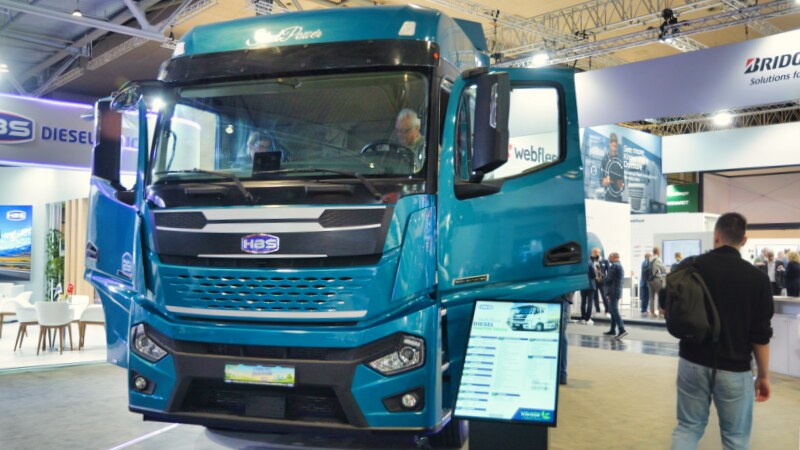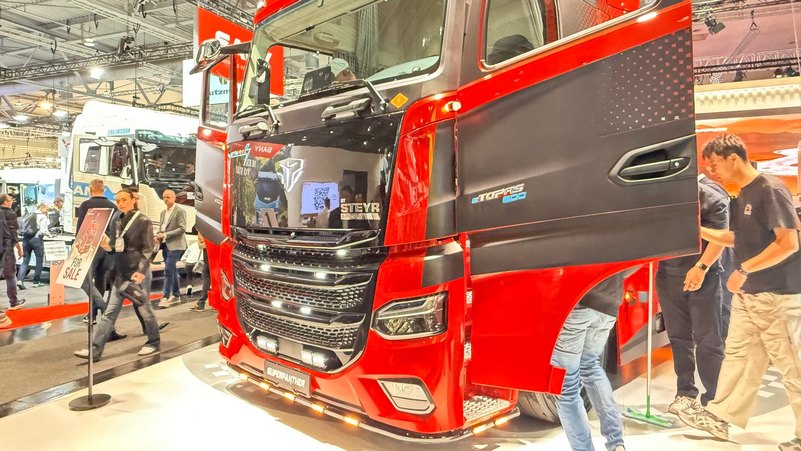






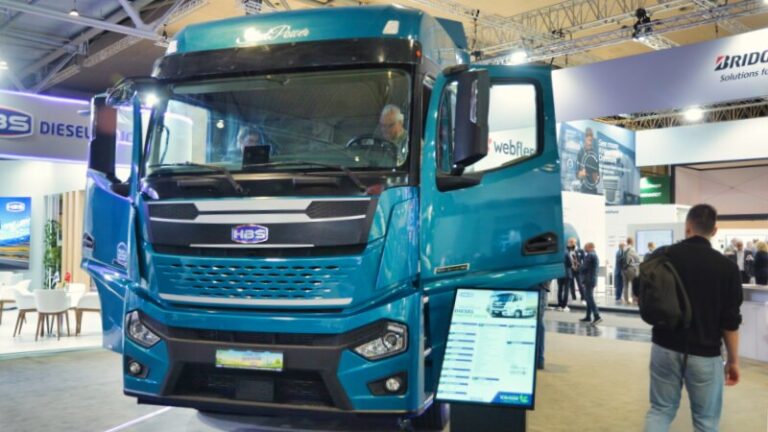
The industrial vehicle landscape at IAA 2026 was distinctly international: alongside the established European brands and the large contingent of Chinese newcomers was Turkish debutant Hbs, the Habaş Group brand dedicated to heavy commercial vehicles. It is not, however, the first industrial vehicle manufacturer from Turkey, a distinction that belongs to Ford Trucks. At the German event, Hbs presented the SteelPower 4x2 tractor unit in two versions, one diesel and one fully electric. Both share the same basic chassis design and differ only in their powertrains.
The diesel-powered SteelPower 4x2 uses the Mercedes-Benz OM471 engine in Euro VI E specification, available with outputs ranging from 331 to 390 kW (450 to 530 hp) and maximum torque of up to 2,600 Nm. The chassis and structural components are made from MC650 high-strength steel, developed and produced by Habaş, which has a long history in the steel industry. The choice combines chassis strength with reduced unladen weight. The SteelPower-e 4x2 applies the same approach to electric propulsion. In this case, it uses a 410 kW (557 hp) interior permanent magnet synchronous motor (IPMSM), with claimed torque of 3,100 Nm. The batteries and traction system stem from the group’s research and development activities, while the structure retains the high-strength steels used on the diesel model.
Founded in the 1950s, Habaş operates in industrial and medical gases, steel, energy, heavy machinery, and maritime and port logistics. Its automotive division was established in 2021, with research and development activities launched in Çiğli, in the Izmir area. For Hbs, the Hanover appearance forms part of the international expansion process that began with the investments made that year. Its production site for industrial vehicles, buses and public transport vehicles is located in Manisa, western Turkey, on an area of 100,000 square metres. The group had announced that the plant would be commissioned in the fourth quarter of 2024 and, at IAA Transportation 2024, said it intended to begin mass production in the first months of 2025. The Habaş website states a production capacity of 15,000 vehicles a year.
Massimiliano Barberis