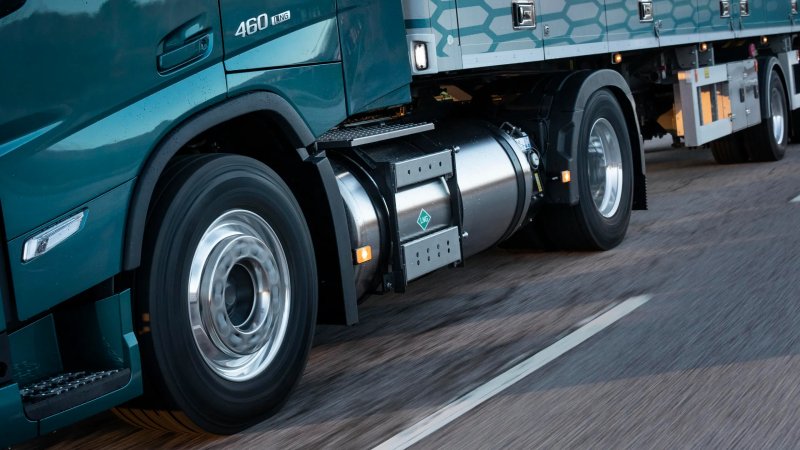







The geopolitical uncertainties affecting global energy markets do not appear to be changing the strategy of German haulier Reinert Logistic, which continues to back natural gas for its heavy vehicle fleet. This was confirmed by the order placed with Volvo Trucks at IAA 2026 for 500 FH Aero tractor units powered by liquefied natural gas, the largest order the Swedish manufacturer has received so far for this technology. The decision was influenced by the positive experience gained from the daily operation of an initial fleet of 50 Volvo gas-powered vehicles, as well as fuel prices. “We realised early on that bio-LNG was the right solution for us,” explained René Reinert, founder and owner of the company, during the contract signing. “Being able to run our vehicles on a locally produced fuel made from manure, organic waste or biogenic residues is simply excellent. Our experience in day-to-day operations has strengthened our determination to continue consistently along this path, also because Volvo Trucks has an excellent service network for gas-powered vehicles.”
Reinert Logistic is based in Mulkwitz, part of the municipality of Schleife in Saxony, where it has operated in third-party road haulage and logistics for more than 30 years. Its activities include general freight transport with curtain-sided semi-trailers, silo transport, crane transport, contract logistics, vehicle advertising and the digital management of journeys, communications and data. The company has sites in Cottbus, where its administration is based, Lübbenau, Velten, Bremen, Leipzig, Spremberg/Schwarze Pumpe and Olszyna in Poland. Its fleet renewal policy provides for vehicles no more than four years old. Gas has been part of Reinert’s strategy for several years. In January 2021, the company said that since December 2020 it had been operating more LNG vehicles than diesel trucks, while in 2022 it ordered electric tractor units for the eHaul project. Its first electric truck entered service in April 2023 and in November of the same year it introduced a battery-swapping system. Since March 2021, it has also taken part in the Lusatia hydrogen cooperation initiative, promoted with Leag and Cottbusverkehr as part of the Cottbus-area mobility project.
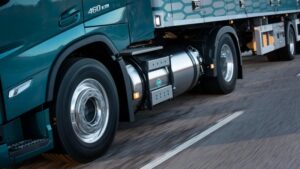
Volvo Trucks has so far delivered more than 10,000 gas-powered vehicles worldwide. The engines are available across the Volvo FM, FH and FH Aero heavy-truck ranges and can run on conventional LNG or bio-LNG. According to the Swedish manufacturer, 2025 was its best-ever sales year for this powertrain and 2026 is expected to be even stronger, helped by fuel availability and cost. Jan Hjelmgren, head of product management at Volvo Trucks, says demand is increasing: in his view, gas engine technology is a benchmark solution in terms of power, torque, engine response and fuel efficiency, while Reinert’s order shows that more sustainable transport can already offer a highly cost-effective alternative. Volvo’s gas-powered trucks can travel up to 1,000 kilometres on a single tank, a range the manufacturer says is suitable for long-haul transport, regional distribution and construction operations.
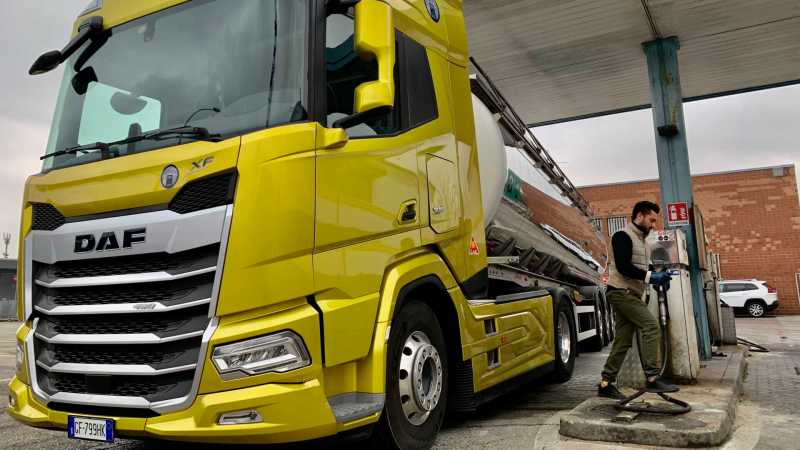
Volvo Trucks says that gas refuelling networks are already well developed in several countries and the availability of bio-LNG is growing rapidly. In Germany, Norway, Finland and Sweden, many gas filling stations already offer the fuel. In 2025, bio-LNG accounted for around 98.5% of the fuel sold at German LNG filling stations, according to data from the German gas and hydrogen association. Volvo says that, for many operators, this can result in CO2 emissions reductions of up to 100% on a well-to-wheel basis, while in markets where tax incentives and public support for renewable fuels are available, bio-LNG can also become a highly cost-effective solution.
P.R.