






- The Kaub gauge, a crucial point on the Middle Rhine, stood at around 104-107 centimetres on 20 June 2026, well below the historical average of about 224 centimetres recorded in 2000-2010, with Bafg forecasts pointing to a further fall in the following days.
- The heatwave affecting western Europe since 20 May, with temperatures up to 10-15 degrees above seasonal averages, follows one of the three warmest springs ever recorded in Switzerland since 1864, worsening evaporation and river low-water conditions.
- Industrial sectors such as chemicals, steel and energy are activating “precautionary mode” protocols: low-draught vessels, higher sailing frequencies and the build-up of precautionary stocks, ahead of a possible worsening in July and August.
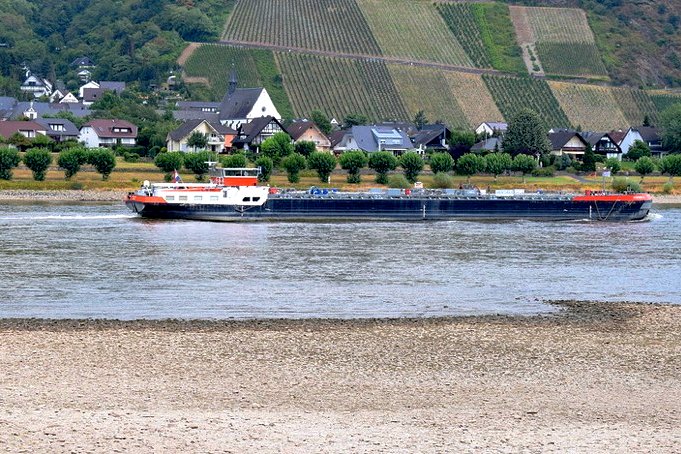
At the end of June 2026, the Rhine is experiencing an early low-water phase, with levels falling in both Germany and Switzerland. Commercial navigation has not yet come to a halt, but the ongoing heatwave and limited rainfall forecast until early July are raising concerns about further deterioration in the coming weeks. The most alarming figure comes from the Kaub gauge, the station that the Zentralkommission für die Rheinschifffahrt (Central Commission for the Navigation of the Rhine) considers decisive for navigation on the Middle Rhine. This is where the shallowest stretch of the river is concentrated, and it must be crossed by freight vessels travelling from North Sea ports towards Germany’s industrial south-west. On 20 June, according to the hydrological service of the Land of Rhineland-Palatinate, the level at Kaub stood between 104 and 107 centimetres, compared with a historical 2000-2010 average of about 224 centimetres, while forecasts from the Bundesanstalt für Gewässerkunde (German Federal Institute of Hydrology), updated on 23 June, indicate a further downward trend in the coming days.
The causes date back to previous months. Spring 2026 was among the three warmest ever recorded in Switzerland since 1864, with an average anomaly of about 1.5 degrees and below-normal rainfall between March and May. Since 20 May, western Europe has been under persistent high pressure, with temperatures up to 10-15 degrees above seasonal averages between late May and June: conditions that increase evaporation and accelerate river low-water levels.
Upstream, on the Swiss section, the situation remains less critical. On 23 June, the Basel Hafenpegel port gauge stood at 464 centimetres and the Basel-Rheinhalle measuring point at 521 centimetres: values below spring averages but still sufficient for normal port operations. More significant is the water temperature figure, which at Rheinfelden was around 23.4 degrees on the same date, indicating marked warming of the Upper Rhine, with possible consequences for fish fauna and industrial cooling uses. In any case, as of 23 June, no formal navigation restrictions were in force in Basel.
The effects on freight transport are already being measured in terms of load capacity. A large container barge travels fully loaded only with levels of around 250-260 centimetres at Kaub; at 135 centimetres, capacity already falls to 50%, and at 75 centimetres to 25%. Below 40 centimetres, freight navigation becomes effectively impracticable, except for vessels designed for minimum draughts. With the current range of 104-107 centimetres, inland shipping companies are loading less per vessel, increasing frequencies and unit costs, but without a generalised traffic shutdown.
The Rhine chemicals industry is structurally dependent on the river for the transport of liquid and solid raw materials and intermediate products, and is among the sectors most exposed to prolonged low-water episodes, according to the Zentralkommission für die Rheinschifffahrt (Central Commission for the Navigation of the Rhine). In 2018, BASF put its losses at about €200 million due to logistics disruptions, lower plant utilisation and additional costs for alternative transport. Covestro applies well-established protocols: additional low-draught vessels, increased frequencies, preventive stocks of raw materials and faster clearance of finished products to free up storage capacity. For now, these plans remain activated in “precautionary mode”, with slightly higher stocks at tank farms and some sensitive consignments shifted to rail.
Steelmaking and energy are also seeing the first consequences. Thyssenkrupp Steel reduces barge loads when Rhine levels fall, offsetting this with more trips to secure an estimated daily requirement of around 60,000 tonnes of ore and coal. Production is being maintained, but with greater operational complexity and higher logistics spending. The same applies to coal transport for power stations and petroleum products: every reduction in capacity on the Rhine forces greater reliance on rail and road, at per-tonne costs far above those of inland waterways.
Studies of the 2018 case quantify the potential macroeconomic impact. A full month of low water can cut growth in barge transport volumes by more than 20 percentage points compared with a normal month, with German industrial production falling by up to about 1.5-1.7% at the peak of the event. IfW Kiel (Kiel Institute for the World Economy), RWI (Leibniz Institute for Economic Research) and Commerzbank broadly agree that any period in which the Kaub gauge remains below 78 centimetres for more than 30 days can reduce German industrial production by about one percentage point, a threshold operators fear could be approached if summer 2026 mirrors the worst years.
German regional chambers of commerce, including IHK Rhein-Neckar (Rhein-Neckar Chamber of Industry and Commerce), are advising companies to diversify carriers, secure reserve rail contracts and invest in warehouses dedicated to managing flows during crises. More structural solutions are also under discussion: river vessels designed for low water, selective infrastructure works on the waterway and strengthened intermodal terminals to absorb rapid modal shifts when the Rhine falls below certain thresholds.
German and Swiss operators are now focusing on prevention: adjusting production plans, plant maintenance schedules and transport modal mixes to avoid a sudden shock like that of 2018. The underlying issue highlighted by economists and industry associations remains unchanged: low water on the Rhine has become a recurring risk, no longer an exception, and must be integrated into the logistics and financial planning of companies operating along the Rhine-Alpine corridor.
Antonio Illariuzzi