




Can hydrogen represent an alternative to diesel-powered engines in rail transport? For now, it still seems to be in an experimental phase, despite the technological push for hydrogen that began several years ago and remains an open and debated issue. One of the earliest applications dates back to 2009, when a powerful shunting and freight locomotive, typical of American railways, the GG20B Green Goat produced by Railpower Technologies, became an experimental platform for the use of hydrogen fuel cells. The diesel generator was removed, and in its place, a hydrogen fuel cell power unit was installed. The hydrogen was stored in a group of tanks housed in a ventilated enclosure on top of the locomotive's long bonnet, above the batteries.
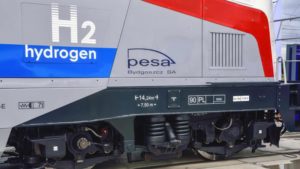
In the intervening years, this technology has not seen significant commercial development. In fact, in the freight traction sector, one of the latest proposals came in 2023 from Poland's Pesa, with a shunting locomotive equipped with 175 kg hydrogen tanks, two 85 kW fuel cells, an energy storage battery, and four traction motors.
The most significant advances for hydrogen-powered traction have been made with lightweight passenger trains. However, the initial optimism now faces a phase of reassessment due to technical challenges or poor reliability of the equipment. In late November 2024, the decision in Germany by the Rhine-Main Transport Authority to withdraw 18 hydrogen multiple units from service starting in 2025 reflects this. The Alstom Coradia trains entered service on the non-electrified network in Hesse in 2022 and within less than two years exposed repeated technical problems with the fuel cells, leading the railway operator to reconsider: the light passenger trains will be replaced by next-generation diesel-powered trains, still reliant on classic diesel traction.
Similar technical problems have been reported on other German lines, such as those on Lower Saxony's regional network, where half of the hydrogen units were withdrawn due to fuel cell failures and a lack of spare parts. Meanwhile, Alstom has committed to developing a completely new generation of fuel cells, expected to be available by the end of 2025 at the earliest; however, it is evident that we are still at the stage of field trials.
In contrast to the German experience, a cautious optimism emerges from recent trials in Spain and Portugal, promoted by the Fch2Rail consortium within an EU-funded project. A bimodal demonstrator train developed by several companies, including rolling stock manufacturer CAF and Toyota for its automotive expertise, covered 10,000 km in just over a month of trials. The assessment is positive, though somewhat inconclusive concerning the overall reliability required not just for testing but for regular operation over many years.
And in Italy? The most advanced project concerns the Brescia-Edolo railway, which is to be entirely converted to hydrogen, though criticism has emerged, particularly concerning the energy source, which will be methane and therefore does not meet the decarbonisation targets set by Europe. Furthermore, there is the issue of costs, justified only partially by an investment driven by strong innovative impetus.
The 14 trains planned will cost over €180 million, effectively double what would be spent on an equivalent electric train. In addition, there is the investment in production stations to consider. The hydrogen path for railways appears challenging, but in the end, the most promising prospect remains that first identified by the Americans for shunting locomotives and short-haul freight services, where investments and production can be optimised.
Piermario Curti Sacchi