








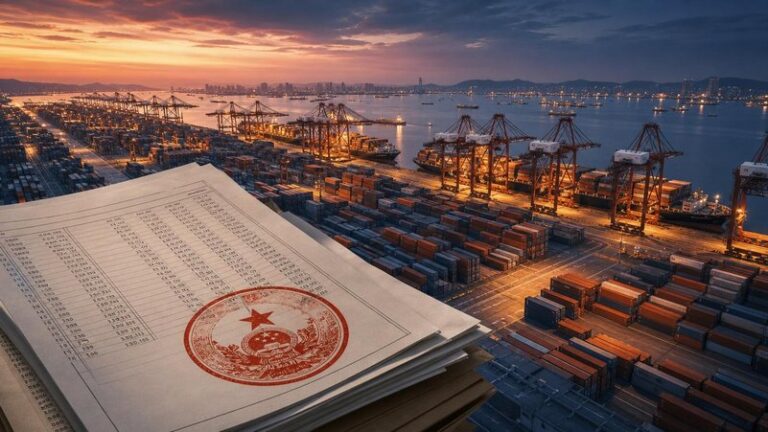
China’s Ministry of Transport has imposed sanctions on nine international shipping companies and seven domestic NVOCC operators for breaches of the rules on mandatory freight rate filing. The carriers affected by the measure are MSC, CMA CGM, Hapag-Lloyd, ONE, Evergreen, Wan Hai, SM Line, Emirates Shipping and TS Lines. The inspections that led to the sanctions were carried out between August and November 2025 at the ports of Guangzhou, Qingdao and Ningbo, three of the main hubs on China’s eastern seaboard.
The alleged breaches fall into two distinct categories. The first concerns failure to submit freight rate filing procedures. The second, regarded as more serious in substantive terms, concerns the gap between the freight rates actually charged to customers and those formally reported to the ministry. In addition to the fines, the Ministry of Transport summoned representatives of the companies involved for talks officially described as "serious", during which it called for improvements to internal filing systems, a clear allocation of responsibilities across corporate functions and substantive compliance with rate declaration obligations. The ministry described the action as a warning to the entire sector and said it would step up future inspections on compliance with filing rules.
The episode is not an isolated one. China’s Ministry of Transport has carried out similar campaigns in the past, repeatedly targeting leading liner operators active on routes to and from China. One documented precedent dates back to 2016, when the ministry imposed penalties on 14-17 liner companies for failing to file rates or for failing to comply with the levels declared, with total fines in the region of 2-2.4 million renminbi, about €300,000 at the exchange rate at the time. During that period, internal communications from some operators had already indicated that failure to comply with filing rules could lead to penalties ranging from 20,000 to 100,000 renminbi for each breach. Chinese authorities have conducted raids and inspections on several occasions at the Shanghai offices of major carriers, with the aim of checking the structure of surcharges and freight rates as part of efforts to combat opaque pricing practices.
The regulatory framework within which the Ministry of Transport operates was strengthened in 2025. Amendments approved by the Chinese State Council to the rules on international maritime transport reaffirmed the obligation on agencies, terminals and trading platforms to provide complete information to the authorities, introducing specific penalties of between 20,000 and 100,000 renminbi for non-compliance. The new provisions also clarify China’s power to adopt countermeasures against countries or regions that impose discriminatory restrictions on its maritime operators, including the possibility of introducing special tariffs or limits on port access. This is a tool that significantly broadens the ministry’s scope for action, turning freight rate filing from a bureaucratic requirement into a lever of trade policy and freight market governance.
For global carriers, the measure introduces a structural compliance risk that goes beyond China alone. In a context in which the US Federal Maritime Commission has also increased its use of enforcement powers on pricing practices, with fines running into hundreds of thousands of dollars for breaches of shipping fee rules, and in which European authorities are scrutinising the conduct of major liner alliances more closely, leading carriers have to manage regulatory compliance across several jurisdictions at the same time. Process errors or a lack of alignment between internal pricing systems and the rates filed with authorities can generate overlapping penalties that are difficult to contain.
China’s measure comes in a market context already marked by tensions between published and actual freight rates. Specialist industry sources have reported the existence of parallel markets on China-Europe routes, where the terms actually offered to shippers differ significantly from benchmark indices, particularly during periods of overcapacity when carriers tend to grant selective discounts to fill vessel space. It is precisely this type of discrepancy that China’s Ministry of Transport intends to make harder to apply, or at least more costly in terms of penalties.
In the short term, carriers are likely to become more cautious in discount policies and offers reserved for Chinese customers, with closer alignment between actual conditions and filed rates. Carriers will need to strengthen internal coordination between commercial teams, trade management, and legal and compliance functions, preventing competitive pressure on individual routes from producing rate deviations that are difficult to justify during inspections. The history of interventions by China’s Ministry of Transport suggests that the current phase is not an anomaly, but part of an established regulatory strategy, which the new 2025 framework has made more robust and harder to ignore.
Mara Gambetta