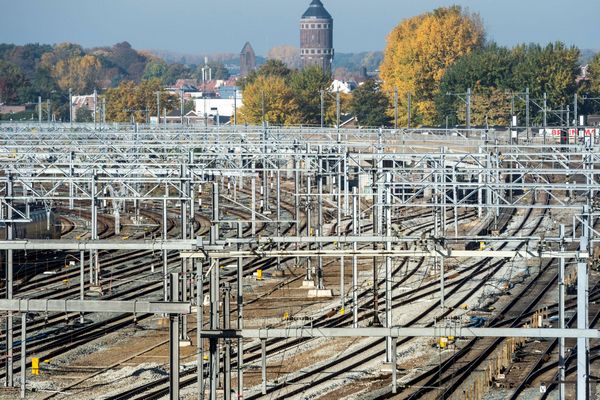




In the early hours of 15 September 2026, dozens of metal pipes and cables were found attached to the rails at at least 35 locations across the Dutch rail network, causing widespread disruption to services between the centre and east of the country. The tampering was discovered by technicians from ProRail, the company that manages the infrastructure, which described it as deliberate sabotage, although the motive remains unknown and no organisation has so far claimed responsibility. The saboteurs used a system that was as simple as it was effective: track circuits, designed to interpret any anomaly as the presence of a train, registered the tampered sections as occupied, automatically triggering red signals along the entire route as a safety measure. In some cases, police sources cited by broadcaster NOS said, the pipes had not simply been placed on the tracks but welded to the rails, a detail investigators regard as evidence of technical preparation rather than an improvised operation.
The worst-affected lines were Amersfoort-Zwolle, Utrecht-Arnhem, Arnhem-Zutphen and Zwolle-Leeuwarden, with knock-on effects at the Zwolle, Deventer and Amersfoort hubs. Police inspections were also reported in Deventer, Veenendaal, Brummen, Barneveld, Twello, Lunteren and Putten. At Steenwijk, in Overijssel, a passenger train struck one of the objects without causing any injuries, an outcome ProRail attributed partly to the train's reduced speed on that section.
For freight transport, the most significant point is that the Betuweroute, the dedicated freight corridor linking the port of Rotterdam with the German border, was not among the affected sections. Disruption to the mixed-use network, where passenger and freight services share much of the infrastructure and many hubs, nevertheless caused indirect delays to alternative routings and staff management, affecting the punctuality of intermodal supply chains connected to terminals in the centre and east of the country.
No further tampering was reported on the main network after 13:00, and on the evening of 15 September ProRail announced the near-complete resumption of services, although residual delays remained on at least two lines. A further incident occurred at around 21:30 near Teuge, on the Apeldoorn-Deventer line, where another pipe was found attached to the track. A few hours earlier, a metal bar had been removed from the Holten-Rijssen section, an incident investigators have not ruled out as being part of the same series of actions.
The investigation took a new turn in the following hours: according to public broadcaster NOS, investigators were paying particular attention to the possible involvement of radical farmers' groups, not necessarily linked to the sector's official organisations. In the days before 15 September, direct action against the railway was reportedly discussed in local farming circles to coincide with Prinsjesdag, the opening day of the parliamentary year, while a photograph showing bars attached to railway tracks circulated among some groups, although it was not possible to establish who had taken it. Initial reports also raised a theory put forward by freight transport association RailGood of a possible link to military installations in the affected area, but this interpretation was not supported by statements from the police, public prosecutors or intelligence services.
The two main farming organisations, Agractie and Farmers Defence Force, denied any direct involvement, although the latter acknowledged that individual farmers may have planned "solo actions" to coincide with the day. Lto Nederland, the agricultural confederation, took a firmer position, saying a line had been crossed: "sabotage has nothing to do with the right to protest", a spokesperson for the organisation said. On the same day, in incidents currently being treated as separate, groups of farmers set fire to hay, tyres and pallets along the A2, A7 and A28 motorways as part of protests against the government's nitrogen emissions policy. Near Breukelen, police arrested seven people on suspicion of endangering road safety. No direct link has been established between these incidents and the railway sabotage and, according to investigators, this remains one of the possibilities under consideration. Meanwhile, ProRail has announced increased inspections along the most exposed sections and additional video surveillance at locations already targeted.
Antonio Illariuzzi