




- From 1 July, EU Regulation 2026/382 replaces the customs exemption for parcels worth less than €150 with a €3 duty applied to each declared tariff item. The measure is transitional until 1 July 2028. In Italy, a national €2 contribution is expected to be added from 1 October.
- In the first month, small parcels transiting through Liège airport fell by 41% compared with the previous month, but total tonnage at the airport rose by 4% thanks to pharmaceuticals and equipment for data centres. Malpensa, by contrast, lost 8.5% in the month and 6.2% in the first seven months.
- All-cargo aircraft capacity between China and Europe fell in July to 28% below June levels, with Madrid down 78% and Budapest down 58%. Meanwhile, e-commerce is moving inventories into European warehouses, through programmes launched even before the duty: Shein in Wrocław, Cainiao in Rokitno, and Temu moving towards 80% of orders fulfilled from within the Union.
In 2025, 5.9 billion parcels worth less than €150 entered the European Union, more than 90% of them shipped from China. For years, this was a flow built on a customs advantage that has no longer existed since 1 July 2026, because of the three-euro duty per tariff item imposed by the European Union on non-EU parcels. One month after the measure came into force, an initial provisional picture can be drawn: European imports of e-commerce products fell by 24% between June and July, national customs authorities are reporting double-digit declines in declarations, and the air cargo capacity built around that traffic has been withdrawn from Eurasian routes. The impact, however, is not the same for all European airports.
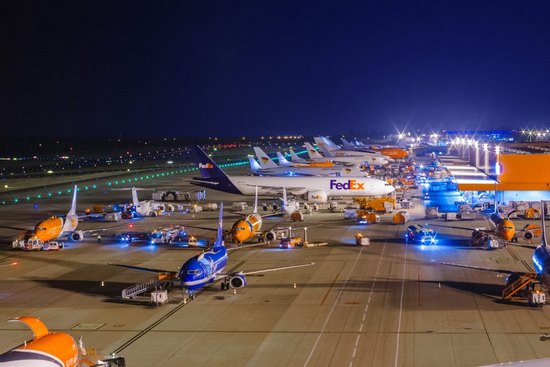
Liège is the case that best illustrates this difference, partly because it is one of Europe’s main airports for e-commerce. In July, the Belgian airport recorded a 41% fall in small-parcel traffic compared with the previous month and a 24% decline compared with July 2025, while customs declarations fell by 52% and 67% respectively. In the same month, however, total tonnage rose by 4% year on year, despite a 4% fall in aircraft movements. The number of consignments therefore fell, but tonnage did not. Another figure shows the weight of small parcels in the Belgian airport’s activity: also in July, Belgian Customs collected about €42.5 million, while national declarations fell by 35%, equivalent to 1.26 million fewer small parcels, and at Liège airport consignments worth more than €150 rose by 10%, suggesting a shift towards higher-value goods, although this did not offset the loss of volumes below the threshold.
Another airport that had focused on trade with Asia is Budapest, for which an analysis by the Polish think-tank Osw, published in February 2026, reconstructs the structure of traffic: about 300,000 tonnes in 2024, 49% more than in 2023, with 70% of goods arriving and more than 40% of inbound cargo and mail coming from China. Shipments below €150 accounted for about 40% of inbound goods, and roughly 90% of these were destined for other European countries. In 2024, the Hungarian customs administration cleared 136 million low-value parcels, generating more than 40 billion forints in VAT, about €104 million, and since 2018 the airport has invested around €80 million in cargo infrastructure, taking Cargo City capacity to 420,000 tonnes a year. The facility hosts Cainiao’s European hub, the logistics operator of e-commerce giant Alibaba. According to Rotate data, in July 2026 bellyhold and freighter capacity on all-cargo aircraft arriving at the Hungarian airport from China fell by 58% compared with the previous month. Another airport hit hard was Madrid, with a fall of as much as 78%, while on the Chinese side the steepest decline affected Ürümqi, down 72%, followed by Hong Kong, down 28%.
The July figures need to be added to those for June, which were also sharply down compared with the previous month, because the market had anticipated the EU deadline. Aevean calculations show that as early as the sixth month of the year, all-cargo aircraft capacity between Asia-Pacific, the Middle East and Europe had fallen by 14%, equivalent to around 18 fewer widebody flights a day. The reduction, however, was unevenly spread across airports: Budapest was down 46%, Malpensa 24%, Liège 16% and Schiphol 12%.
Italy is in a specific position, because a significant share of small non-European parcels had shifted abroad well before the introduction of the European duty, owing to the two-euro tax imposed by the 2026 Budget Law, again on shipments worth less than €150. Protests by logistics operators led to its application being suspended, first postponed from 15 March to 1 July and then to 1 October 2026. But the announcement of the tax alone penalised national airports, especially those in Lombardy. In July, Malpensa suffered an 8.5% fall in tonnage, compared with an average national decline of 1%. Dario Nanna, head of commercial aviation at Orio al Serio airport, quantified the reduction in cargo movements linked to e-commerce at 40% and observed that without the government’s postponement of the two-euro contribution, the impact on Italy would have been even greater. The Bergamo airport is growing overall while at the same time losing a significant share of the small-parcel segment, in a pattern similar to that seen in Liège.
The European duty is modest in scale, but it is having serious consequences not only for air transport, but also for e-commerce logistics, whose reorganisation began before its introduction and is now accelerating. In December 2025, Shein opened its European logistics hub in Wrocław, Poland, which may expand to as much as 740,000 square metres, while Temu aims to fulfil up to 80% of European orders from warehouses located in the Union, with availability already activated in Germany, France, Spain, the Netherlands, Italy and Austria. Cainiao (Alibaba’s logistics arm) launched its third logistics platform in Poland, at Rokitno, in January 2025, reaching a total surface area of 600,000 square metres within the Union. None of these Chinese companies has explicitly linked these investments to the EU duty, and some localisation programmes predate the reform, but the new levy increases their economic appeal and will encourage the import of large quantities before small shipments are created inside the Union.
For airports, the shift from millions of small shipments to consolidated consignments changes the nature of the work even before it changes the quantity of goods handled. Simplified declarations, single-parcel handling and the saturation of dedicated flights are decreasing, while the importance of documentary checks on imported batches, demand for warehouse space and intra-European road connections is increasing, because goods released for free circulation in one member state can reach the others without further customs formalities. This mechanism is turning an administrative issue into a competition between airports, logistics platforms and road corridors. Or, as Liège is already doing, it is changing specialisation. The Belgian airport’s management already attributes the resilience of volumes to growth in pharmaceuticals, equipment for data centres and cut flowers, while continuing to expand temperature-controlled warehouses. But not all airports will be able to evolve so quickly.
M.L.