






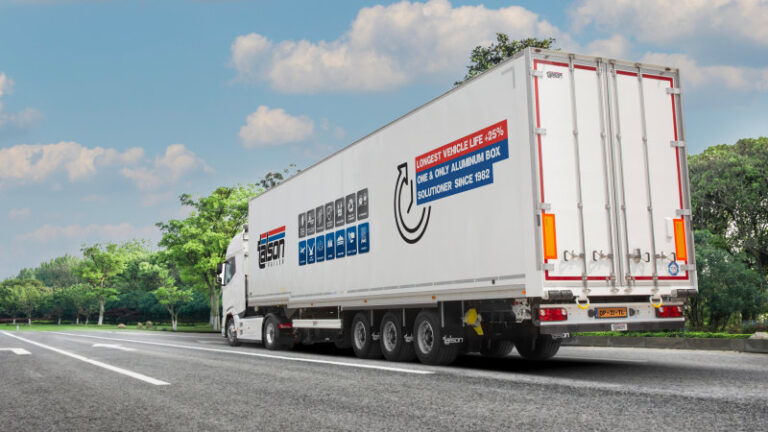
Talson will bring its range of aluminium swap bodies and semitrailers for high-value goods to IAA Transportation 2026 in Hanover. The presentation line, summed up by the slogan "Time Passes. Value Lasts", shifts the focus from tare weight reduction to the vehicle’s operational durability and the value it retains at the end of its service life. Talson AI, an artificial intelligence assistant for drivers and workshops, will also make its debut.
The Dutch manufacturer, active in aluminium superstructures since 1982 and specialised in equipment for air cargo road transport, builds its bodies with an aeronautical-derived self-supporting sandwich structure: the external aluminium sheets are riveted onto a substructure using an internally developed process, while the internal wall lining can be fitted with panels equipped with the Talfix system. The materials resist corrosion and do not require painting, eliminating one of the main causes of aesthetic and functional deterioration in box semitrailers over the medium term. On durability, Talson says one of its vehicles can remain in service for an average of 15 years, with a useful life at least 25% longer than conventional box semitrailers, while retaining up to twice the residual value. The same company sources put the reduction in ownership costs during the middle phase of the vehicle’s life at up to 74%.
The load securing system is the second technical element on which the Hanover presentation will focus. Talfix provides thousands of securing points distributed across the walls and 26 recessed rings in the floor, with a grid that allows the same vehicle to be quickly reconfigured for different types of cargo: electronic products, luxury goods, hanging garments, event materials and air cargo units. The same structure allows double-deck configurations, increasing volume utilisation. For transport operations more exposed to theft risk, Talson offers the Secure version, developed in line with Tapa requirements and introduced in 2018. It has a reinforced body that can integrate locking, alarm, vehicle location and tracking systems.
The modular construction has a positive impact on routine and extraordinary maintenance times. As the side panels can be replaced individually and there is no paint cycle to restore, repairs are limited to the damaged element. As a result, the manufacturer reports a reduction in intervention times of up to 75%, with a corresponding decrease in vehicle downtime. In air cargo road transport, where Talson has built its European position, the bodies reach 100 cubic metres in volume and can accommodate up to four ULD loading units. The shaped Concorde roof and integrated rollerbeds are designed for handling units at airport terminals.
Talson AI, a candidate in the "Future" category at the International Trailer Awards, is based on natural-language interaction through an artificial intelligence system. It enables drivers and fleet managers to query the system to retrieve manuals, operating procedures, technical documentation and aftersales assistance guidance, with the aim of shortening the diagnostic phase in the event of a fault. Founded in 1982, Talson entered the orbit of Türkiye’s Tirsan in 2003. Tirsan had acquired the Kässbohrer brand the previous year and later bought fellow Turkish company Van Eck in 2019. Vehicle production is split between the Dutch plant in Venlo and the group’s two German facilities in Goch and Ulm.
Massimiliano Barberis