








In Spain they are known as surferos, or surfers, because they are able to rob a lorry while it is moving by jumping onto the target vehicle from another vehicle. On 18 June 2026, the Guardia Civil dismantled one of these gangs, which had an international component and operated on Spanish motorways, arresting ten people and recovering stolen goods worth €481,000. The Juzgado de Primera Instancia (Court of First Instance) number 2 of Orihuela, in the province of Alicante, then ordered pre-trial detention in prison for all of them.
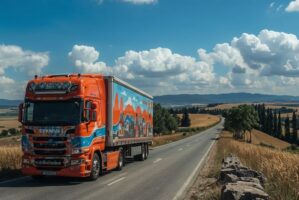
The gang followed a precise and coordinated sequence. Two high-powered vehicles slowed traffic to isolate the target vehicle, while a third vehicle, a specially modified lorry, approached from behind, taking advantage of a change in gradient or a similar road situation. The modification allowed one of the attackers to leave the cab and reach the rear of the targeted vehicle, where he forced the locks with an angle grinder or similar tools, selected the goods and threw them to the support vehicle. Investigators say this method enabled drivers to discover the theft only when they arrived at their destination, making real-time detection virtually impossible.
Investigators describe a highly specialised organisation able to operate for long periods thanks to several countermeasures: its members did not stay in the same country for more than two weeks, constantly changed routes and vehicles, and stayed in homes rented using false documents. It was this international mobility, combined with a stable logistics network in several European Union countries, that allowed the group to operate on a continental scale before the coordinated intervention by Guardia Civil, Europol and the Romanian authorities, El Debate reported. The thieves carried out raids in five provinces - Cáceres, Cuenca, Huesca, Toledo and Murcia - while the group’s logistics base was in a rented property in Cox, in the province of Alicante. The organisation also had a stable infrastructure in several European Union states, including France, the United Kingdom, Italy and Germany.
The group is accused of 11 thefts using deception committed between February and May 2026, with the total haul estimated at €481,000. According to investigators, the largest theft involved an industrial vehicle loaded with tobacco on the AP-36 motorway near Quintanar de la Orden, in the province of Toledo: the goods stolen on that occasion were worth €400,000. A second incident, which took place on the night of 17 June on a vehicle travelling on the A-7 towards Madrid, led to the theft of 16 plasma televisions worth €12,800. The goods were later recovered and returned to the owner, Cadena Ser reported.
The investigation was led by the Ceres investigative group of the Comandancia della Guardia Civil of Toledo, with coordination involving the Romanian Ministry of Internal Affairs, Europol, the Grupo de Reserva y Seguridad number 3 of Valencia and the Technical Judicial Police Unit of the Guardia Civil. All those arrested have previous convictions for offences against property, and in some cases also against individuals, while one was already subject to an international search warrant issued by the Romanian and Austrian authorities. The breakthrough came on 13 June 2026, when the Guardia Civil identified the arrival in Spain of several members of the group, who had moved into the house in Cox. After the theft of the televisions on the night of 17 June, officers searched the property the following day, arresting all ten members of the organisation. The public disclosure of the results of the operation, and the related media coverage in Spain, came only on 4 and 5 July. During the search of the Cox property, officers seized a van and a lorry modified to facilitate the attacks, radio communication systems, number plates from several countries and specialised burglary tools.
P.R.