








- According to the World Bank’s Container Port Performance Index 2025 (CPPI), average global port performance declined slightly compared with the previous year, as vessel dwell times increased amid recurring external shocks. Upper-middle-income economies continue to outperform high-income economies, supported by exports and infrastructure investment.
- The report identifies “burst congestion” as the main operational stress factor of 2025: fleets forced to divert because of the Red Sea crisis are concentrating on alternative ports in sudden waves, wiping out the ability to plan berth, labour and yard capacity.
- The Chinese port of Fuzhou leads the efficiency ranking ahead of Dalian, Salalah, Mawan and Chiwan. Among the strongest recoveries over the past year, Durban stands out with a 479-point jump in 12 months, while Los Angeles recorded an 81-point improvement, confirming its return to normal operations.
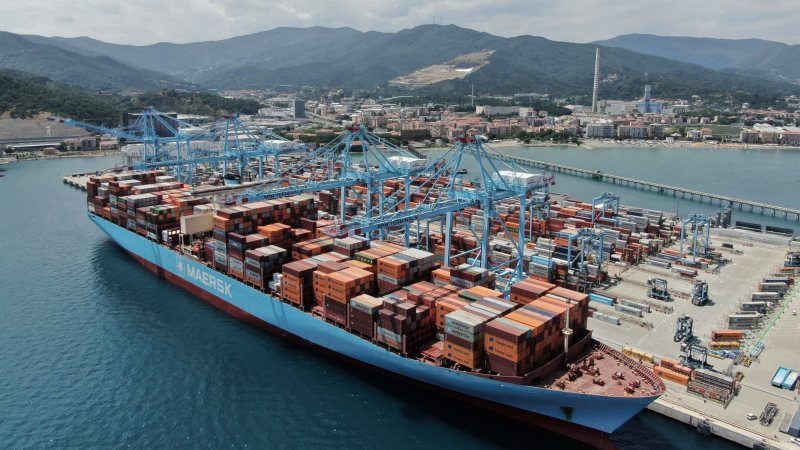
On 11 June 2026, the World Bank released the Container Port Performance Index 2025 (CPPI), the annual index used to assess vessel turnaround times at container terminals worldwide. The report says average global port performance deteriorated compared with 2024: the aggregate index line fell slightly below zero during the year, signalling that the general increase in vessel dwell times at ports is not a localised issue but a structural one, caused by the build-up of external shocks that continue to destabilise global supply chains.
The report begins its analysis with the two-way relationship between terminal efficiency and international logistics stress. Ports no longer simply absorb disruption generated elsewhere; they now act as transmission nodes. When sailing schedules break down, as has been happening for months on routes avoiding the Suez Canal because of tensions in the Red Sea, vessels concentrate on alternative ports, removing the ability of terminals to plan berth, labour and yard use in advance. The loss of local efficiency then affects the global fleet: every extra hour a vessel spends at anchorage reduces the effective capacity available across the network, pushes up freight rates and spreads delays to subsequent routes.
The phenomenon described by the report as “burst congestion” is the main new feature of the 2025 edition. Unlike structural bottlenecks linked to volume growth, this type of congestion is unpredictable and short-lived: it appears as a sudden peak in arrivals at a port caused by weather events, strikes or route reorganisations imposed by geopolitical crises. According to the CPPI, the resilience of a port is now measured not only by the theoretical peak capacity of its facilities, but by the speed with which it can absorb excess traffic and reduce unproductive time before it spreads across the network.
The report correlates the CPPI trend with the Global Supply Chain Stress Index (GSCSI) and vessel schedule reliability data. The result is that the curves mirror each other: when the share of vessels arriving on time collapses, average delays per vessel rise to five or six days and the global CPPI falls in sync. According to the authors, this correlation confirms that terminal performance is increasingly a variable dependent on the overall quality of the logistics ecosystem in which ports operate.
In terms of regional disparities, the CPPI 2025 data presents a picture that challenges the intuitive assumption that national wealth guarantees stronger port performance. Upper-middle-income economies, particularly those in East and South Asia, are consistently above the average, outperforming both high-income and low-income economies. The report attributes this result to a combination of export orientation, continuous investment in capacity and operational flexibility. By contrast, ports in high-income countries are affected by labour market rigidities and congestion in inland access networks. Sub-Saharan Africa remains the region with the longest dwell times: an economy largely based on imports requires larger storage areas and more complex logistics coordination, in a context where infrastructure remains insufficient.
The absolute ranking of the world’s top 20 ports by efficiency is dominated by Asia. Four of the top five ports are Chinese: Fuzhou takes first place, followed by Dalian, Mawan and Chiwan. Salalah, in Oman, moves up to third place, the only non-Asian port in the top five and a notable case of operational resilience given its geographical position in the area most directly affected by the Red Sea crisis. Between sixth and tenth place, Tanger Med in Morocco remains in sixth and Hamad Port in Qatar in eighth, both steadily growing intercontinental transhipment hubs. Europe appears only in twelfth place, with Algeciras in Spain, confirming the structural difficulties weighing on the continent’s ports.
Another important finding concerns the ports that have delivered the strongest improvements over the five years from 2020 to 2025, a period marked by the pandemic, the post-Covid capacity crisis and geopolitical tensions. The overall lead goes to Port Elizabeth, in South Africa, with an 80-point increase in the index. It is followed by Khalifa Bin Salman Port, in Bahrain, up 75 points, a port that also entered the top 20, ranking nineteenth. In third place is Posorja, in Ecuador, up 70 points, signalling a transformation in the South American port system; it too entered the top 20, in twentieth place. Göteborg, in Sweden, stands out as Europe’s leading performer, up 68 points, while Muhammad Bin Qasim, in Pakistan, completes the top five with a 52-point gain.
The most significant data from the point of view of recent operational dynamics concerns the “top improver” over the 12 months from 2024 to 2025. Durban, in South Africa, ranks first, advancing 479 points in one year: the port moved from queues of more than 20 vessels waiting to near-zero waiting times. The CPPI attributes this result to the award, in December 2025, of a 25-year concession to the private group ICTSI to modernise the terminal: a case the report uses as an example of how an influx of private capital and renewed governance can quickly unlock chronic inefficiencies.
Freeport, in the Bahamas, ranks second, up 221 points, followed by Coega/Ngqura Port, in South Africa, up 165 points. The presence of three South African ports among the top six in the annual ranking, with Port Elizabeth in sixth place at plus 146 points, indicates, according to the report, a coordinated system-wide effort to rehabilitate the country’s entire port network. Cristobal, in Panama, and Manzanillo, in Mexico, complete the top five, up 154 and 152 points respectively.
Among the notable recoveries, the CPPI also highlights Los Angeles, twelfth in the annual ranking with an 81-point gain. After years of operational paralysis linked to the pandemic and queues of vessels anchored offshore, the Californian port has normalised flows, reducing waits at anchorage and restoring fluidity to cargo-handling operations. Djibouti, in eighth place with a 119-point improvement, stands out for improving its performance despite being located in the geographical area most directly exposed to the consequences of the Red Sea crisis, confirming that local management measures can produce significant results even in contexts of strong external pressure.
M.L.