






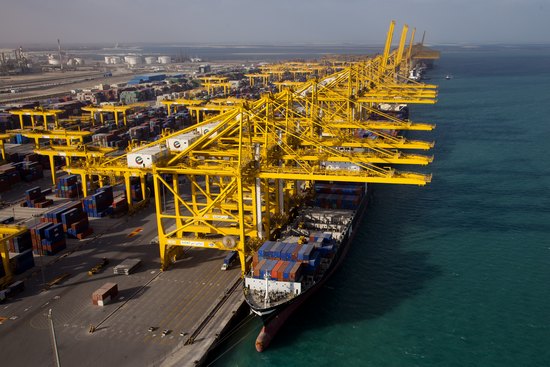
Since the end of February 2026, as container traffic diversions have increased significantly, the Persian Gulf port network has been forced to confront a reality analysts have highlighted for years: the Strait of Hormuz has no effective short-term logistical substitutes. An analysis by Drewry captures the situation clearly: ports that could theoretically serve as bypasses do exist, but they are constrained by inadequate inland infrastructure, prohibitive distances and a lack of active rail connections. The combined nominal capacity of the alternative ports considered — Khor Fakkan, Fujairah, Sohar, Salalah and other Emirati and Omani terminals located outside the strait — exceeds 20 million TEU per year. However, Drewry notes that this figure “narrows significantly” when measured against the reality of inland transport corridors: unfavourable geography, limited road capacity, the absence of rail and high transfer costs substantially reduce the system’s actual absorption capacity.
Among the ports analysed, Khor Fakkan stands out as the only one with strong practical value as a bypass. Located in the United Arab Emirates outside the strait, it has significant container infrastructure and is connected to Dubai by around 80–130 kilometres of motorway. Authorities have introduced emergency customs procedures, the so-called “green corridor”, to enable direct road transfers to Jebel Ali and the free zones of Dubai and Abu Dhabi. Even so, the effective capacity of the road network remains well below the terminal’s theoretical quay capacity.
Fujairah and Sohar also play an important role as alternative gateways, supported by road corridors and dedicated customs links between Oman and the UAE. However, analysis shows that transit times and costs, combined with limited road and rail capacity, reduce the gap between nominal port capacity and “system” capacity. Truck and rail transfers to Jebel Ali and Khalifa have already been activated, but they remain insufficient for the volumes involved.
The most emblematic case is Salalah in Oman, which Drewry describes as a paradox: abundant latent capacity on paper, but limited usefulness as a Gulf bypass. The port lies about 1,000 road miles from Dubai and lacks active rail connections, effectively making it a transhipment hub on east–west routes rather than an alternative gateway for Gulf imports and exports.
The most immediate consequences are being felt at the hubs of Jebel Ali (Dubai) and Khalifa (Abu Dhabi), which handle around 65% of their traffic in transhipment. When ocean-going vessels can no longer reach these hubs via Hormuz, not only does their national gateway function suffer, but connectivity to Kuwait, Qatar, Bahrain and eastern Saudi Arabia is also disrupted. This network is served by a dense system of regional feeder services handling between 1.2 and 1.5 million TEU per year. With the strait closed and bypass capacity reduced, the cargo feeding these services shrinks, leaving feeders operating with constrained space and sharply rising rates.
According to Sea-Intelligence estimates, a prolonged closure of Hormuz could “trap” more than 200,000 TEU of ocean capacity, generating congestion at gateway ports and transhipment hubs outside the region. If containers cannot be discharged in the Gulf, there is a risk they will be held at origin ports — often in China — or at regional hubs such as Singapore and Tanjung Pelepas, creating a cascading congestion effect that would shift towards Asia.
Drewry notes that a closure lasting more than 24 months could act as a catalyst for long-delayed infrastructure investment in the Gulf: the GCC (Gulf Cooperation Council) rail network, dedicated container corridors along the Jeddah–Dammam–Kuwait axis, and the strengthening of hubs outside the strait. However, some projects, such as the new container hub at Duqm in Oman, would require between three and five years to become fully operational — too long to mitigate the current crisis.
In the meantime, volumes bound for the Gulf are being partially rerouted to other transhipment hubs in the Mediterranean, Asia and East Africa. If sustained, this shift risks structurally strengthening already growing alternatives — Levant ports, the eastern Mediterranean and Horn of Africa gateways — at the expense of the Gulf’s central role in global routes. For operators serving the markets of the United Arab Emirates, eastern Saudi Arabia, Qatar, Kuwait and Bahrain, the combination of bottlenecks along bypass routes and reduced hub-feeder connectivity is translating into longer transit times, less reliable schedules, surcharges linked to the strait and inland transfers, and the need to rethink the positioning of regional strategic inventories.
Antonio Illariuzzi