






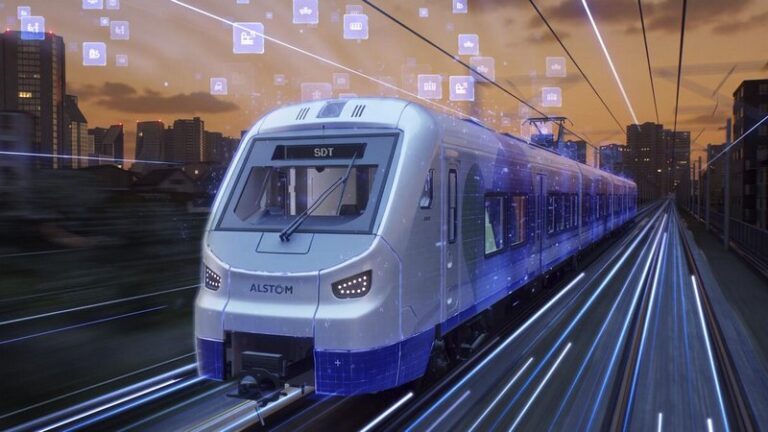
A train entering service today essentially retains the same architecture until it is withdrawn thirty years later: the same software, the same functions and the same limitations fixed on the day it is delivered. This is the paradox Alstom says it wants to overcome with the Software Defined Train (SDT), an architecture presented at InnoTrans 2026 that aims to transform the train from an immutable physical asset into a digital platform capable of evolving throughout its service life. The inspiration – explicitly acknowledged by the company – comes from smartphones and software-defined vehicles: hardware and software, which have different life cycles, are separated instead of designing each subsystem, such as traction, air conditioning, passenger information and maintenance, as a closed unit with its own dedicated electronics. The SDT architecture has three overlapping layers: physical, abstraction and application, with sensors, communication systems and computing power shared across functions rather than duplicated within each subsystem. In practical terms, this means less wiring, fewer relays and less complexity to maintain over time.
The issue is becoming increasingly important because of the pressure facing operators: they need to increase fleet capacity, improve reliability and contain costs throughout the rolling stock life cycle, while passenger expectations and available technologies change far more quickly than the useful life of a train. An architecture designed once and never updated therefore risks becoming technologically obsolete well before it becomes mechanically obsolete.
Alstom is building the SDT system on three foundations that define what the concept actually involves, beyond the simple fact that software has already been used on trains for decades. The first is data-driven design, which breaks down silos between onboard systems, fleets and lineside infrastructure, supporting predictive maintenance and Digital Twin applications, virtual replicas of vehicles used for simulation and diagnostics. The second is digital continuity, connecting onboard systems, infrastructure and the cloud, processing data wherever this can be done most efficiently and enabling over-the-air service updates. The third, evolution, introduces new functions through software updates without requiring fresh homologation, thanks to a service-oriented architecture and built-in segregation mechanisms. It remains to be seen how this promise will fit with the certification timescales typical of the rail industry, which so far have been anything but rapid.
Alstom places applications that already exist within the SDT ecosystem, including remote driving, the HealthHub condition-monitoring platform, Agate Media multimedia content and C-DAS driver advisory systems. Nor is the concept purely theoretical: in January 2026, Deutsche Bahn and Alstom tested the remote driving of suburban trains in a depot environment, providing a practical test bed for capabilities that the SDT architecture is intended to extend more broadly. However, the questions that accompany announcements of this kind remain open, particularly as the concept is being presented by the manufacturer itself without figures on costs, commercial introduction timescales or the specific train models involved. How much of this vision is already ready to be engineered at scale, and how much remains an architectural concept rather than something already deployed? For now, the January trial with Deutsche Bahn remains the most concrete evidence available.
Antonio Illariuzzi