









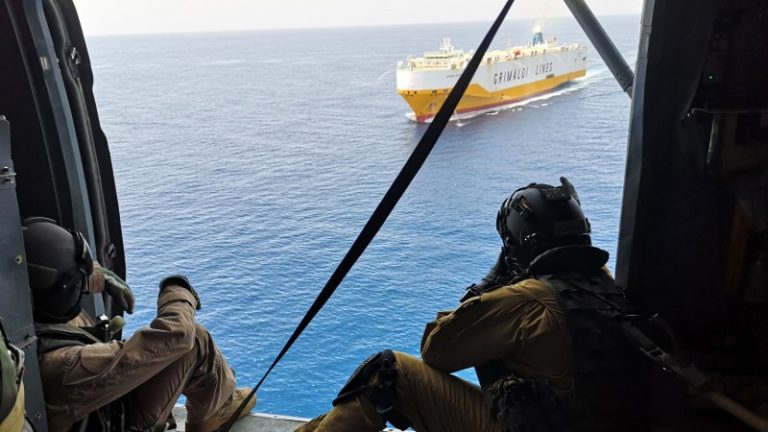
Italy is preparing to use its own military assets to ensure the passage of cargo ships of national interest through the Bab el-Mandeb Strait, following the geographical expansion of the Houthi presence in recent days. The defence minister announced the move on 17 September 2026 while speaking at the Forum Risorsa Mare in La Spezia. In agreement with the Chief of the Defence Staff, the minister asked the Italian Navy to assess the operational and security situation in the Red Sea and draw up a plan for merchant ship transits, without waiting for the European Aspides operation to "determine whether ships can pass or not". However, the proposal remains at the planning stage. "We will probably take action," the minister added, and his comments do not indicate that an order has already been finalised setting out the number and classes of vessels to be deployed or the timeframe, issues that will also have to be considered by the Government and Parliament. The minister said any additional ships would operate "to protect merchant ships", without offensive duties, with the aim of restoring traffic. His remarks therefore do not yet indicate that a full escort operation is planned.
The minister's statement leaves several questions open. It is unclear which ships would fall within the definition of "national interest", whether the criterion would be flag, ownership, chartering or cargo, or whether protection would be provided within Aspides, in coordination with the mission or through an autonomous Italian deployment. The announcement would not imply Italy's withdrawal from the European operation, in which at least one Italian vessel is reportedly already operating: the FREMM frigate Carlo Bergamini is in the area as part of the mission. Aspides is a European Union maritime military operation conducted under the Common Security and Defence Policy, with its operational headquarters in Larissa, Greece. Its mandate is exclusively defensive and covers the Red Sea, the Bab el-Mandeb Strait, the Gulf of Aden, the Arabian Sea and adjacent areas. The mission is not under NATO command, nor is it part of the US-led coalition, and it does not carry out operations against targets in Yemen. Its tasks are to build a maritime surveillance picture along the route, accompany merchant ships through the most exposed sections and protect them against threats from missiles, drones or surface vessels.
The concept of protection does not necessarily involve a naval vessel sailing alongside cargo ships throughout the entire passage. Under Aspides, shipowners report a planned transit, including the vessel's route, timing and characteristics. The command then assesses the level of risk and the availability of naval units in the area and, where conditions allow, a frigate accompanies the merchant ship through the section considered critical before allowing it to continue towards its destination. The European External Action Service (EEAS), the EU's diplomatic service, has reported successful escorts in the first days of September, with ships, crews and cargo reaching their destinations. However, the mission's capacity remains dependent on the vessels provided by Member States, and High Representative Kaja Kallas recently called on EU countries to assign more ships to Aspides to maintain its credibility, particularly in the face of restrictions on traffic through Bab el-Mandeb.
The security situation in the region deteriorated further overnight between 17 and 18 September, when an attack on the Saudi air base at Ta'if, near Mecca, hit an Italian Air Force Eurofighter Typhoon, designated F-2000. The defence minister said no Italian military personnel at the base had been injured and that there had been no further damage to Italian equipment or infrastructure. The extent of the damage to the aircraft has not been disclosed, and no official source has confirmed that it was destroyed. The fighter was deployed at Ta'if as part of Inherent Resolve, the US-led international operation against ISIS in Iraq and Syria. Some sources have attributed the attack to the Houthis, although there has so far been no claim of responsibility and no official Saudi or Italian statement on how the attack was carried out or what weapon was used. Ta'if is in western Saudi Arabia, far from the bases at Khamis Mushait and Abha in the south of the country, which had been targeted by drones and missiles in the preceding days.
There is no evidence linking this incident to the minister's announcement on intervention in the Bab el-Mandeb Strait, so it must be regarded as a coincidence. But even that possibility is not reassuring, because it highlights the risks of friction between the Italian Armed Forces and the Houthis. So far, the Yemeni group has not directly threatened Italian cargo ships, having said that it is restricting navigation only for vessels linked to Saudi Arabia. However, this definition could also include ships calling at a Saudi port and therefore merchant vessels sailing under any flag. In any case, with or without military protection, rising tensions would keep many ships away from the area, not least because of the surge in insurance premiums.
M.L.