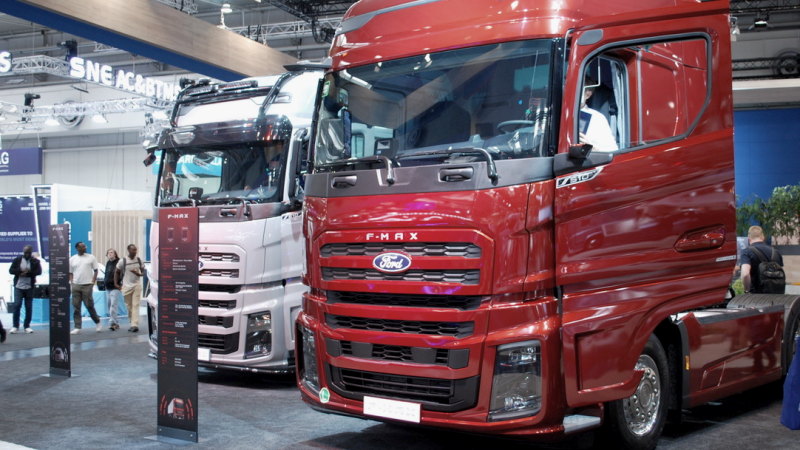




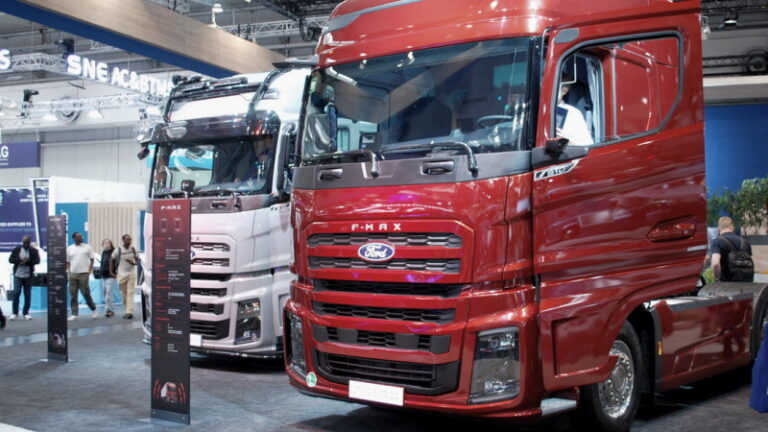
"One Vision for Every Journey" is the message chosen by Ford Trucks for its participation in IAA Transportation 2026 in Hanover. The Turkish manufacturer, part of Ford Otosan, is bringing to Germany a range that reflects the different directions of its development: the evolution of its diesel long-haul tractor with the new F-Max Gen2.0, its heavy-duty offering with the F-Line Construction family and its entry into electric commercial vehicles with the new F-LineE. Connectivity and digital fleet management solutions complete the display.
At the centre of the stand, we saw the F-Max Gen2.0, an evolution of the long-haul tractor that has been Ford Trucks' main calling card in the European long-distance market. It introduces several updates designed to improve overall efficiency and productivity in long-haul transport. A major part of the development concerns the new Ecotorq Gen2, the latest-generation diesel engine developed by Ford Otosan, on which the manufacturer is focusing part of its strategy to reduce fuel consumption and operating costs. The new powertrain is combined with improvements to vehicle aerodynamics and an updated suite of advanced driver assistance systems. The approach therefore focuses on the vehicle as a complete system rather than on the power unit alone, seeking efficiency gains through the combination of the engine, electronic management, aerodynamics and safety technologies.
While the F-Max represents the evolution of Ford Trucks' road transport offering, the F-Line Construction family is aimed at more demanding applications. These models are designed for the construction sector and worksite operations, where trucks need to provide robustness, versatility and the ability to accommodate different body configurations. One of the most interesting new products in Ford Trucks' Hanover line-up is part of the F-Line family: the fully electric F-LineE, which brings battery technology to a segment where electrification must meet demanding requirements in terms of weight, range, workload and vehicle availability. The decision to start with professional and construction applications is noteworthy because it brings electrification to operations where duty cycles can be more easily defined and planned. For Ford Trucks, the energy transition therefore does not mean immediately abandoning conventional powertrains, but progressively introducing different technologies alongside them according to the application.
Another element of the strategy presented in Hanover is connectivity. With the ConnecTruck platform, Ford Trucks uses data generated by its vehicles to provide operators with fleet management tools. Digitalisation therefore becomes an integral part of the offering: vehicle monitoring, usage information, operations management and efficiency monitoring can all be incorporated into day-to-day fleet management. This becomes particularly important with the arrival of electric vehicles, as energy management and mission planning become essential components of operations. Connecting the vehicle with the fleet management system makes it possible to move beyond simply having data available and use it to organise work. The direction outlined in Hanover is therefore one of gradual transition, with diesel, electric technology and digital services coexisting within a strategy designed around different transport missions. The approach aims to develop both products and operational management in parallel, leaving fleets to choose the solution that best meets their practical requirements.
Massimiliano Barberis