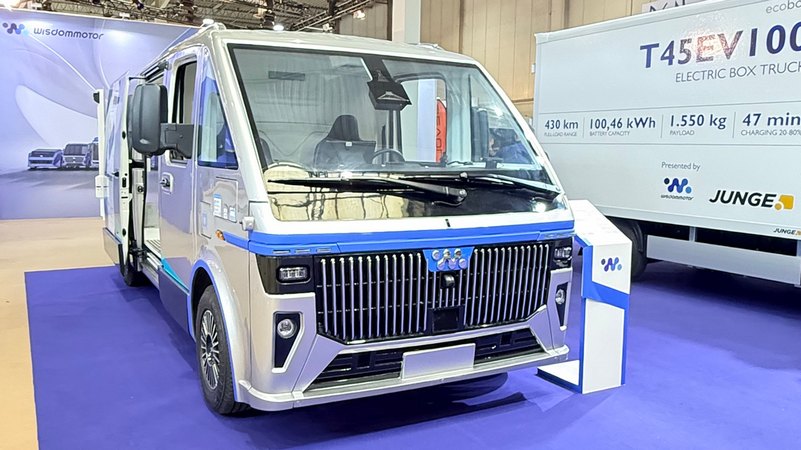






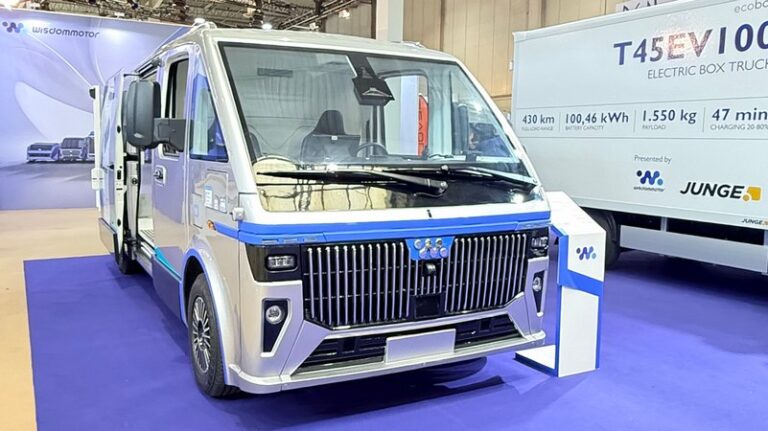
The gradual electrification of distribution is opening the way for new manufacturers and new vehicle architectures, as seen at IAA 2026. Among the many Chinese companies attending the German trade fair was Wisdom Motor, which specialises in the development and production of zero-emission commercial vehicles and has brought to Europe an approach that integrates design, production and customisation, with a particular focus on reducing energy consumption and using sustainable materials. The group says it has production capacity across more than 480,000 square metres of industrial sites and aims to offer an alternative to traditional commercial vehicle supply-chain models, focusing on shorter delivery times, in-house design capabilities and customisation options.
One element that distinguishes its production approach is the manufacture of monocoque structures and the use of composite materials developed in-house, combining low weight, structural rigidity and design flexibility. These characteristics are particularly important for electric vehicles, where vehicle mass directly affects energy consumption and range. The group has already begun expanding internationally in several regions, with deliveries in North America, the United Kingdom, Australia, Denmark, Japan, South Korea, Israel, Singapore and Hong Kong, and plans to extend its presence to the Middle East, Europe, South America and South-East Asia.
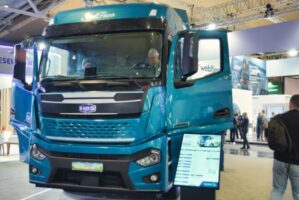
The T45 model displayed at IAA is one of the most interesting examples of Wisdom Motor’s technological approach. At the heart of the project is a carbon-fibre body, a solution designed to reduce weight and therefore the vehicle’s energy requirements. The manufacturer says the structure has a service life of 20 years, while the battery pack is expected to last 15 years. Lower energy consumption does not rely on reduced weight alone, as the T45 also incorporates intelligent energy-management systems and a vehicle-wide thermal-management system designed to improve the operation of the various subsystems and use available energy as efficiently as possible.
In terms of safety, the T45 features a range of driver-assistance systems, including autonomous emergency braking (AEB), lane-departure warning and blind-spot monitoring. These are complemented by passive-safety features such as a collapsible steering column and structures designed to absorb energy in the event of a collision, while also taking into account the protection of vulnerable road users.
Wisdom Motor’s strategy is not limited to battery-electric technology. The company is developing industrial partnerships with several industry operators to accelerate the development and deployment of sustainable energy technologies, with an interest in hydrogen-powered commercial vehicles using fuel cells. This broadens the manufacturer’s scope, as batteries can provide a solution for many urban and distribution applications, while hydrogen may be considered for operations requiring longer ranges and different refuelling times.
Massimiliano Barberis