







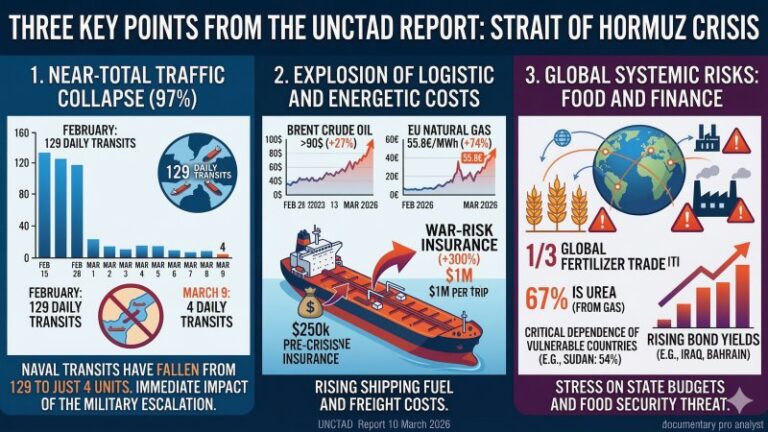
- Maritime traffic through the Strait of Hormuz came to an almost complete halt at the beginning of March 2026. According to Unctad (United Nations Conference on Trade and Development), daily transits collapsed from an average of 129 vessels recorded in February to just four ships on 9 March, a reduction of 97% that effectively blocks one of the world’s main energy corridors.
- The impact is immediately reflected in the logistics costs of energy transport. Freight rates for crude oil tankers and refined product carriers have increased by as much as 72%, while war risk insurance premiums have quadrupled. Marine fuel prices have also surged, in some cases nearly doubling.
- The logistical crisis is spreading to energy and agricultural markets. Brent crude has exceeded 90 dollars per barrel (+27%), while European natural gas has reached 55.8 euros per megawatt hour (+74%). The disruption also affects the maritime trade in fertilisers, with potential implications for food security in many developing countries.
Maritime traffic through the Strait of Hormuz collapsed almost entirely in early March 2026, turning one of the world’s most important energy corridors into a logistical choke point with systemic implications. According to a report published by Unctad (United Nations Conference on Trade and Development) on 10 March 2026, daily transits fell from an average of 129 vessels recorded in February to just four ships on 9 March. The reduction amounts to 97% and reflects the immediate impact of the military conflict in the Persian Gulf region. The Strait of Hormuz is one of the most sensitive nodes in global energy logistics. In 2024, around 20 million barrels of oil per day passed through the strait, equal to roughly 25% of the global seaborne oil trade. Of this volume, about 14 million barrels consisted of crude oil and condensate, while a further six million barrels were refined petroleum products.
The corridor concentrates very large shares of global energy and chemical trade flows. Before the current crisis, the strait handled 38% of seaborne crude oil, 29% of liquefied petroleum gas, 19% of liquefied natural gas and around 13% of chemicals and fertilisers. The near paralysis of maritime traffic along this route therefore has an immediate impact not only on energy markets but also on the entire global logistics chain linking Gulf producers with Asian and European markets.
Analysis of the visualisations included in the report highlights the speed of the disruption. The chart tracking daily vessel transits shows stable traffic between 1 and 27 February, with an average of 129 ships and peaks of up to 141 vessels per day. From 28 February, however, a sharp decline is recorded: transits fall to 20 ships on 1 March, then to 10, then three, before reaching just four vessels on 9 March. The trajectory points to an almost complete paralysis of the maritime corridor.
From a logistics perspective, the first effect has been a surge in maritime transport costs. According to data cited by Unctad, between 27 February and 6 March 2026 the Bdti index, which measures crude oil tanker freight rates, increased by 54%. Even stronger growth was recorded in the Bcti index, which tracks the transport of refined petroleum products, rising by 72%. At the same time, vessel operating costs have increased. In Singapore the price of low-sulphur marine fuel reached 874 dollars per tonne, almost double previous levels (+99%). High-sulphur fuel climbed to 1,020 dollars per tonne (+100%). These increases directly affect the overall cost of maritime transport and are passed along the entire energy supply chain.
The sharpest increase, however, concerns war risk insurance. According to the Unctad analysis, the base premium has risen from 0.25% to 1% of a vessel’s value, an increase of 300%. For a large oil tanker with an estimated value of 100 million dollars, the insurance cost for a single voyage rises from roughly 250,000 dollars to around one million dollars. This increase directly affects transport costs and may further reduce the availability of tonnage willing to transit the region.
The crisis in the Strait also has a strongly unbalanced geographical dimension. Asia is the main destination market for energy exports passing through Hormuz. According to the Unctad report, the region receives about 14.3 million barrels per day of crude oil from the Persian Gulf, equal to 84% of the flows transiting the strait. Asia’s share is similar for liquefied natural gas, with around 295 million cubic metres per day, equivalent to 83% of total volumes. Europe is less exposed but still significantly affected. European countries absorb about 11% of the crude oil and 13% of the liquefied natural gas passing through the strait. Even this relatively smaller share can influence continental energy prices when global supply is sharply reduced.
Logistical tensions are already reflected in international energy markets. According to data reported in the Unctad analysis, the price of Brent crude has risen above 90 dollars per barrel (exceeding 100 dollars by 11 March), marking a 27% increase between the end of February and early March 2026. Over the same period, European natural gas prices reached 55.8 euros per megawatt hour, up by 74%. Unctad notes that these price movements fit into a well-documented historical pattern. Charts in the report show that spikes in oil prices are often followed by increases in the FAO food price index. Similar dynamics are observed for natural gas, whose price rises are frequently associated with increases in the cost of nitrogen fertilisers.
The link between energy and agriculture represents one of the most critical aspects of the current crisis. The Strait of Hormuz is not only an energy route but also a key corridor for maritime fertiliser trade. In 2024, around one third of fertilisers transported by sea globally passed through this corridor, totalling approximately 16 million tonnes. According to Unctad, 67% of these volumes consist of urea, a nitrogen fertiliser whose production depends directly on natural gas. An increase in gas prices therefore tends to feed rapidly into fertiliser costs and, ultimately, into food prices.
The impact is particularly sensitive for several developing countries that depend heavily on supplies from the Persian Gulf. Seaborne imports through Hormuz account for 54% of total fertiliser imports for Sudan, 36% for Sri Lanka, 31% for Tanzania and 30% for Somalia. In these economies, higher fertiliser prices can quickly translate into rising agricultural costs and increased food prices.
Alongside the logistical and energy dimensions, the crisis also has a financial component. Unctad notes that the escalation in the Strait is already affecting regional bond markets. Between 27 February and 9 March 2026, yields on government bonds denominated in foreign currencies increased across the region. Iraq recorded the sharpest rise, with yields climbing from 6.4% to 7.1%, an increase of 0.64 percentage points. In Bahrain, yields rose from 6.3% to 7.0% (+0.41). Other Gulf countries also saw widespread increases: Jordan from 6.0% to 6.4% (+0.24), Oman from 5.2% to 5.3% (+0.26), Saudi Arabia from 4.9% to 5.1% (+0.26), Qatar from 4.7% to 4.8% (+0.27), the United Arab Emirates from 4.6% to 4.8% (+0.28) and Kuwait from 4.3% to 4.4% (+0.28).
According to Unctad, this trend signals a growing perception of risk among international investors. Higher yields translate into higher borrowing costs for governments in the region, at a time when many emerging economies are already facing limited fiscal space and elevated levels of public debt. The combination of a logistical shock, rising energy costs and financial tensions highlights the systemic nature of the crisis unfolding in the Strait of Hormuz. A maritime corridor through which energy, fertilisers and strategic raw materials flow has thus become a decisive factor in the stability of global supply chains.
P.R.