


Array ( [0] => 8 [1] => 10155 )

Podcast K44

Cronaca

  • Incendio in un deposito di autotrasporti a Pozzolo Formigaro

    Incendio in un deposito di autotrasporti a Pozzolo Formigaro

    Pneumatici esausti e residui oleosi all'origine del rogo scoppiato nella mattina del 3 giugno 2026 nella zona industriale in provincia di Alessandria. Nessun ferito, ma danni ingenti alla struttura e preoccupazioni ambientali per la nube di fumo nero sprigionatasi per ore.

Transpotalk

Normativa

Mare

  • Antitrust approva l’acquisizione di Terminal San Giorgio di Genova

    Antitrust approva l’acquisizione di Terminal San Giorgio di Genova

    L'Autorità sulla concorrenza ha autorizzato con rimedi vincolanti l'acquisizione del Terminal San Giorgio di Genova da parte di Ignazio Messina, riaprendo il procedimento dopo l'annullamento giudiziario del precedente via libera. Era una vertenza riconducibile a Grimaldi e Msc.

Autotrasporto

  • Diciotto Paesi UE per camion autonomi transfrontalieri

    Diciotto Paesi UE per camion autonomi transfrontalieri

    Diciotto Stati membri dell'Ue hanno firmato l'8 giugno 2026 a Lussemburgo una dichiarazione d'intenti congiunta per la creazione di aree di test transfrontaliere per veicoli autonomi, con attenzione su trasporto merci e logistica.

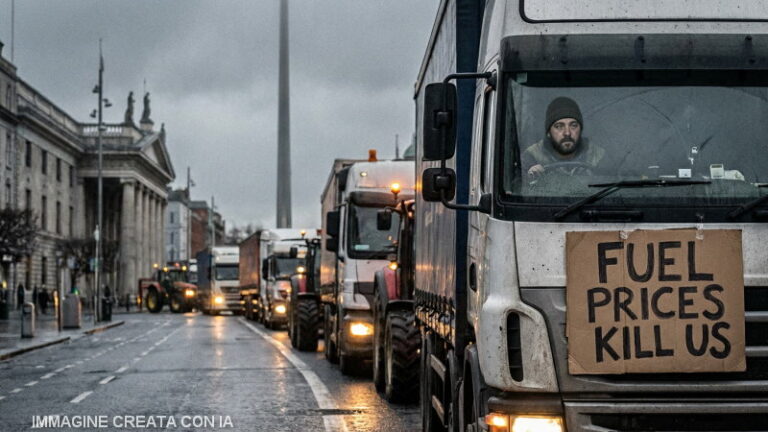
    European road haulage in revolt over high diesel prices and EU rules

    Immagine: TrasportoEuropa IA

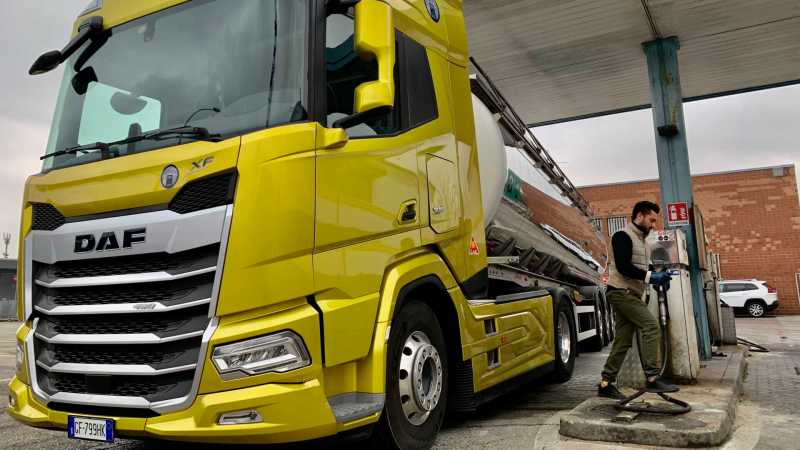
    7 April 2026, morning. On the M7 motorway in County Kildare, Ireland, a column of hundreds of lorries, tractors, buses and private cars crawls forward. The same scene is repeated on the M4, the M8 in Offaly, the M3 in Meath and the M6 towards Galway. Shortly before 11:00, a large convoy reaches O’Connell Street in Dublin. An Garda Síochána, the Irish national police, reports “significant disruption” in the country’s main cities: Dublin, Cork, Galway and Limerick. The movement, rallying under the slogan “The People of Ireland Against Fuel Prices”, is calling for a cap on fuel prices and a reduction in excise duties for haulage and agriculture. Organisers point to diesel prices forecast to reach up to €2.30 per litre in the following days, as a direct consequence of the ongoing conflict in Iran.

    Ireland is not an isolated case. Since late January 2026, a wave of protests has spread across European road haulage with a speed and consistency not seen for years. Two reinforcing factors lie behind it: rising diesel costs, driven higher by the Middle East crisis, and tighter EU border rules affecting carriers from the Western Balkans. The result is a tense April, affecting at least five key regions of the continent and putting pressure on supply chains, national governments and European institutions.

    High fuel costs are the most widespread cause. Diesel has consistently exceeded €2 per litre on Italy’s urban network, with peaks of €2.11 on motorways. Even higher levels have been recorded in France, where some areas report prices of up to €2.50 per litre, and in the Netherlands, where the symbolic threshold is set at €2.30. Several energy sector analyses describe this phase as a diesel crisis more severe than the oil shocks of 1973 and 1979, with tangible risks of shortages and rationing in Europe.

    In Italy, trade associations describe an unsustainable situation: freight rates remain stagnant while operating costs continue to rise. The temporary excise duty cut introduced by the government—around 25 cents per litre—has effectively been absorbed by price increases, leaving pump prices at record levels. Trasportounito has called a national haulage strike from 20 to 25 April, describing an “absolute emergency”. Unatras has announced permanent assemblies and demonstrations in around one hundred cities, describing the sector as “at breaking point”, and has convened its executive council to consider possible strike action.

    In France, mobilisation preceded Italy’s by several weeks. Between 29 and 30 March, hauliers—and in some areas farmers and other road operators—staged so-called “snail operations” on the Paris Périphérique and on the main routes into the capital. The tactic, involving slow-moving convoys that create congestion without formally blocking traffic, was chosen to maximise visibility while limiting the risk of clashes with law enforcement. Actions continued in the following days on other national routes.

    In the Netherlands, the “Enough: €2.30!” mobilisation took shape on 2 April, organised from the ground up by small firms and owner-drivers. Actions focused on major roads and logistics hubs, with slow-moving industrial vehicle convoys and pickets. The slogan points to the price threshold deemed unsustainable for diesel, reflecting the sector’s perception of costs that are eroding the already thin margins of smaller operators.

    The Balkan front has a different, more structural character. On 26 January 2026, more than 20 border crossings between the EU and the Western Balkans—between Serbia and Hungary, Serbia and Croatia, Bosnia and Herzegovina and Croatia, and other entry points into the Schengen area—were blocked by around 75,000 lorries. The protest targeted the launch of the Entry/Exit System (EES) and the full enforcement of the 90-days-in-180 rule for non-EU drivers. The blockades, coordinated by the main national road haulage associations in the countries involved, led to queues with waiting times of up to 48–72 hours. Only essential goods—medicines, live animals, emergency shipments, military transport and dangerous goods—were guaranteed passage.

    With the EES fully operational, the tracking of days spent in the Schengen area turns the 90/180 rule into a concrete operational constraint for non-EU drivers who frequently cross borders for work. Balkan associations argue that lorry drivers are being treated as tourists rather than workers with a specific professional mobility regime, risking entry refusals, penalties and, in extreme cases, deportation. Blockades continued in waves between February and March, with further actions announced at borders on 23 March. Between 1 and 9 April, waiting times at crossings persisted, with hauliers threatening to continue until adjustments are made to EES rules and the management of permitted stay periods.

    The impact on the logistics chain has been immediate and significant. The Balkan blockades are slowing freight traffic between the EU, Turkey and the Middle East, affecting delivery times and vehicle availability along east–west corridors. Italy and other Member States are among the most exposed, as a substantial share of flows to and from Turkey and the Middle East transits through the Balkan corridors. This is compounded by actions in France, the Netherlands and Ireland, increasing congestion on routes linking to Northern European ports and corridors with the United Kingdom.

    Demands from hauliers across different countries converge on several points: structural measures on fuel prices rather than temporary relief, and, where applicable, exemptions or adjustments to EES/90-180 rules for non-EU professional drivers. In Italy, associations are also calling for mandatory alignment of freight rates with real costs, a measure the sector has sought for years. National government responses are widely seen as insufficient: excise cuts are described as “temporary” and “absorbed by increases”, while tax credits are labelled “limited”.

    European institutions, for their part, are under pressure to consider exemptions to EES and 90/180 rules for professional drivers in order to avoid structural bottlenecks at the EU’s eastern borders. Several industry associations warn that April’s actions could be only a prelude to wider mobilisation if structural responses are not delivered, both on fuel costs and on entry rules for transport workers in the Schengen area.

    Michele Latorre

    © TrasportoEuropa - Riproduzione riservata - Foto di repertorio
    Segnalazioni, informazioni, comunicati, nonché rettifiche o precisazioni sugli articoli pubblicati vanno inviate a: redazione@trasportoeuropa.it


      Puoi commentare questo articolo nella pagina Facebook di TrasportoEuropa
      bottone newsletter piccolo Vuoi rimanere aggiornato sulle ultime novità sul trasporto e la logistica e non perderti neanche una notizia di TrasportoEuropa? Iscriviti alla nostra Newsletter con l'elenco ed i link di tutti gli articoli pubblicati nei giorni precedenti l'invio. Gratuita e NO SPAM!


    CONTENUTI SPONSORIZZATI


Videocast K44

Aereo

Ferrovia

Persone

  • Fredrik Swartling sarà l’amministratore delegato d’Italscania

    Fredrik Swartling sarà l’amministratore delegato d’Italscania

    Fredrik Swartling, attuale responsabile Services d’Italscania, succederà a Enrique Enrich alla guida della filiale italiana di Scania dal primo settembre 2026. Un passaggio interno che punta a consolidare i risultati ottenuti negli ultimi anni, valorizzando la continuità di gestione e la conoscenza diretta del mercato italiano.
Renault Trucks rinnova la catena cinematica dei camion diesel

TECNICA

Renault Trucks rinnova la catena cinematica dei camion diesel
Scania investe 70 milioni in Francia per i camion elettrici

TECNICA

Scania investe 70 milioni in Francia per i camion elettrici
Scania lancia il modulo batteria sotto cabina e la ricarica Mcs

TECNICA

Scania lancia il modulo batteria sotto cabina e la ricarica Mcs
Artemis per la sicurezza del Monte Bianco

TECNICA

Artemis per la sicurezza del Monte Bianco
Kia torna nel furgone italiano col PVB 5

TECNICA

Kia torna nel furgone italiano col PVB 5
previous arrow
next arrow
Fusione nel trasporto merci olandese tra Ewals e Vos

LOGISTICA

Fusione nel trasporto merci olandese tra Ewals e Vos
Dkv Mobility rafforza la rete europea di ricarica con Optimile

LOGISTICA

Dkv Mobility rafforza la rete europea di ricarica con Optimile
L’idrogeno può essere competitivo nell’autotrasporto oltre 300 km

LOGISTICA

L’idrogeno può essere competitivo nell’autotrasporto oltre 300 km
Sciopero nella FedEx ligure per cambio appalto logistica

LOGISTICA

Sciopero nella FedEx ligure per cambio appalto logistica
Tre colossi europei della logistica al centro delle proteste contro Israele

LOGISTICA

Tre colossi europei della logistica al centro delle proteste contro Israele
previous arrow
next arrow
Bruxelles approva il regime italiano da 23 miliardi per le rinnovabili

ENERGIE

Bruxelles approva il regime italiano da 23 miliardi per le rinnovabili
Operazione Red Gold contro frode nei carburanti in Abruzzo

ENERGIE

Operazione Red Gold contro frode nei carburanti in Abruzzo
Quattro indagati per uso stradale di gasolio agricolo nel Salento

ENERGIE

Quattro indagati per uso stradale di gasolio agricolo nel Salento
Il taglio delle accise è prorogato fino al primo maggio

ENERGIE

Il taglio delle accise è prorogato fino al primo maggio
Petrolio sopra 110 dollari al barile dopo dichiarazioni di Trump

ENERGIE

Petrolio sopra 110 dollari al barile dopo dichiarazioni di Trump
previous arrow
next arrow
Gaston Schul cresce nelle spedizioni genovesi con Parodi Forwarding

SERVIZI

Gaston Schul cresce nelle spedizioni genovesi con Parodi Forwarding
L’Italia è molto esposta nel cibercrimine nel trasporto e logistica

SERVIZI

L’Italia è molto esposta nel cibercrimine nel trasporto e logistica
Carta DKV per ricaricare il camion elettrico

SERVIZI

Carta DKV per ricaricare il camion elettrico
Video | Dkv al Transpotec oltre la carta carburante

SERVIZI

Video | Dkv al Transpotec oltre la carta carburante
Zucchetti presenta una logistica digitale integrata software e robot

SERVIZI

Zucchetti presenta una logistica digitale integrata software e robot
Golia360 punta sulla digitalizzazione per gli autisti

SERVIZI

Golia360 punta sulla digitalizzazione per gli autisti
Come la logistica può guadagnare dalle multe Antitrust

SERVIZI

Come la logistica può guadagnare dalle multe Antitrust
Tra Genova e Barcellona l’asse della formazione per la logistica

SERVIZI

Tra Genova e Barcellona l’asse della formazione per la logistica
Transporeon introduce la ricerca con l’intelligenza artificiale

SERVIZI

Transporeon introduce la ricerca con l’intelligenza artificiale
Nasce Synlog Alliance consorzio dati per la logistica

SERVIZI

Nasce Synlog Alliance consorzio dati per la logistica
Sogedim potenzia le spedizioni per America Latina con Eagle Service

SERVIZI

Sogedim potenzia le spedizioni per America Latina con Eagle Service
Leviahub cresce in Spagna con due acquisizioni

SERVIZI

Leviahub cresce in Spagna con due acquisizioni
Trans.eu cresce in Italia con la borsa carichi relazionale

SERVIZI

Trans.eu cresce in Italia con la borsa carichi relazionale
L’evoluzione della borsa carichi autotrasporto è relazionale

SERVIZI

L’evoluzione della borsa carichi autotrasporto è relazionale
Padrosa realizzerà un parcheggio per camion ad Alessandria

SERVIZI

Padrosa realizzerà un parcheggio per camion ad Alessandria
previous arrow
next arrow