






On 24 July 2025, the long legal battle over compensation for the environmental and economic damage caused by the sinking of the container ship X-Press Pearl came to an end. The vessel sank on 17 June 2021, nine nautical miles off the port of Colombo, Sri Lanka. Four years later, the country’s Supreme Court ordered X-Press – including the owners, operators and local agents – to pay one billion dollars, invoking the “polluter pays” principle.
The ruling stated that the ship’s master, operator and local agent “intentionally suppressed and concealed from the Colombo Harbour Master truthful, timely, complete and accurate information regarding the evolving situation”. The payment was split into three instalments: 250 million dollars by 23 September 2025, a further 500 million within six months of the ruling, and the remaining 250 million within a year. The money is to be deposited in a newly established trust fund named the “MV X-Press Pearl Compensation and Environment Restoration and Protection Fund”.
The investigation and trial meticulously reconstructed the chain of events that led to what is considered Sri Lanka’s worst environmental disaster. The story began on 11 May 2021 in the port of Jebel Ali, Dubai, when a container holding nitric acid was loaded onto the X-Press Pearl – a vessel launched just three months earlier. The container began leaking at a rate of one litre per hour. The ship set sail carrying 1,486 containers, 81 of which contained hazardous materials, including 25 tonnes of nitric acid, caustic substances, methanol, epoxy resin and 1,680 tonnes of plastic pellets (nurdles).
The crew discovered the leak after leaving Jebel Ali, and the captain urgently requested to offload the container at the next ports of call. However, on the same day, port authorities at Hamad Port in Qatar refused to accept the damaged container, citing the lack of specialised facilities and technical expertise to handle a nitric acid leak, further complicated by Ramadan holidays.
A similar situation occurred at the port of Hazira in India, where the terminal declined to offload the leaking container, presumably due to time constraints and a lack of adequate capacity to deal with damaged hazardous cargo. Tim Hartnoll, executive chairman of X-Press Feeders, described these refusals as a case of “not in my backyard”, arguing that the disaster could have been avoided had the ports fulfilled their international obligations.
The container ship continued its voyage under these conditions until it entered Sri Lankan territorial waters on the night of 19 May, anchoring 9.5 nautical miles off Colombo while awaiting a berth. On the morning of 20 May, local agent Sea Consortium Lanka informed the Colombo Harbour Master via email of the presence of a nitric acid container requiring repairs upon docking.
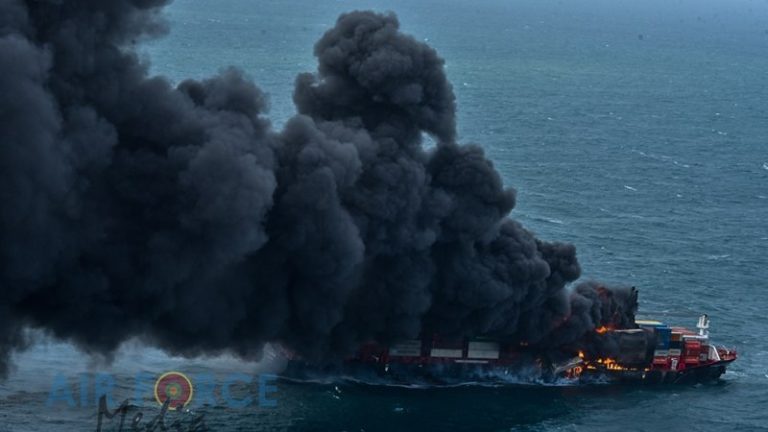
At around 4 p.m. on 20 May, the crew reported yellow and brown fumes emanating from the hold, soon followed by signs of a possible fire in cargo hold number two. The ship’s fixed CO2 fire extinguishing system was activated in an attempt to contain the blaze. On 21 May, efforts to fight the fire intensified with the deployment of fire brigades and a helicopter. Despite these efforts, explosions were heard in the hold on 22 May and the ship was engulfed in flames. The situation worsened drastically on 25 May when massive explosions rocked the vessel, forcing the immediate evacuation of all 25 crew members.
With the fire under control by 31 May, a decision was made to tow the vessel 50 nautical miles offshore to minimise the environmental impact on the coast. However, on 2 June, after being towed for nearly one nautical mile, the stern sank about nine nautical miles from Colombo and 4.5 miles from the shoreline. By 17 June, the entire ship had settled on the seabed at a depth of around 21 metres, with only the forecastle and one crane partially visible.
The incident released 46,960 bags of low and high-density polyethylene from twenty containers, spilling between 70 and 75 billion plastic nurdles along Sri Lanka’s western coast. These microplastics, used as raw material in the production of plastic goods, dispersed across the country’s western, southern and northern shores. The contamination was so severe that, four years later, volunteers are still combing kilograms of these pellets from the sand.
Investigators reported that the sinking of the X-Press Pearl led to the deaths of 417 sea turtles, 48 dolphins, eight whales, and numerous fish species, many of which washed ashore in the aftermath. The disaster also had a significant economic impact on Sri Lanka’s coastal fishing communities, with a fishing ban enforced for over a year along the western coastline. This deprived local fishers of their income, livelihoods and right to work.
Immediately after the disaster, Sri Lanka submitted an initial compensation claim of 40 million dollars in June 2021. The ship’s insurer, the London P&I Club, began making interim payments: 3.6 million dollars in July 2021, 1.75 million in January 2022, and 2.5 million in September 2022, for a total of 7.85 million dollars. However, a committee of 40 experts convened by Sri Lanka’s Marine Environment Protection Authority (MEPA) estimated in a preliminary report that environmental damages amounted to 6.4 billion dollars. This figure took into account the losses to wildlife, tourism and fisheries, as well as the negative effects of the ship’s toxic emissions on local residents.
The investigation revealed multiple instances of negligence by the X-Press group. Singapore’s Transport Safety Investigation Bureau identified a series of failures by the ship’s crew and the port of Colombo. When the leak was first discovered, despite the container being marked with identification plates, the crew did not verify its contents and attempted to contain the leak using sawdust. During the trial, the Court found that their actions breached international maritime regulations under MARPOL and SOLAS, and declared the X-Press Pearl group the sole polluter in the case.
The judges also highlighted failures on the part of several Sri Lankan authorities. The Marine Environment Protection Authority (MEPA) and its former chair Dharshani Lahandapura were found guilty of dereliction of duty. Minister Nalaka Godahewa failed to establish the legally mandated Marine Environment Council, and the Attorney General was criticised for not prosecuting the ship’s owners and operators and for pursuing the compensation case in Singapore rather than in Sri Lanka.
The X-Press Pearl case also had wider implications for international regulations, exposing serious gaps in the legal framework for managing maritime disasters involving hazardous goods. The incident triggered discussions at the International Maritime Organization on the reclassification of plastic pellets as a dangerous substance under the International Maritime Dangerous Goods Code. Sri Lanka has led efforts to have these pellets officially classified as hazardous under the IMO code to ensure safe handling and storage – a move that could have significant consequences for the future of maritime plastic transport.