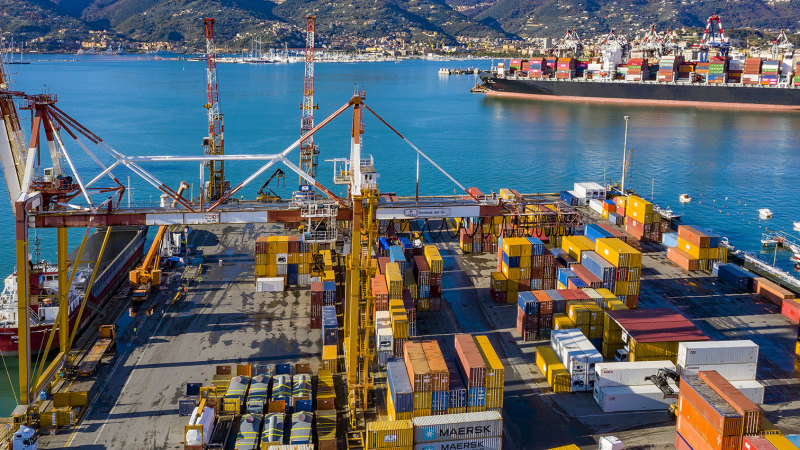









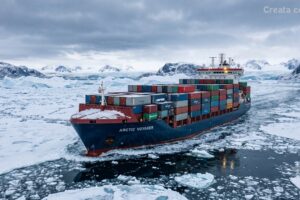
Container ships under construction or awaiting keel-laying at shipyards worldwide now total 16.2 million TEU, equivalent to 46.5% of the active fleet, the highest ratio since the 2009 crisis, according to Linerlytica's October 2026 figures. And there is no sign of a slowdown in ordering: since the beginning of the year, Chinese shipyards alone have secured contracts for a record 4.94 million TEU, representing 88% of all capacity ordered. In 2025, a record year for newbuilding contracts, 737 container ships totalling 5.05 million TEU were ordered, expanding the orderbook by almost a third. Another 329 vessels, with a combined capacity of 1.89 million TEU, were added in the first half of 2026.
The pressure on supply will become apparent next year. In its report published on 23 September, BIMCO states that the global fleet has already reached 34 million TEU and is expected to expand by 4.6% in 2026 and 9% in 2027, with scrapping remaining limited. However, effective shipping capacity is expected to grow more slowly because of the reduced sailing speeds adopted by container ships. BIMCO therefore forecasts supply growth of between 5% and 6% in 2027, compared with demand growth of 0.5-2.5% if the Strait of Hormuz remains closed and 2.5-4.5% if traffic through the strait returns to normal. In both scenarios, supply growth will exceed demand growth.
Delivery figures and forecasts vary between analysts. According to Clarksons' figures from late 2025, deliveries were projected at 1.7 million TEU in 2026, rising to 2.8 million in 2027 and 3.5 million in 2028. Maritime Strategies International, however, is more pessimistic after revising its forecasts to reflect the latest wave of orders. It expects deliveries to approach 5 million TEU in 2028, equivalent to approximately 13% of the fleet at the end of 2027, even assuming the scrapping of 500,000 TEU. This would represent the highest annual ratio since 2007.
In the first seven months of 2026, global seaborne container volumes increased by 5.1% year on year, with exports from East and Southeast Asia accounting for more than half of that growth, according to BIMCO. Route diversions and port congestion are also helping to absorb shipping capacity. Linerlytica reports that congestion at Asian ports reached 4.3 million TEU in September, exceeding the peak recorded during the pandemic, while diversions around the Cape of Good Hope absorb between 5% and 7% of global capacity. These conditions have pushed container ship time-charter rates to their highest levels in four years, despite record newbuilding orders, while scrapping activity is slowing. Vessels aged 20 years or more account for just 16% of total capacity.
Container ships on order are becoming increasingly large. According to BIMCO, 59% of the capacity on order is accounted for by vessels exceeding 12,000 TEU. For ships above 17,000 TEU, the orderbook stands at 5 million TEU, equivalent to the entire existing capacity of that segment. In terms of propulsion, the industry has increasingly turned towards liquefied natural gas (LNG). According to Clarksons, 62% of container ship capacity ordered in 2025 was designed to operate on alternative fuels, with LNG accounting for 80% of the tonnage ordered in this category. DNV estimates that the 2025 container ship order mix consisted of approximately 58% LNG-powered vessels, 36% conventional-fuel ships and 6% methanol-powered vessels. Methanol, which until 2024 had appeared to be the emerging alternative, has almost come to a standstill. Clarksons recorded just four orders for methanol dual-fuel vessels in the first half of 2026. Bunkering logistics are also a constraint, as only 48 ports currently offer or plan to offer methanol bunkering facilities. LNG also leaves open the possibility of using renewable fuels. Maersk, for example, is adding LNG-powered vessels alongside its methanol-fuelled ships and is seeking supplies of liquefied biomethane. In the first nine months of 2026, DNV recorded orders for 311 alternative-fuel vessels, including 200 LNG-powered ships, 55% of which were container ships.
MSC is leading the ordering race. The Swiss shipping group, which operated 1,017 vessels with a combined capacity of 7.45 million TEU as of 21 October, has a further 2.94 million TEU on order. Its latest reported contract involves the Chinese shipyard Hengli, where MSC is understood to have added an order for twenty 24,000 TEU vessels, representing another 480,000 TEU. This would bring its programme of ships exceeding 20,000 TEU at the yard to 62 vessels. Maersk has abandoned the cautious ordering policy it followed in recent years. On 18 September, the Danish group confirmed an order for 26 LNG dual-fuel container ships of 18,600 TEU each, scheduled for delivery in 2029 and 2030. According to Dynaliners, the contract adds approximately 484,000 TEU and increases Maersk's orderbook by 28%, bringing it close to 2.2 million TEU. COSCO Asset Management has signed contracts for 18 vessels worth more than $2.9 billion (approximately €2.5 billion). The package is divided into two series: Shanghai Waigaoqiao will build twelve 22,000 TEU LNG dual-fuel container ships at $224 million each (approximately €195 million), while CSSC Huangpu Wenchong will construct six 3,200 TEU feeder vessels. The larger ships will be delivered between 2028 and 2030 and deployed on services between the Far East and north-western Europe. With this latest contract, COSCO's orders placed in 2026 have risen to 48 vessels, representing approximately 676,800 TEU and around $8 billion (approximately €7 billion). Of these ships, 36 will be LNG dual-fuel vessels.
M.G.