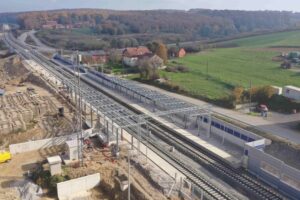









Croatia is stepping up its efforts to strengthen its role as a link in rail connections across the Balkans. The latest development on its national rail network concerns the TEN-T Mediterranean Corridor. Croatian infrastructure manager HŽ Infrastruktura has signed a contract for the complete reconstruction and double-tracking of a section that, despite forming part of the European network, remains an outdated single-track line. The upgrade covers the 83 km railway between Dugo Selo, a station a short distance east of Zagreb, and Novska, a major junction from which the partly upgraded, electrified double-track railway runs towards Serbia.
The project, for which a construction contract was signed with Afcons Infrastructure in October 2026, has a total value of almost €900 million, effectively funded in full by EU sources, reflecting European interest in strengthening rail corridors across the Balkans. Just under €290 million is being provided through the Connecting Europe Facility, while €610 million comes from the EU’s Competitiveness and Cohesion Programme 2021–2027.
The comprehensive upgrade of the Dugo Selo–Novska railway, due to begin in early 2027, is expected to take just under six years and is divided into four sections that can be completed separately. Once the work is finished, the upgraded railway will allow passenger trains to run at up to 160 km/h, leaving no operating speed constraints for freight services. Alongside the second track, new safety, signalling, command and control systems will be installed. The Dugo Selo–Novska upgrade forms part of HŽ Infrastruktura’s current €1.5 billion investment programme. Further renewal and modernisation projects worth around €6 billion are planned across the rail network by 2035. These include another phase of upgrading and capacity expansion on the partly double-track route beyond Novska, specifically the 130 km railway between Okučani and Vinkovci, near the Serbian border.
According to Croatia’s transport ministry in Zagreb, 25 major infrastructure projects are now being implemented, sixteen of them co-funded by the European Union. A leading project is the route linking Zagreb to the port of Rijeka. Here, infrastructure manager HŽ Infrastruktura is upgrading the 44 km railway between Hrvatski Leskovac, just south-west of Zagreb, and Karlovac, an important junction south of the Slovenian border. The work is worth almost €300 million and involves extensively rebuilding the existing track and constructing a second track alongside it.
The Hrvatski Leskovac–Karlovac section lies on the Balkan–Mediterranean corridor of the trans-European transport network and will enable more efficient connections between the port of Rijeka and inland markets in Hungary, Slovakia and Poland. Croatian rail freight operator HŽ Cargo aims to increase its freight volumes to more than 25 million tonnes over a decade, by 2033. The Balkans are set to become an increasingly important bridge between Europe and Asia. The European Union has decided to accelerate investment in the region under a plan adopted in 2020. This will shift the focus from a patchwork of individual countries’ railway lines to an integrated network. It means adopting common technological standards, such as the European Rail Traffic Management System (ERTMS), using interoperable rolling stock and applying the same safety and maintenance criteria.
Piermario Curti Sacchi