









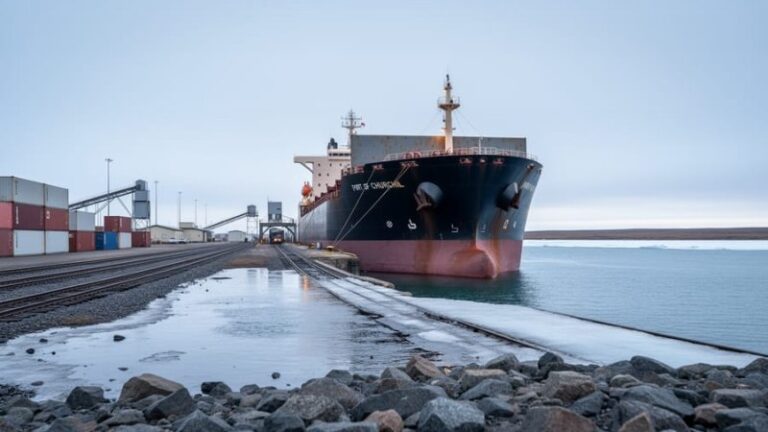
DP World is considering integrating Churchill, on Hudson Bay and Canada’s only rail-served Arctic seaport, into its international logistics network. Its subsidiary DP World (Canada) has signed a memorandum of understanding with Arctic Gateway Group, which owns and operates the port and the Hudson Bay Railway and is owned by 29 First Nations and 12 northern Manitoba communities, and with CentrePort Canada, Winnipeg’s logistics hub served by road, rail and air. The agreement covers port operations, logistics services and the potential development of a corridor linking the port, railway, CentrePort and DP World’s network. The parties signed it on 29 September 2026 at Winnipeg’s Fort Garry Hotel, and announced it on 26 October 2026, coinciding with the Crown Prince of Abu Dhabi’s visit to Ottawa. The following day, the Canadian government included it among the commercial agreements under its new strategic partnership with the United Arab Emirates.
The agreement is exploratory and currently includes no financial commitments, traffic targets or deadlines: DP World described it as a first step towards assessing commercial opportunities in Manitoba. Alongside the bulk cargoes and commodities that traditionally make up the port’s traffic, the partners are also considering containers. The proposed model would consolidate inland cargo within southern Manitoba’s logistics network, where CentrePort covers around 8,100 hectares across Winnipeg and the Rural Municipality of Rosser and hosts more than 1,000 businesses, move it along the Hudson Bay Railway, which connects The Pas to Churchill, and ship it to international markets. The joint statement also envisages an intermodal link between Europe and Asia across Canada. DP World has operated in Canada since 2006, with five marine terminals across British Columbia and New Brunswick, a project in Montréal and annual throughput of more than one million TEU in the country.
Chris Avery, chief executive of Arctic Gateway, links the project to the need to develop trade infrastructure that is not geared towards the United States, while the statement emphasises route diversification and supply chain resilience. On 28 September 2026, Arctic Gateway signed an agreement with the Port of Rotterdam to strengthen transatlantic trade. In 2026, Churchill handled grain, zinc concentrate, Manitoba-produced potash and supplies for Nunavut communities, its broadest cargo mix ever, according to the operator. On 31 August 2026, it loaded its first grain vessel since 2020, carrying around 30,000 tonnes of durum wheat from Agt Foods bound for Europe.
The Arctic shipping season currently lasts four to five months. On 21 August 2026, the Canadian and Manitoba governments presented studies by the University of Manitoba, Fednav and the Arctic Research Foundation, which found that year-round navigation along the Churchill corridor was technically feasible with ice-capable vessels. Before winter operations can begin, however, environmental assessments, approvals, consultations with Indigenous and northern communities, and further simulations of the final approach through the Churchill River estuary must be completed. Infrastructure capacity and Arctic marine insurance costs also weigh on the route’s commercial viability.
On 21 March 2025, the federal government allocated C$175 million over five years (around €108 million): C$125 million (€78 million) for railway operations and maintenance, including C$43.8 million previously announced, and C$50 million (€31 million) for preliminary port development work. Arctic Gateway estimates the overall cost of upgrading the port, railway and rail facilities at The Pas at C$2–3 billion (€1.2–1.9 billion). The Manitoba government’s proposal has a different scope, including an offshore liquefied natural gas platform, and is valued at C$70–80 billion (€43–50 billion).
Antonio Illariuzzi