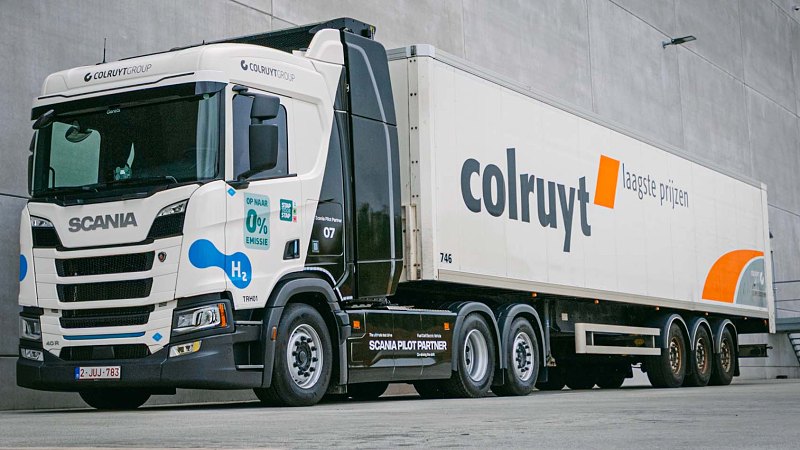





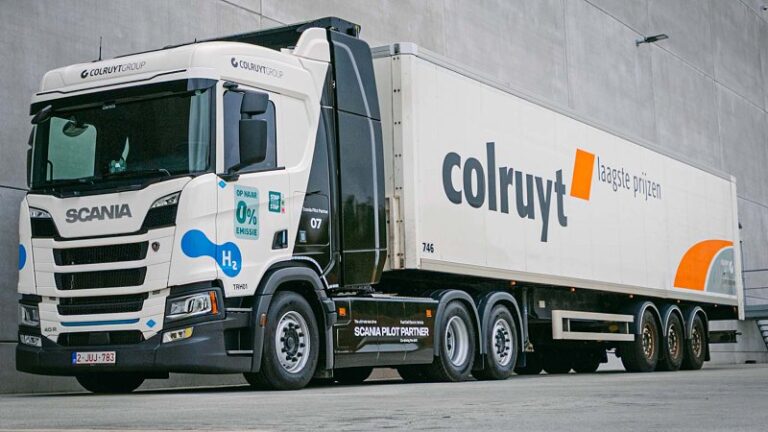
Colruyt Group has added two Scania hydrogen-powered fuel cell heavy goods vehicles to its fleet for distribution in Belgium. The initiative is part of the Scania Pilot Partner programme, the collaborative platform with selected customers launched in 2021 to test technologies that offer alternatives to conventional propulsion. The programme assesses solutions ranging from battery-electric vehicles to combustion engines equipped with range extenders, as well as emerging alternatives such as hydrogen fuel cells. Its aim is to measure the technical performance, operational feasibility and commercial potential of each solution. Scania has built around 20 vehicles in this series, which are being tested in a limited number of countries: "By testing these technologies in real transport environments, we learn what works best in practice and how to accelerate progress," said Tony Sandberg, head of the Scania Pilot Partner programme.
The vehicles chosen by Colruyt Group use an electric powertrain delivering a continuous output of 400 kW and offering up to 480 kW of regenerative braking power to maximise energy efficiency. The road tractor is a 6x2 with a steering rear axle and can reach a gross combination weight of up to 50 tonnes. The hydrogen is stored in tanks with a total capacity of 56 kg at a pressure of 700 bar, with refuelling carried out at existing and future Hrs stations in Hal and Ollignies. The vehicle is also equipped with two battery packs providing a combined gross energy capacity of 356 kWh, which can be charged externally via a CCS2 Combo socket with a maximum current of 500 amps, corresponding to charging power of up to 375 kW.
The combination of battery-electric propulsion and hydrogen fuel cell gives the truck a range of around 800 kilometres. The vehicle is also fitted with a Scania front element compliant with the European IVD (Increased Vehicle Dimensions) directive, allowing the articulated vehicle to exceed the maximum length of 16.5 metres without reducing load space. The regulation allows additional length only to improve aerodynamics, safety and energy efficiency.
The collaboration between Scania and Colruyt Group on hydrogen began in 2020, and since then the two companies have developed the concept into the vehicle now being tested. Their work has focused not only on the technical possibilities of the hydrogen powertrain, but also on its practical use in Colruyt Group’s distribution operations, adapting the vehicle concept, infrastructure, operational requirements and logistics processes. "Our road transport will be fully zero-emission by 2030, thanks to battery-electric and hydrogen vehicles. By 2035, our freight transport will run entirely on green electricity and green hydrogen," said Lieselot Rouquart, head of Colruyt Group’s Transport division, adding that the group is looking forward to thoroughly testing Scania’s innovation.
One of the project’s main difficulties concerned homologation, because the vehicle configuration did not fully match the existing European regulatory framework in this area. A full individual approval process was therefore required before the vehicle could operate on Belgian roads. The process involved close collaboration between Scania, Colruyt Group, inspection bodies and several technical partners to obtain all the partial certificates and necessary authorisations. The procedure lasted around a year and a half, after which the vehicle was authorised for testing under real-world conditions on Belgian roads.
Antonio Illariuzzi