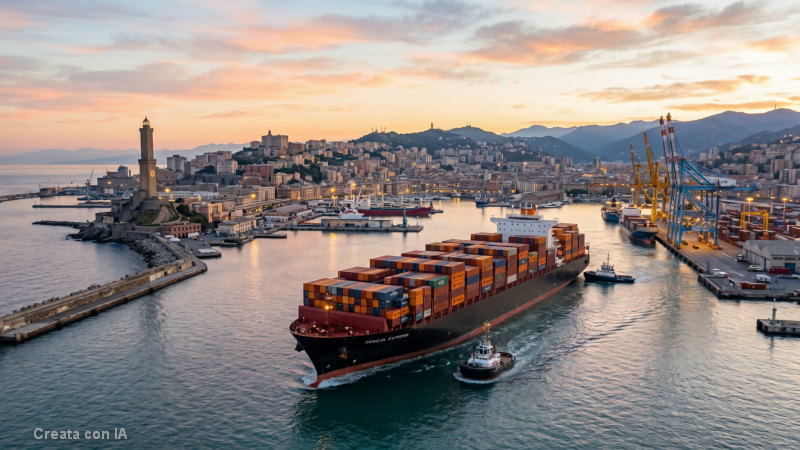







China is expanding and renewing its container ship fleet through Cosco Shipping Asset Management, a subsidiary of Cosco Shipping Holdings, which on 28 August 2026 signed two contracts to build eighteen container ships, worth a total of about $2.99bn, or around €2.57bn. The first order covers twelve 22,000 TEU LNG dual-fuel vessels, to be built by Shanghai Waigaoqiao Shipbuilding in partnership with China Shipbuilding Trading. Each ship will cost about $224m, or around €193m, for a total of $2.688bn, or around €2.31bn. The second contract, awarded to Cssc Huangpu Wenchong Shipbuilding, covers the construction of six 3,200 TEU wide-beam feeder vessels, for a total value of about $302m, or around €260m.
The two orders add about 283,200 TEU of nominal capacity to Cosco’s fleet. Deliveries of the twelve megamax vessels are scheduled between 2028 and 2030, while the six feeder ships are due between 2028 and 2029. Up to 70% of the cost of each vessel may be financed through external debt or bank loans, with the remainder covered by the group’s internal liquidity. The large container ships will be deployed on the Far East–northern Europe route, where Cosco aims to strengthen its position, while the feeder vessels will serve regional traffic around the group’s main ports, including Chancay and Yangpu, and Piraeus in the Mediterranean.
This is the third round of shipbuilding orders in 2026 signed by Cosco Shipping Holdings, bringing the total to 48 container ships. The programme requires overall investment of about $8bn, or around €6.88bn, and will add 677,000 TEU of capacity for the Chinese group. The two contracts signed in January, covering twelve 18,000 TEU ships and six 3,000 TEU vessels for about $2.7bn, or around €2.32bn, were followed in April by an order for twelve 13,600 TEU units through its subsidiary Ooil, worth about $2.22bn, or around €1.91bn. Thirty-six of these vessels are dual-fuel ships, with LNG among their fuel options.
Cosco can support this ambitious programme thanks to a strong financial position. Cosco Shipping Holdings closed the first quarter of 2026 with net profit of RMB5.88bn, or around €750m, up 54.72% on the previous quarter, while its debt-to-assets ratio fell to 40.90%. As at 31 March 2026, the combined capacity of its self-operated fleet and orderbook stood at about 4.84m TEU. Its terminal division, Cosco Shipping Ports, ended the first half of 2026 with total throughput of more than 80m TEU, a year-on-year increase of 7.9%.
The Chinese order forms part of a broader wave of container ship orders. In the same week in August, Oocl, also controlled by the Cosco group, ordered a dozen additional units, while Greek owner Costamare confirmed 16 vessels backed by long-term charters, supported by the Chinese group itself. Industry sources reported by TheLoadstar suggest Cosco may reserve more than 100 slots at Chinese yards, taking the group’s overall orderbook, including non-container vessels, above $18bn, or around €15.5bn.
The trend is not confined to the Chinese group. According to an estimate by Linerlytica, the global container ship orderbook has reached 1,712 units, with total capacity of 13.7m TEU. Alphaliner says around 1,000 new container ships, representing 8.5m TEU, will enter service between 2027 and 2028, a volume more than four times the historical average over such a short period. “Unless cargo demand continues to grow strongly, ship scrapping accelerates significantly and slow steaming expands, the risks of serious overcapacity are very real,” the analyst firm warned. A possible return to normality in the Suez Canal, which would release additional capacity by reducing sailing times between Asia and Europe, would add further pressure on container shipping.
M.L.