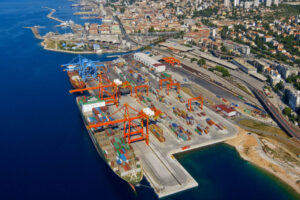









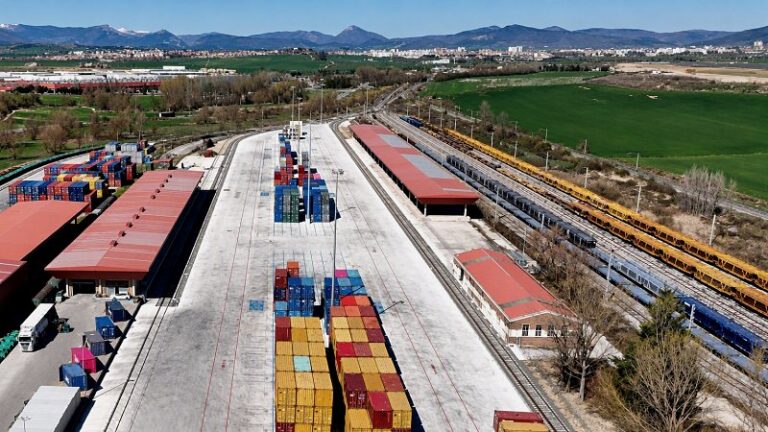
In the Iberian peninsula, the future of rail transport is increasingly tied to intermodal terminals. While upgrade works at the Navarra facility in Spain have now been completed, Portugal is moving closer to the construction phase for a logistics park near the port of Sines. The Navarra intermodal terminal, located in Noáin, a few kilometres south of Pamplona, can now offer operating capacity four times higher than its original level. The facility is managed by Terminal Catalunya, a company controlled by Hutchison Ports under a concession running until 2045. The recently completed works are designed to improve connectivity between the region and the port of Barcelona, which includes, among others, the Hutchison Ports-owned Best terminal.
The terminal expansion included two new 600-metre mixed-gauge tracks, for both Iberian and European standard gauge, which will in future be extended to 750 metres in European module, with an electrified pick-up and delivery area. In addition, a 34,000 sq m area has been paved for rail operations and container storage. Intermodal rail services between Noáin and Barcelona are operated by Synergy, Hutchison Ports’ rail division. Following the upgrade works, the terminal can handle up to eight freight trains a day. However, the outlook is even more significant once the tracks reach 750 metres, with intermodal capacity expected to rise from around 13,700 to 60,000 ITUs. The Navarra terminal has also been equipped to handle intermodal services involving the rail forwarding of road semi-trailers.
There is also news from Portugal, where the construction phase is approaching for the Grândola multimodal logistics park along the Lisbon-Sines corridor. The terminal will cover an area of 1.3 million sq m in a strategic location around 100 kilometres south of Lisbon and 50 kilometres north of the port of Sines, served by the southern railway line. The park will be located along the wider Sines-Évora/Caia freight corridor towards Spain, where the existing railway line is due to be modernised and upgraded with the aim of increasing capacity to as many as 50 freight trains a day to the 750-metre standard. Overall investment will amount to almost €470 million.
The rail terminal will have four internal tracks, while the whole complex will be divided into seven large plots, with the logistics area accounting for 80% of the total surface area and industrial activities occupying the remaining 20%. The first phase, which includes the rail terminal from the outset, is expected to be completed in about two years. The Grândola park is one of Portugal’s most significant intermodal projects, in a country that lacks large logistics sites. It will serve as a gateway linking the port of Sines with markets across the Iberian peninsula and the rest of Europe.
Piermario Curti Sacchi