







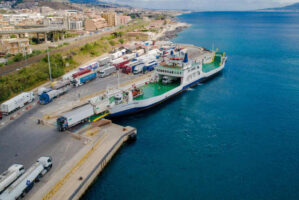
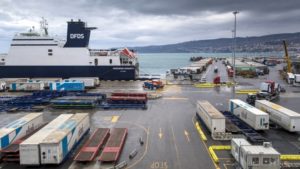
A flow of counterfeit money and forged documents was travelling on industrial vehicles from Turkey to Germany, accompanied by documentation, also false, declaring a shipment of telecommunications equipment. In a container fixed to an articulated lorry that had disembarked from a ro-ro vessel at the port of Trieste, officers from the Guardia di Finanza (Italian financial police) and officials from the Agenzia delle Dogane (Italian Customs Agency) found €1.17m at the end of June 2026, made up of 23,400 fake €50 banknotes, 25 counterfeit identity documents and around 10,000 digital files intended for the production of further forgeries.
The truck belongs to a Turkish company that is supposed to operate in the telecommunications sector and, according to the transport documentation, the goods were destined for a company incorporated under Dutch law and physically bound for Hamburg. Among the documents found during the inspection were a Moroccan identity card, five passports linked to British and US authorities, five residence permits issued by Lithuania, Greece and Finland, and 14 visas apparently issued by diplomatic missions from Spain, Germany and Belgium.
According to investigators, the material could have been used to commit several offences, including identity theft, e-commerce fraud, money laundering and the facilitation of illegal immigration. One element highlighted by the Italian financial police concerns production channels: this type of material is increasingly finding outlets on the dark web and through alternative messaging channels, making checks by the Authorities more complex. The investigations, coordinated by the Dda di Trieste (Trieste District Anti-Mafia Directorate), are currently under way and could be extended to other European states through international cooperation procedures between judicial authorities and police forces, as the trafficking involves several jurisdictions: Turkey, the Netherlands and Germany.