









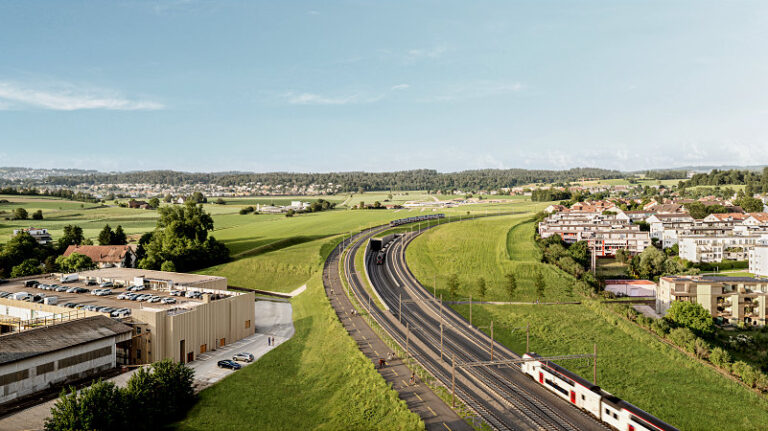
Swiss Federal Railways launched work on the MehrSpur Zurich-Winterthur project on 2 July 2026. The scheme will expand the line to four tracks and includes the construction of the nine-kilometre Brütten tunnel, with investment of CHF3.3bn, or about €3.58bn, and entry into service planned by 2037. The project, being carried out on behalf of the Confederation, is designed to resolve one of the main bottlenecks on the Swiss rail network. The opening ceremony took place in Bassersdorf, at the centre of the 30-kilometre works area between Zurich and Winterthur. The site will host the main assembly area for construction of the tunnel, which will run 20 metres below the current level, as well as a public information centre where visitors can follow the project’s progress. Federal Councillor Albert Rösti, Zurich Government Councillor Martin Neukom and Sbb Ceo Vincent Ducrot officially inaugurated the works before about 100 representatives of federal, cantonal, city and municipal authorities, as well as the media.
Rösti, who heads the Federal Department of the Environment, Transport, Energy and Communications, described the start of work as a sign that network expansion is moving ahead in parallel with political discussions on increasing rail capacity under Transport ’45. He recalled that the expansion of Stadelhofen station and the Zimmerberg II base tunnel have top priority and will be submitted to Parliament for approval. Neukom said the project represents a bypass at the heart of Swiss public transport: capacity between Zurich and Winterthur will increase by 30%, reaching about 900 trains and more than 150,000 passengers a day. However, he said the long-term resilience of the Zurich S-Bahn also depends on the construction of the fourth track at Stadelhofen and other complementary civil engineering works. Only then, in the long term, can a quarter-hourly frequency become the basis of the Zurich S-Bahn’s core network.
Ducrot set out the scale of the works, describing the site as the largest in Switzerland and the biggest of Sbb’s infrastructure projects currently under way. Up to 1,000 people will be employed along the 30-kilometre work zone, with average investment of about CHF1m a day, or around €1.09m, over the ten-year construction period. In addition to the tunnel, the CEO cited the expansion of the stations at Dietlikon, Bassersdorf, Wallisellen and Winterthur Töss, together with their access lines, as essential to providing greater capacity on one of the country’s busiest routes.
The works will continue for about a decade along one of the busiest corridors in the Swiss network, much of it close to residential areas. For this reason, a substantial share of the activity will take place at night, when passenger services are not operating, with unavoidable noise, dust, vibration and road logistics traffic, including at weekends. Sbb said it intends to limit the impact on local residents and provide regular updates on the progress of the works. Rail operations will largely be maintained throughout the construction period. However, changes to some S-Bahn lines are planned from the December 2026 timetable change.
The various sub-projects will follow a staggered timetable, delivering gradual benefits for passengers, although dates may change. For the Brütten tunnel, which will consist of two single-track bores, tunnel-boring machine excavation will begin in 2029, with entry into service scheduled for 2037. At Wallisellen station, work to widen the platforms and adapt access points and underpasses will start in 2028, with opening planned for the end of 2032 work to widen the platforms and adapt access points and underpasses will start in 2028, with opening planned for the end of 2032. A new 580-metre single-track bridge west of the station will begin construction in 2026 and become operational in 2031. At Dietlikon, the fourth track, new platform access points, footbridge with lifts and new station building will start in 2027 and are due to be ready in summer 2032, while the Bahnhofstrasse underpass, to be rebuilt at a lower level beneath the new urban tunnel, will begin in 2028 and open in 2031. Bassersdorf station will gain new underpasses and step-free access from 2027, with opening scheduled for summer 2030. At Winterthur Töss, the new underpass and step-free access will start in 2027 and be ready by the end of 2028, while the 800-metre single-track bridge in the Neumühle area, with work starting in 2027, will enter service in 2034.