






The Italian Ministry of Enterprises and the US aerospace company Radia signed a memorandum of understanding in Rome on 18 June 2026 to renew cooperation on the WindRunner programme, the cargo aircraft under development to transport exceptional loads to locations that are difficult to reach through conventional logistics systems. The project aims to develop the largest all-cargo aircraft in the world. The agreement sets out a framework for institutional and technical cooperation to support the involvement of Italy’s aerospace and industrial sector in the programme, including organisations active in manufacturing, engineering and the supply chain.
The memorandum of understanding includes binding commitments relating to the cooperation framework, but any future investments or operational decisions linked to the programme remain subject to further analysis, approvals and additional agreements between the parties. Alongside coordination with regional stakeholders, particularly the Campania and Puglia regions, the broader aim of the agreement is to assess and support Italian industrial participation at national level, while also strengthening transatlantic cooperation in the aerospace sector. Radia, founded in 2016 in the United States, already has a presence in Italy, as one of the company’s main offices outside the US is located in Rome.
“As strategic mobility requirements continue to grow, allied nations will need new air transport capabilities,” said Mark Lundstrom, founder and chief executive of Radia. “No new strategic transport aircraft has been produced anywhere in the world for more than a decade. WindRunner is being developed precisely to help close this gap, providing a new capability for the transport of outsize and mission-critical cargo. We are proud to strengthen our collaboration with Mimit and with Italy’s aerospace and industrial sector as we advance this revolutionary programme.”
The WindRunner programme is designed to serve several sectors, including defence, energy, industry and aerospace. By reducing delivery times from months to days or hours through direct flights, the aircraft is intended to improve supply chain resilience, supporting both national security and commercial applications, thanks to what its designers describe as unprecedented cargo volume and the ability to operate from compacted dirt runways.
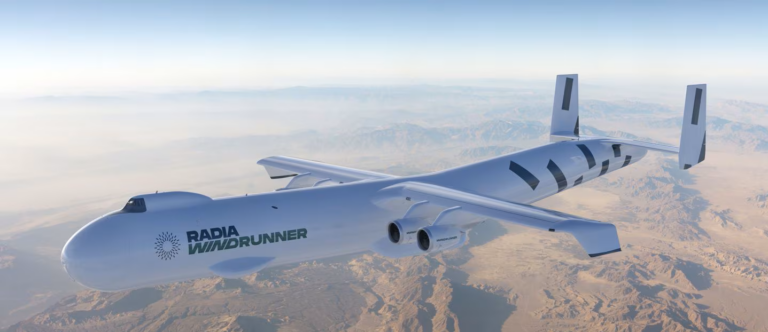
WindRunner is designed as a “super-cargo” aircraft optimised for volume rather than weight, with the ability to operate from short, unpaved runways in remote areas. The aircraft does not yet exist, although renderings have been released, and Radia says it will be about 108-109 metres long, 24 metres high and have a wingspan of 80 metres, with cargo volume of between 6,800 and 7,700 cubic metres, about ten times that of a Boeing 777 and twelve times that of a Boeing 747 in terms of usable volume. Its maximum payload reaches 105 metres in length, up to 9 metres in height and 10 metres in width, with a maximum transportable weight of about 72-72.6 tonnes, or 160,000 lb, lower than that of an An-124 or C-5 but with significantly greater volume.
The stated performance includes a cruising speed of around Mach 0.6-0.8, or 730-800 kilometres per hour, at an altitude of 12-12.5 kilometres, with a range of about 2,000 kilometres at full load. The aircraft will be equipped with four turbofan engines, whose model has not yet been disclosed, and will have an operating ceiling of about 41,000 feet. The required take-off and landing distance is around 1,800 metres, including unpaved or semi-prepared runways, to allow direct operations close to installation sites, such as future onshore wind farms under the GigaWind programme.
Thanks to its large cargo hold, WindRunner will be able to transport wind turbine blades up to 104-105 metres long to remote sites, overcoming size limits and the costs of road transport linked to bends, tunnels, viaducts and special permits. The aircraft will also be able to carry components for large energy plants, transformers and prefabricated structures, as well as sections of space launch vehicles or rocket stages bound for launch sites. Dual-use applications include the delivery of bulky equipment to operational theatres or disaster-hit areas, thanks to its ability to land on semi-prepared runways.
A significant part of the programme concerns Italy. The Grottaglie site, in the province of Taranto, has been identified as the final assembly centre and industrial hub, with a new plant expected to generate hundreds of jobs across the supply chain. Leonardo is named as the main partner for the fuselage, while Magnaghi Aeronautica in Italy and Spain’s Aernnova will contribute other structural sections and landing gear. Radia has also appointed a chief executive for its Italian operations, Giuseppe Giordo, who will lead industrial and institutional relations with national and European governments.
The programme is currently still in the engineering and industrialisation phase. The first flight is targeted for 2029, with commercial entry into service expected between 2030 and 2031, according to the most recent information released by Radia. Completion of the programme will also depend on public and private funding and authorisations from the competent authorities, including the US FAA, Enac (Italian Civil Aviation Authority) and EASA (European Union Aviation Safety Agency).
Antonio Illariuzzi