







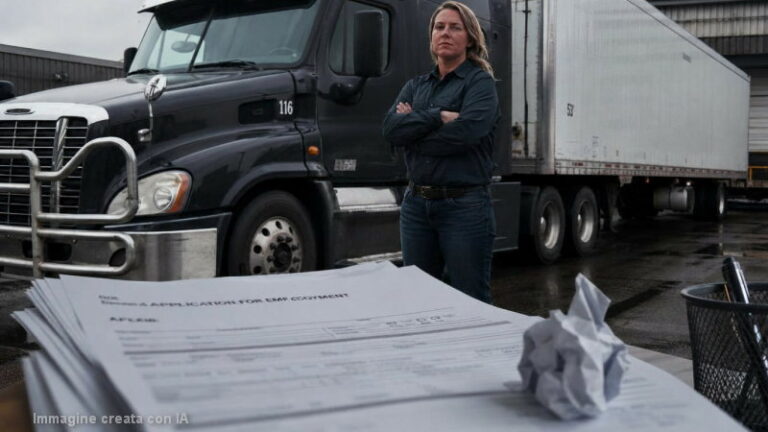
US road haulage company Central Transport has reached a $5.5 million, about €4.9 million, settlement with the U.S. Equal Employment Opportunity Commission after being accused of systematically excluding women from driver jobs for at least a decade. The case, described by the Commission as intentional and structural discrimination, has led to the signing of a consent decree requiring the company to implement extensive corrective measures and submit to several years of external oversight. The federal lawsuit was filed on 31 March 2026 with the relevant court, and the consent decree was signed on 30 April of the same year, less than a month after service. The speed of the settlement suggests that the company preferred to avoid the discovery phase and a trial over allegations of discriminatory conduct that had allegedly continued for around a decade.
Central Transport is a national road haulier based in Warren, Michigan, and operates more than 200 regional and local terminals across the United States. The company belongs to the business network of the Moroun family, also known for owning the Ambassador Bridge, the road crossing between Detroit and Windsor, Canada. The settlement provides for the money to be distributed among the four original claimants and a broader class of qualified applicants who had applied at various company locations but were not hired. The sum covers back pay, lost benefits, interest and compensatory damages.
The U.S. Equal Employment Opportunity Commission (EEOC) says that, for at least ten years, Central Transport systematically rejected qualified female applicants for driver roles, favouring male candidates who often had less experience or lacked the minimum requirements set by the company itself. According to the agency’s reconstruction, decisions on who to select for interviews and who to hire were centralised at headquarters, producing a hiring imbalance that was strongly unfavourable to women between 2016 and early 2022. In the EEOC’s view, the alleged conduct amounted to a breach of Title VII of the Civil Rights Act of 1964 and the Civil Rights Act of 1991, namely intentional sex-based discrimination in hiring.
The EEOC’s case is built on three categories of evidence: direct testimony from applicants, statistical hiring data and evidence relating to the company’s internal procedures. Statistically, the agency argues that, with equivalent qualifications, the hiring rate for female applicants was considerably lower than that for male candidates, with a disparity that could not be explained by neutral factors. At some terminals, including Phoenix and El Paso, not a single female driver was allegedly hired for years, despite documented evidence of numerous qualified female applicants.
The testimony gathered describes specific incidents. A female truck driver with 15 years’ experience said her CV was ignored by the Phoenix terminal while, during the same period, a man who did not meet the company’s minimum requirements was hired. In another case, an applicant who had applied together with her male cousin saw, when she returned to the site, an employee retrieve her application from the bin; her cousin was hired, she was not. Several other women reported that they were never called for interview despite meeting or exceeding the required criteria, while male candidates with weaker profiles were contacted and hired quickly.
On internal procedures, the EEOC cites a specific episode: a coordinator at the Dunbar terminal in West Virginia allegedly told an applicant that instructions had come from the central offices in Warren not to hire any women as drivers. The complaint also states that many female applicants were not treated consistently with the ordinary selection practices applied by the company to male candidates, amounting to an explicit double standard. Taken together, these elements - discarded applications, internal exclusion instructions and different response times - were presented by the EEOC as evidence of intentional and repeated discrimination.
The consent decree signed on 30 April 2026 is not limited to financial compensation. Central Transport must allow the women affected to reapply and take part in selection processes free from discrimination and retaliation linked to the litigation. The company is required, at its own expense, to hire an external consultant tasked with reviewing and rewriting its equal opportunities policies and hiring procedures for driving staff. All employees with decision-making authority over the hiring of drivers will have to attend mandatory training sessions on non-discrimination and equal opportunities.
For two and a half years, Central Transport will also be subject to oversight by an independent monitor, who will report periodically to the EEOC. The company must submit six-monthly reports on its hiring practices, enabling the federal agency to verify compliance with the commitments it has made. The case arose from complaints by four women but was quickly classified by the EEOC as a “class case” on a national scale, in a context in which the share of women in US road haulage remains low. The agency is using strategic litigation to target structural discrimination in hiring, with growing attention to sectors where women’s under-representation has historically been pronounced and is difficult to explain on the basis of market conditions or qualifications.
P.R.