







- Volvo Trucks announced on 12 May 2026 a global product launch covering a new 13-litre combustion engine platform, available in diesel (D13) and gas (G13) versions, and a new generation of long-range electric trucks. The investment is worth billions of Swedish kronor and is intended to strengthen the group’s competitiveness across global markets.
- The new combustion engines deliver fuel savings of up to 4% compared with previous power units, are compatible with biodiesel, HVO, biogas and bio-LNG, and are ready for future hydrogen applications. Sales will begin in the third quarter of 2026 in Europe, Morocco, Turkey and India, with other markets to follow.
- On the electric side, Volvo is introducing a new long-range heavy-duty model with a range of up to 700 kilometres on a single charge, expanding a line-up that already includes eight models and more than 6,000 vehicles sold in over 50 countries since 2019.
Volvo Trucks unveiled on 12 May 2026 a package of new products that reshapes its global offering of combustion engines and electric powertrains, with the aim of accelerating the decarbonisation of freight transport and achieving carbon neutrality by 2040. The announcement covers two distinct but complementary areas: a newly designed combustion platform and a second generation of electric vehicles with extended ranges.
At the centre of the combustion engine announcement is a 13-litre engine platform developed entirely by Volvo, from which two power units are derived: the D13 diesel version and the gas-powered G13. Both are available in configurations ranging from 380 to 560 horsepower for the diesel variant, with torque between 1,800 and 2,900 Nm, and from 420 to 500 horsepower for the gas version, with torque between 2,400 and 2,800 Nm. The new engines comply with the requirements of the European Euro VI standard and the new NNR3 noise regulation, and are designed to meet future legislation as well.
The Swedish manufacturer claims fuel savings of up to 4% compared with the previous generation of engines, based on simulations carried out on a Volvo FH with a fully loaded gross weight of 42 tonnes in representative European driving conditions, using Cruise Control, I-See and I-Roll functions with automatic engine stop and start. The latter function, which allows the engine to be switched off and the vehicle to coast downhill in neutral, will be available on many D13 variants, extending fuel-consumption benefits to a wider range of operators. The platform also includes a refined engine brake, new cylinder and turbocharger designs, and an updated version of the I-Shift automated gearbox.
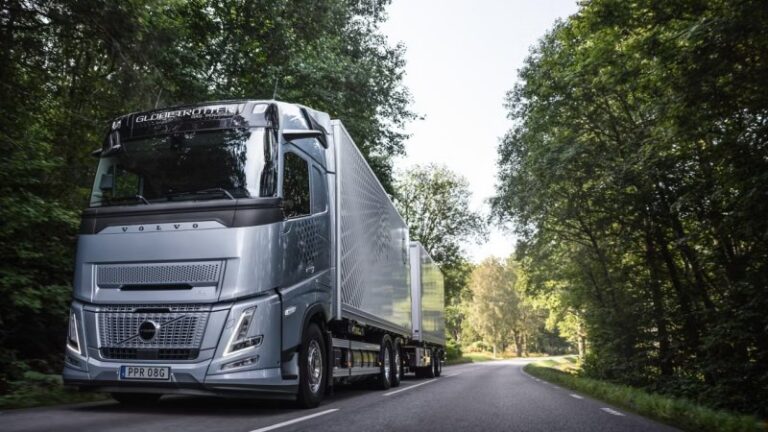
The new engines will be fitted to the Volvo FM, FMX, FH and FH Aero models. Production of the engines takes place at the Skövde plant in Sweden, while vehicle assembly is carried out at the Tuve plant in Sweden and the Ghent plant in Belgium. Commercial launch is scheduled for the third quarter of 2026, with a phased rollout starting in European markets, Morocco, Turkey and India, followed later by North America, Asia and South Africa.
On the electric side, Volvo Trucks is strengthening the leading position it began building in 2019, when it became the first manufacturer to enter the market for battery-electric heavy-duty trucks. Today, its range includes eight different models and more than 6,000 vehicles sold in over 50 countries. The new flagship model introduces a range of up to 700 kilometres on a single charge, a threshold that, according to the company, makes second-generation electric trucks suitable to replace diesel vehicles in the vast majority of use cases. Production of the new electric vehicles will take place at the Gothenburg plant in Sweden and the Ghent plant in Belgium, with a phased start from 2026.
Roger Alm, president of Volvo Trucks, framed the launch within a three-track strategy that the company intends to pursue simultaneously on the road to net zero emissions by 2040: battery-electric vehicles, fuel cell electric vehicles and combustion engines powered by renewable fuels, including green hydrogen, produced by electrolysis of water using renewable energy, biogas, biodiesel and HVO. The adoption of a single engine platform for diesel and gas versions also reflects an industrial logic that brings greater production synergies and higher manufacturing volumes, with positive effects on costs and the global availability of spare parts.
P.R.